
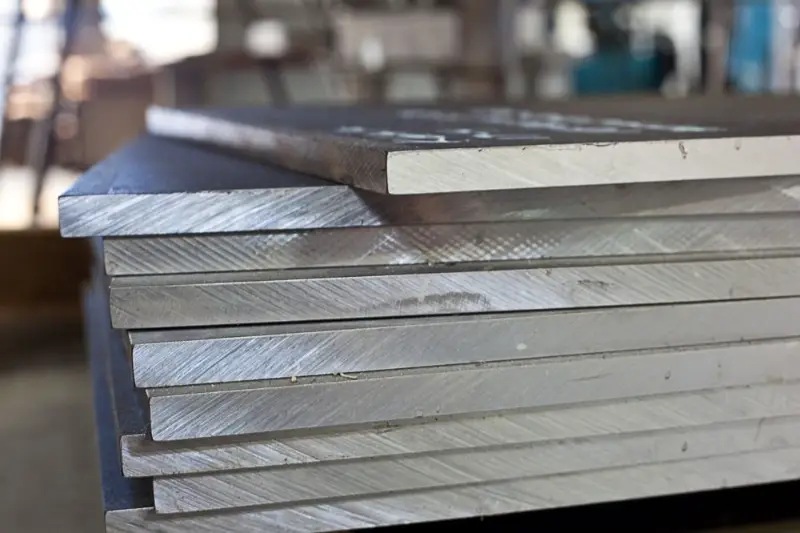
StE380 Fine-Grain Structural Steel
StE380 Fine-Grain Structural Steel - High-Strength Automotive Plate per DIN 17102
Explore the properties, composition, and applications of StE380, a thermomechanically rolled fine-grain structural steel widely used in automobile and heavy machinery manufacturing.
Hot rolling, thermomechanical rolling, cold forming, welding, machining
- Phone : +8618037372205
- Email : [email protected]
- WhatsApp: Contact via Whtsapp
- WeChat: +8618037372205
StE380 Fine-Grain Structural Steel Introduction
StE380 is a weldable fine-grain structural steel specified in DIN 17102. It is produced by thermomechanical rolling (TM) to achieve a minimum yield strength of 380 MPa while maintaining excellent toughness and cold formability. The fine-grain microstructure, achieved by controlled rolling and microalloying elements (Nb, V, Ti), provides superior weldability and resistance to brittle fracture at low temperatures. This grade is particularly suited for dynamically stressed components in automotive and mobile crane construction.
- Key features: high strength, good weldability, notch toughness down to -20°C, reliable cold bending properties.
- Typical shapes: plates, wide flats, bars, and sections.
- Surface condition: as-rolled or pickled and oiled.
StE380 Fine-Grain Structural Steel Chemical Composition
The composition limits according to DIN 17102 for StE380. Microalloying elements (Nb, V, Ti) are added for grain refinement and precipitation strengthening. The sum of these elements is restricted to ensure consistent mechanical properties and weldability.
- Aluminum is required to be present as a grain refiner.
- Phosphorus and sulfur are kept low for improved ductility and toughness.
| Element | Standard Value (%) | Remarks |
|---|---|---|
| C | ≤ 0.20 | |
| Si | ≤ 0.50 | |
| Mn | 1.00 - 1.70 | |
| P | ≤ 0.035 | |
| S | ≤ 0.030 | |
| Al_total | ≥ 0.020 | Acid-soluble Al may be specified |
| Nb | ≤ 0.05 | Sum Nb+V+Ti ≤ 0.22% |
| V | ≤ 0.20 | Sum Nb+V+Ti ≤ 0.22% |
| Ti | ≤ 0.20 | Sum Nb+V+Ti ≤ 0.22% |
| Cr | ≤ 0.30 | Residual element, not intentionally added |
| Ni | ≤ 0.30 | Residual element |
| Cu | ≤ 0.35 | Residual element |
| Mo | ≤ 0.08 | Residual element |
| N | ≤ 0.020 | If sufficient Al is present, N is combined |
StE380 Fine-Grain Structural Steel Thermal and Electrical Physical Properties
Physical properties are typical for low-alloy structural steels and are not part of the mandatory standard requirements. These values serve as guidelines for engineering calculations and can vary slightly depending on the exact composition and heat treatment condition.
- Thermal expansion coefficients are similar to those of other carbon-manganese steels.
- Electrical resistivity increases slightly with temperature and alloy content.
| Property | Typical Value | Unit | Test Condition / Remarks |
|---|---|---|---|
| Density (ρ) | 7.85 | g/cm³ | At room temperature |
| Elastic modulus (E) | 210 | GPa | At room temperature |
| Shear modulus (G) | Approx. 81 | GPa | Calculated from E and ν |
| Poisson's ratio (ν) | 0.3 | – | At room temperature |
| Thermal expansion coefficient (α) | 11.1 | 10⁻⁶/K | 20–100°C |
| Thermal expansion coefficient (α) | 12.3 | 10⁻⁶/K | 20–200°C |
| Thermal expansion coefficient (α) | 13.1 | 10⁻⁶/K | 20–300°C |
| Thermal conductivity (λ) | 47 - 53 | W/(m·K) | At 20°C |
| Specific heat capacity (c) | Approx. 460 | J/(kg·K) | At 20°C |
| Electrical resistivity (ρ_e) | 0.20 - 0.25 | µΩ·m | At 20°C |
StE380 Fine-Grain Structural Steel Mechanical Properties
Mechanical properties as specified in DIN 17102 for thermomechanically rolled condition (TM). Values depend on product thickness. Charpy impact energy is guaranteed for longitudinal specimens; transverse values are typically lower but may be agreed upon.
- Yield and tensile strengths decrease with increasing thickness.
- Bend test is performed with a mandrel diameter 2 times the plate thickness (2a) for plates ≤ 50 mm.
| Property | Standard Requirement | Unit | Test Condition / Remarks |
|---|---|---|---|
| Yield strength (ReH) | ≥ 380 | MPa | Nominal thickness ≤ 16 mm |
| Yield strength (ReH) | ≥ 360 | MPa | Nominal thickness 16 < t ≤ 50 mm |
| Yield strength (ReH) | ≥ 340 | MPa | Nominal thickness 50 < t ≤ 100 mm |
| Tensile strength (Rm) | 510 - 650 | MPa | Nominal thickness ≤ 50 mm |
| Tensile strength (Rm) | 490 - 630 | MPa | Nominal thickness 50 < t ≤ 100 mm |
| Elongation after fracture (A) | ≥ 19 | % | Longitudinal (L), gauge length L0=5.65√S0, thickness ≤ 16 mm |
| Elongation after fracture (A) | ≥ 18 | % | Longitudinal (L), thickness 16 < t ≤ 50 mm |
| Elongation after fracture (A) | ≥ 17 | % | Longitudinal (L), thickness 50 < t ≤ 100 mm |
| Bend test: mandrel diameter | 2a (180°) | – | For all thicknesses up to 50 mm (a = specimen thickness) |
| Charpy impact energy (KV, min.) | ≥ 27 | J | Longitudinal, at -20°C, thickness ≥ 10 mm |
| Charpy impact energy (KV, min.) | ≥ 34 | J | Longitudinal, at 0°C, thickness ≥ 10 mm |
| Charpy impact energy (KV, min.) | ≥ 40 | J | Longitudinal, at +20°C, thickness ≥ 10 mm |
StE380 Fine-Grain Structural Steel Fully Equivalent Material Standards and Replaceable Grades
| Country / Region | Standard | Grade | Remarks |
|---|
StE380 Fine-Grain Structural Steel Application Introduction
StE380 is engineered for applications demanding high static and dynamic strength combined with good weldability and adequate low-temperature toughness. It is especially suitable for automated welding processes without preheating up to moderate thicknesses. The steel can be cold formed to typical radii when the processing follows the recommendations given in the standard.
- Typical processing includes plasma or laser cutting, submerged arc or MAG welding, and protective coating (priming or hot-dip galvanizing).
- Stress-relief annealing is not normally required, but if needed it should be performed below 580°C to avoid loss of strength.
Product Applications: Truck chassis frames and subframes, Boom sections for telescopic cranes, Trailer beams and drawbars, Structural components of off-road vehicles, Welded bridge girders and box sections, Mining dump truck bodies
Processed into products: Longitudinal and cross members, Reinforcement plates and gussets, Flanges and webs for built-up sections, Brackets and mounting plates, Press-brake formed profiles (U-, L-, hat-sections), Welded tube and hollow sections (when formed from plate)
Application industries: Automotive and commercial vehicle manufacturing, Mobile and crawler crane construction, Agricultural and earth-moving machinery, Heavy steel construction (bridges, masts, frames), Pressure vessel and storage tank fabrication (with additional qualification), Mining equipment
StE380 Fine-Grain Structural Steel Similar / Substitute Materials Recommendation
There is no identical grade in current EN standards because the 380 MPa yield class was omitted from EN 10025-3 and -4. The listed materials offer comparable yield strength or can serve as substitutes in welded structures. Selection should consider notch toughness requirements and processing route.
| Country / Region | Standard | Grade | Remarks |
|---|---|---|---|
| Europe | EN 10025-3 | S355M / S355ML | Lower yield (355 MPa), but improved toughness in ML version. Often used as a direct alternative where 355 MPa is acceptable. |
| Europe | EN 10025-3 | S420M / S420ML | Higher yield strength (420 MPa). May require adjustments in forming and welding procedures. |
| Europe | EN 10025-4 | S355M / S355ML | Thermomechanical rolled; same as EN 10025-3 but in a different standard (for certain product forms). |
| Japan | JIS G 3106 | SM490A / SM490B / SM490C | Minimum yield 325–365 MPa depending on thickness and grade. SM490B/C offer comparable notch toughness. |
| China | GB/T 1591 | Q390B / Q390C | Yield ≥ 390 MPa (≤16 mm). Similar microalloyed approach, suitable for welded structures. |
| USA | ASTM A572/A572M | Grade 55 [380] or 60 [415] | A572 Gr. 55 has min. yield 380 MPa (55 ksi). Check for fine-grain practice if toughness required. |
Notes:
The information provided is based on DIN 17102:1980 edition, as the standard has not been officially withdrawn in all application sectors, though it has been largely replaced by the EN 10025 series. Users should verify the applicability for modern design codes and may need to request properties specific to the actual melting and rolling process. For critical welded joints, a welding procedure qualification test is recommended to confirm the mechanical properties of the heat-affected zone.
- Share



