
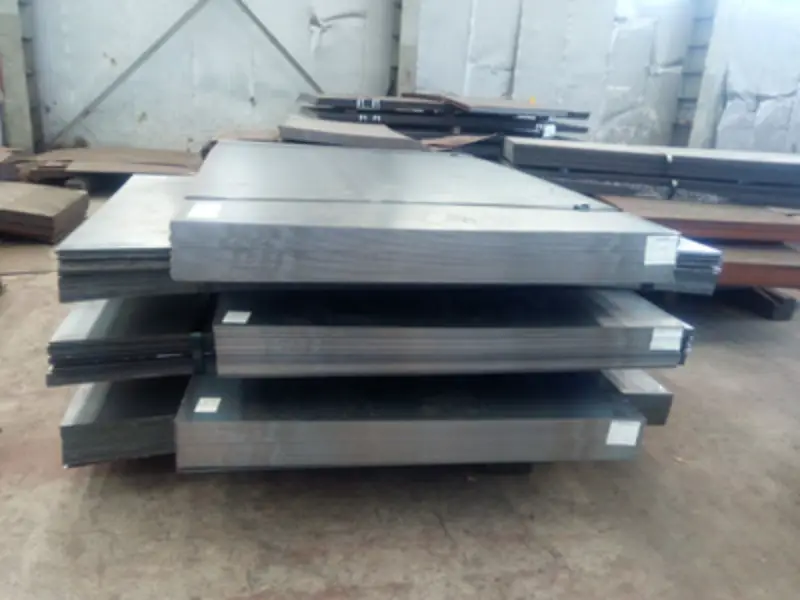
DIN 17102 WStE355
DIN 17102 WStE355: Weldable Fine Grain Structural Steel for Automobile Applications
Comprehensive material data for WStE355 structural steel per DIN 17102, featuring minimum yield strength 355 MPa, excellent weldability and notch toughness.
Normalizing, normalizing rolling, thermomechanical rolling (for certain variants), welding, hot and cold forming, machining
- Phone : +8618037372205
- Email : [email protected]
- WhatsApp: Contact via Whtsapp
- WeChat: +8618037372205
DIN 17102 WStE355 Introduction
WStE355 is a weldable fine-grain structural steel defined in the German standard DIN 17102. Supplied in normalized or normalizing-rolled condition, it offers a minimum yield strength of 355 MPa and is characterised by high toughness and good weldability. Fine grain treatment with aluminium, often combined with microalloying elements (Nb, V, Ti), ensures fine grain structure and enhanced mechanical properties even after welding. The steel is primarily used for stressed components in automobile construction, crane building, bridge engineering and general steel structures where safe load-bearing capacity and low-temperature impact resistance are essential. The delivery condition (normalized) guarantees homogeneous properties across the cross-section, making it suitable for further forming and welding processes.
DIN 17102 WStE355 Chemical Composition
The fine grain steel WStE355 relies on aluminium for grain refinement. Microalloying elements such as niobium, vanadium and titanium may be added singly or in combination to enhance strength. Phosphorus and sulphur are limited to ensure toughness and weldability. Carbon equivalent (CEV) is typically below 0.45%.
| Element | Standard Value (max or range) | Remarks |
|---|---|---|
| Carbon (C) | ≤0.20 | |
| Silicon (Si) | ≤0.50 | |
| Manganese (Mn) | 0.90 – 1.65 | |
| Phosphorus (P) | ≤0.035 | |
| Sulfur (S) | ≤0.030 | |
| Aluminium total (Al) | ≥0.020 | Fine grain treatment |
| Niobium (Nb) | ≤0.05 | Optional microalloying |
| Vanadium (V) | ≤0.12 | Optional microalloying |
| Titanium (Ti) | ≤0.12 | Optional microalloying |
DIN 17102 WStE355 Thermal and Electrical Physical Properties
The physical properties are representative for carbon-manganese fine grain steels. They assist in design calculations involving heat transfer, thermal expansion, and electromagnetic loading. Density is practically constant, while thermal expansion and conductivity vary with temperature.
| Property | Typical Value | Unit | Test Condition |
|---|---|---|---|
| Density (ρ) | 7.85 | g/cm³ | 20 °C |
| Elastic modulus (E) | 210 | GPa | 20 °C |
| Shear modulus (G) | ≈81 | GPa | 20 °C |
| Poisson's ratio (ν) | 0.3 | – | – |
| Thermal expansion coefficient (α) | 12.0 | 10⁻⁶/K | 20 – 100 °C |
| Thermal expansion coefficient (α) | 12.5 | 10⁻⁶/K | 20 – 200 °C |
| Thermal expansion coefficient (α) | 13.0 | 10⁻⁶/K | 20 – 300 °C |
| Thermal conductivity (λ) | 51 | W/(m·K) | 20 °C |
| Specific heat capacity | ≈460 | J/(kg·K) | 20 °C |
| Electrical resistivity (ρ_e) | ≈0.15 | Ω·mm²/m | 20 °C |
DIN 17102 WStE355 Mechanical Properties
Mechanical properties are guaranteed in the normalized condition (N). The steel exhibits a minimum yield strength of 355 MPa for thicknesses up to 16 mm. The tensile strength ranges from 470 to 630 MPa. Elongation values decrease with increasing thickness. Notch impact energy at -20°C meets at least 27 J (longitudinal). Bend test requires no cracking.
| Property | Required Value | Unit | Test Condition |
|---|---|---|---|
| Yield strength (ReH) | ≥355 | MPa | Thickness ≤ 16 mm |
| Yield strength (ReH) | ≥345 | MPa | Thickness > 16 ≤ 40 mm |
| Yield strength (ReH) | ≥335 | MPa | Thickness > 40 ≤ 63 mm |
| Yield strength (ReH) | ≥325 | MPa | Thickness > 63 ≤ 80 mm |
| Yield strength (ReH) | ≥315 | MPa | Thickness > 80 ≤ 100 mm |
| Yield strength (ReH) | ≥295 | MPa | Thickness > 100 ≤ 150 mm |
| Tensile strength (Rm) | 470 – 630 | MPa | Thickness ≤ 50 mm |
| Tensile strength (Rm) | 450 – 600 | MPa | Thickness > 50 ≤ 100 mm |
| Tensile strength (Rm) | 440 – 590 | MPa | Thickness > 100 ≤ 150 mm |
| Elongation (A) | ≥22 | % | Thickness ≤ 16 mm (longitudinal) |
| Elongation (A) | ≥22 | % | Thickness > 16 ≤ 40 mm |
| Elongation (A) | ≥21 | % | Thickness > 40 ≤ 63 mm |
| Elongation (A) | ≥20 | % | Thickness > 63 ≤ 80 mm |
| Elongation (A) | ≥19 | % | Thickness > 80 ≤ 100 mm |
| Elongation (A) | ≥18 | % | Thickness > 100 ≤ 150 mm |
| Bend test | No cracks | – | 180°, mandrel diameter typically 1t–3t (by agreement) |
| Impact energy (KV) -20°C | ≥27 | J | Longitudinal, Charpy V-notch |
DIN 17102 WStE355 Exact Equivalent Material Standards and Substitute Grades
| Country/Region | Standard | Grade | Remarks |
|---|---|---|---|
| Europe | EN 10025-3:2004 | S355N | Normalized, minimal Yield 355 MPa, Charpy -20°C ≥27J |
| Europe | EN 10025-3:2004 | S355NL | If -50°C impact test required; otherwise same basis |
| France | NF A36-201 | E355R | Fine grain steel, normalized |
| Italy | UNI 7740 | Fe E355 KGN | Weldable fine grain steel |
| Belgium | NBN A24-201 | E355R | Similar requirements |
| Japan | JIS G3106 | SM490YA | Higher Mn, slightly different chemistry but equivalent strength level |
| USA | ASTM A572 | Gr. 50 (345 MPa) | Not exactly equal, but often cross-referenced for 50 ksi min yield |
DIN 17102 WStE355 Application Introduction
Due to its high strength, excellent weldability and assured low-temperature toughness, WStE355 is particularly suitable for heavy loaded welded structures in automotive and general engineering. It can be formed by bending, cutting, welding and machining into various structural parts.
Product Applications: Truck chassis and frames, Crane booms and outriggers, Bridge beams and box girders, Welded pressure vessels and heat exchangers, Structural building frames, Earthmoving machinery components
Processed into products: Longitudinal and cross members for vehicle chassis, Brackets and gusset plates, Welded tubular sections for cranes, Stiffeners and diaphragms in bridges, Flanges and nozzles for pressure vessels, Base plates and support structures
Application industries: Automotive and heavy vehicle manufacturing, Crane and lifting equipment, Bridge construction, Mechanical engineering and machine frames, Pressure vessel and storage tank fabrication, Offshore and marine structures
DIN 17102 WStE355 Similar / Alternative Material Recommendations
| Country/Region | Standard | Grade | Remarks |
|---|---|---|---|
| Europe | EN 10025-2 | S355J2+N | Structural steel with similar yield, normalised, limited fine grain guarantee |
| Russia | GOST 19281 | C345 (09G2S) | 345 MPa yield, good weldability, used for welded structures |
| China | GB/T 1591 | Q345D | HSLA steel, yield 345 MPa, Charpy -20°C, comparable toughness |
| India | IS 2062 | E350 BR | High strength structural steel, normalised, 350 MPa min yield |
| USA | ASTM A516 | Gr. 70 | Pressure vessel steel, 485–620 MPa tensile, not identical but similar for medium temp. |
Notes:
Note on delivery conditions: DIN 17102 specifies WStE355 primarily in normalized (N) state. For thermomechanically rolled steels, the suffix "TM" may appear; the standard also covers a thermomechanical condition but the base designation often implies normalized delivery. Welding recommendations: Low hydrogen welding processes are advised. Preheat and interpass temperatures depend on thickness and carbon equivalent. Post-weld heat treatment is generally not required for thicknesses up to 40 mm. Forming: Hot forming should be followed by normalization if mechanical properties must be restored. Cold forming is possible for radii larger than 2t. Certification: Material certificates to EN 10204 3.1 or 3.2 are common upon request. All information is based on the published DIN 17102 standard and typical mill practices.
- Share



