
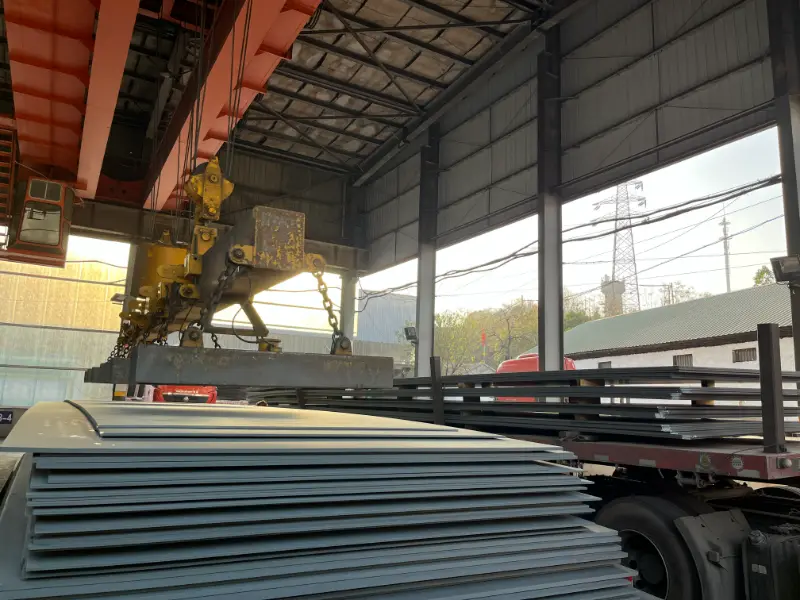
DIN 17102 StE355 Fine
DIN 17102 StE355 Automobile Structure Steel Plate – Full Specifications & Global Equivalents
Complete technical data for StE355 steel plate under DIN 17102: chemical composition, mechanical and physical properties, thermal/electrical characteristics, international equivalents, and application guide for automotive structural engineering.
Hot rolling, normalizing, thermomechanical rolling, welding, bending, flanging, punching, machining
- Phone : +8618037372205
- Email : [email protected]
- WhatsApp: Contact via Whtsapp
- WeChat: +8618037372205
DIN 17102 StE355 Fine Introduction
StE355 is a weldable fine-grain structural steel standardized by DIN 17102. It is supplied in normalized or equivalent condition and is widely used for dynamically loaded welded structures, especially in the automotive sector. The steel exhibits a minimum yield strength of 355 MPa for thicknesses up to 16 mm, combined with good forming and welding properties. Its microalloying with aluminium and optionally niobium, vanadium or titanium ensures fine grain size and improved toughness at low temperatures. Typical applications include car chassis parts, truck frames, crane booms and heavy transport equipment. The standard has been superseded by EN 10025-3 (S355N), but the grade remains a reference for legacy designs.
DIN 17102 StE355 Fine Chemical Composition
Ladle analysis limits as per DIN 17102 for StE355. The steel is fully killed and contains grain refining elements. Aluminium content ensures fine grain size. Microalloying elements such as Nb, V and Ti may be added individually or in combination to meet mechanical property requirements; the total content of these elements is normally limited to ≤ 0.22%. The nitrogen content is restricted to avoid detrimental effects on toughness.
| Element | Value (max unless range given) | Remarks |
|---|---|---|
| Carbon (C) | ≤ 0.20 | |
| Silicon (Si) | ≤ 0.50 | |
| Manganese (Mn) | 0.90 – 1.65 | |
| Phosphorus (P) | ≤ 0.035 | |
| Sulfur (S) | ≤ 0.030 | |
| Aluminium (Al total) | ≥ 0.015 | For grain refinement |
| Nitrogen (N) | ≤ 0.020 | |
| Niobium (Nb)¹ | ≤ 0.05 | Optional microalloy |
| Vanadium (V)¹ | ≤ 0.10 | Optional microalloy |
| Titanium (Ti)¹ | ≤ 0.05 | Optional microalloy |
DIN 17102 StE355 Fine Thermal and Electrical Physical Properties
Typical physical properties for fine-grain structural steel of the StE355 type at room temperature. These values are not part of the DIN 17102 standard but are widely accepted for engineering calculations. Thermal expansion and conductivity are given for common intervals; resistivity is approximate. Small variations may occur depending on the exact chemical composition and delivery condition.
| Property | Typical value | Unit | Test condition / Remarks |
|---|---|---|---|
| Density (ρ) | 7.85 | g/cm³ | At 20 °C |
| Modulus of elasticity (E) | 210 | GPa | At 20 °C, static |
| Shear modulus (G) | ~ 80 | GPa | Calculated from E and ν |
| Poisson's ratio (ν) | 0.3 | — | Elastic range, room temperature |
| Thermal expansion coefficient (α) | 11.1 | 10⁻⁶/K | 20 – 100 °C |
| Thermal expansion coefficient (α) | 12.1 | 10⁻⁶/K | 20 – 200 °C |
| Thermal expansion coefficient (α) | 12.9 | 10⁻⁶/K | 20 – 300 °C |
| Thermal conductivity (λ) | 45 | W/(m·K) | At 20 °C |
| Specific heat capacity (c) | ~ 460 | J/(kg·K) | At 20 °C |
| Electrical resistivity (ρₑ) | ~ 0.20 | μΩ·m | At 20 °C |
DIN 17102 StE355 Fine Mechanical Properties
Minimum mechanical properties for flat products in normalized or equivalent condition as per DIN 17102. The values apply to longitudinal (parallel to rolling direction) test specimens for product thicknesses up to 63 mm. For impact testing the default condition is transverse at -20°C with a minimum absorbed energy of 27 J (Charpy-V). Values for higher test temperatures or other orientations may be agreed upon at the time of ordering.
| Property | Value | Unit | Test condition |
|---|---|---|---|
| Yield strength (ReH) | ≥ 355 | MPa | Thickness ≤ 16 mm |
| Yield strength (ReH) | ≥ 345 | MPa | Thickness 16 < t ≤ 40 mm |
| Yield strength (ReH) | ≥ 335 | MPa | Thickness 40 < t ≤ 63 mm |
| Tensile strength (Rm) | 490 – 630 | MPa | Thickness ≤ 63 mm |
| Elongation after fracture (A5, Lo=5.65√So) | ≥ 22 | % | Thickness ≤ 16 mm, longitudinal |
| Elongation after fracture (A5) | ≥ 22 | % | Thickness 16 < t ≤ 40 mm, longitudinal |
| Elongation after fracture (A5) | ≥ 21 | % | Thickness 40 < t ≤ 63 mm, longitudinal |
| Impact energy (KV₂, Charpy-V) | ≥ 27 | J | At -20 °C, transverse (standard condition) |
DIN 17102 StE355 Fine Fully Equivalent Material Standards & Substitute Grades
| Country / Region | Standard | Grade | Remarks |
|---|---|---|---|
| Germany | DIN 17102 | StE355 | Original designation; normalized fine grain steel |
| Europe | EN 10025-3: 2004 | S355N | Direct successor; normalized / normalized rolled |
| Europe | EN 10025-3: 2004 | S355NL | Low-temperature variant with guaranteed impact properties down to -50 °C |
| Europe (obsolete) | EN 10113-2: 1993 | S355N | Predecessor of EN 10025-3; fully compatible |
| International | ISO 630-2: 2021 | S355N | Normalized structural steel with 355 MPa minimum yield |
| China | GB/T 1591-2018 | Q355ND | Normalized fine grain steel; also Q355NE for lower temperature |
DIN 17102 StE355 Fine Application Introduction
StE355 steel plate is designed for dynamically loaded welded structures in automotive and transport engineering. Its fine grain structure guarantees reliable toughness at service temperatures down to -20°C, while the normalized condition ensures uniform mechanical properties. The steel can be formed, cut and welded with common workshop processes. Typical product forms include cut sheets, heavy plates and wide strips for further fabrication.
Product Applications: Car and truck chassis longitudinal beams, Trailer frames and cross members, Mobile crane booms and outriggers, Concrete mixer drums and support rings, Railway wagon underframes, Bridge box girders and stiffening plates
Processed into products: Longitudinal beams and side members, Cross members and brackets, Reinforcement plates and gussets, Flange plates for welded I‑girders, Boom sections and telescopic arms, Welded subframes and mounting consoles
Application industries: Automotive and trailer manufacturing, Heavy transport and special vehicle engineering, Mobile crane and lifting equipment, Bridge construction and civil engineering, Agricultural and earthmoving machinery, Machine frame and support structure manufacturing
DIN 17102 StE355 Fine Similar / Approximate Substitute Material Recommendations
| Country / Region | Standard | Grade | Remarks |
|---|---|---|---|
| Europe | EN 10025-2: 2019 | S355J2+N | Non-fine grain structural steel; similar strength, lower toughness guarantee, normalized |
| Europe | EN 10025-3: 2004 | S355M / S355ML | Thermomechanically rolled fine grain steel; comparable strength, often reduced carbon equivalent |
| USA | ASTM A572 / A572M | Grade 50 [345] | HSLA steel with 345 MPa minimum yield; typical for structural applications, not identical fine grain practice |
| Japan | JIS G 3106: 2015 | SM490A | Welded structural steel with 490 MPa min tensile; normalized, similar uses in bridges and vehicles |
| Russia | GOST 19281-2014 | 17G1S | Manganese-silicon structural steel; yield ~345 MPa, used in welded metal constructions |
Notes:
- Supersession note: DIN 17102 has been withdrawn and replaced by EN 10025-3. For new designs, S355N or S355NL should be specified, but StE355 remains valid for maintenance and existing structures.
- Thickness range: The mechanical properties above apply to products up to 63 mm. For greater thicknesses, the standard foresees reduced strength values and may require special agreement.
- Welding: StE355 exhibits excellent weldability with conventional methods (SMAW, GMAW, SAW). Low hydrogen practices and appropriate preheat/interpass temperatures are recommended, especially for thicker sections.
- Bending: Minimum bend radii depend on the plate thickness and orientation; as a guideline, r ≥ 2·t for longitudinal bending and r ≥ 3·t for transverse bending are common starting points.
- Share



