
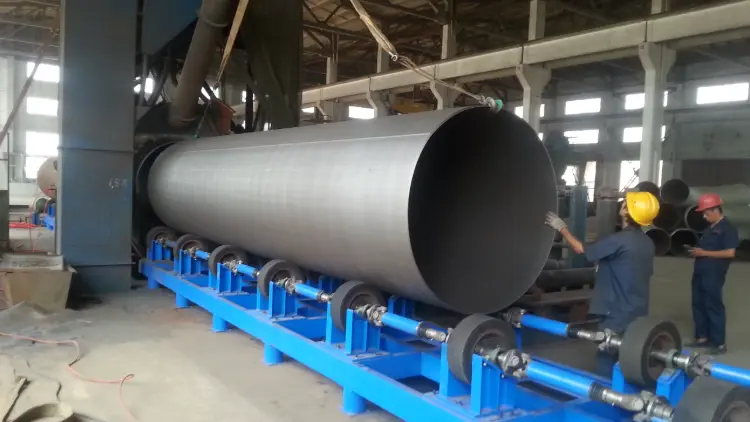
GB/T 9711-2011 PSL1 L175 ERW Pipeline Steel Pipe
In-Depth Data Sheet: GB/T 9711-2011 PSL1 L175 ERW Pipeline Steel Pipe
Explore the complete material specifications for L175 grade ERW steel pipe under GB/T 9711-2011 Product Specification Level 1 (PSL1). Chemical, mechanical, and physical data with international equivalents.
Hot‑rolled strip/coil, formed and electric resistance welded (high‑frequency ERW); optional post‑weld normalizing or stress‑relieving heat treatment by agreement
- Phone : +8618037372205
- Email : [email protected]
- WhatsApp: Contact via Whtsapp
- WeChat: +8618037372205
GB/T 9711-2011 PSL1 L175 ERW Pipeline Steel Pipe Introduction
This specification covers L175 grade electric resistance welded (ERW) steel pipe produced in accordance with GB/T 9711-2011 (equivalent to ISO 3183:2007 and API 5L 44th edition) under Product Specification Level 1 (PSL1). With a minimum yield strength of 175 MPa, L175 steel belongs to the low‑strength carbon‑manganese group for line pipe applications. The pipe is primarily used for conveying oil, gas, and water in low‑pressure onshore and offshore pipeline systems. Its chemistry is simple and allows easy welding and forming; the ERW process ensures cost‑effective production from hot‑rolled coils. As a PSL1 grade, it meets basic requirements for chemistry and tensile properties, while supplementary tests such as Charpy impact toughness are not mandatory unless agreed. The material offers good ductility and adequate toughness for general service at ambient temperatures. This datasheet summarizes the normative chemical composition limits, typical mechanical performance, physical constants, and a comparison with international equivalents to assist engineers, buyers, and quality inspectors.
GB/T 9711-2011 PSL1 L175 ERW Pipeline Steel Pipe Chemical Composition
The table below lists the maximum limits for chemical elements in L175 PSL1 steel according to GB/T 9711‑2011. The composition ensures good weldability and ductility. Only the four elements are explicitly restricted; other residual elements (Cu, Ni, Cr, Mo) are not separately limited but must not exceed levels that impair the steel's performance. Trace additions of Nb, V, and Ti may be used at the manufacturer's discretion, provided their combined content does not exceed 0.15% if declared.
| Chemical Element | Standard Value (max, wt%) | Remarks |
|---|---|---|
| Carbon (C) | 0.22 | Heat analysis limit |
| Manganese (Mn) | 0.90 | Heat analysis limit |
| Phosphorus (P) | 0.025 | Heat analysis limit |
| Sulfur (S) | 0.015 | Heat analysis limit |
GB/T 9711-2011 PSL1 L175 ERW Pipeline Steel Pipe Thermal and Electrical Physical Properties
The physical data below represent generic reference values for low‑carbon steel of this type, since GB/T 9711‑2011 does not prescribe physical parameters. These values are useful for design calculations, thermal stress analysis, and corrosion engineering. They correspond to wrought carbon‑manganese steel at room temperature unless otherwise noted. Slight variations may occur depending on the actual chemical composition and production route.
| Property | Typical Value | Unit | Test Conditions / Remarks |
|---|---|---|---|
| Density (ρ) | 7850 | kg/m³ | At 20 °C |
| Young's Modulus (E) | 210 | GPa | At 20 °C; decreases with temperature |
| Shear Modulus (G) | 81 | GPa | Calculated from E and Poisson's ratio |
| Poisson's Ratio (ν) | 0.30 | — | At room temperature |
| Thermal Expansion Coefficient (α) | 11.7 × 10⁻⁶ | K-1 | Average, 20 °C to 100 °C; increases moderately with temperature |
| Thermal Conductivity (λ) | 50 | W/(m·K) | At 20 °C; for low‑carbon steel |
| Specific Heat Capacity (cp) | 460 | J/(kg·K) | At 20 °C; rises with temperature |
| Electrical Resistivity (ρe) | 0.142 × 10⁻⁶ | Ω·m | At 20 °C |
GB/T 9711-2011 PSL1 L175 ERW Pipeline Steel Pipe Mechanical Properties
The following mechanical properties are based on the GB/T 9711‑2011 requirements for PSL1 L175 ERW pipe. Tensile testing is performed on transverse strip specimens taken from the pipe body or weld zone. The yield strength (ReH) is determined by the 0.5% total extension under load method. Elongation values are calculated according to the formula Af = C · Axc0.2 / Rm0.9, where Axc is the cross‑sectional area of the specimen and Rm the measured tensile strength. For illustrative purposes, a typical calculated minimum elongation of around 25% is shown for a common wall‑thickness range. Charpy V‑notch impact tests are not mandatory under PSL1 unless specified in the purchase order.
| Property | Standard Requirement | Unit | Test Conditions / Remarks |
|---|---|---|---|
| Yield Strength (ReH) | 175 (minimum) | MPa | Transverse strip test; 0.5% total extension (load method) or as agreed |
| Tensile Strength (Rm) | 310 (minimum) | MPa | Transverse strip test |
| Elongation after fracture (Af) | Calculated per standard formula; typical minimum values: 25% (for pipe wall thickness ≤ 12.7 mm, 50 mm gauge length rectangular specimen) | % | Based on formula Af=C · Axc0.2 / Rm0.9, C = 1940 (SI units); actual Rm used |
| Bend Test (Body and weld) | 180° bend; mandrel diameter = 4 × wall thickness (minimum 25 mm). No cracks allowed. | — | Ambient temperature; applicable for pipe diameter > 60.3 mm |
| Charpy Impact Energy (KV) | Not required for PSL1 (unless supplementary requirement agreed) | J | Test temperature and specimen type to be stated if ordered as an extra |
GB/T 9711-2011 PSL1 L175 ERW Pipeline Steel Pipe Directly Equivalent Material Standards and Substitute Grades
| Country / Region | Standard | Grade | Remarks |
|---|---|---|---|
| International | API 5L (44th ed. / 46th ed., PSL1) | Grade A | Identical strength and chemistry requirements; interchangeable for L175 ERW line pipe |
| International | ISO 3183:2007 / ISO 3183:2012 (PSL1) | L175 | Normative reference of GB/T 9711; completely equivalent |
| Europe | EN 10208-1:2009 | L210 (nearest; L175 not specified) | EN 10208-1 does not include L175 grade; for pressure and mechanical equivalence use L210 with agreement |
| Russia / CIS | GOST 31447-2012 (ГОСТ 31447) | K34 (approximate equivalent) | Similar strength grade; verify chemical and dimensional compatibility |
GB/T 9711-2011 PSL1 L175 ERW Pipeline Steel Pipe Application Introduction
L175 ERW pipe is widely used in low‑ to medium‑pressure fluid transportation and structural systems. Its cost‑effective manufacturing and good weldability make it suitable for numerous industries.
Key application areas and typical products include:
Product Applications: Spiral or straight‑seam ERW line pipe for underground and above‑ground installations, Coated or lined pipe (FBE, 3LPE, coal tar enamel) for corrosion protection, Welded pressurised vessels (within design limitations), Piling pipes and casings, Fencing, scaffolding and greenhouses (when ductility is sufficient)
Processed into products: Pipe spools for pipeline systems, Bends, elbows, tees and reducers (fabricated from L175 pipe), Flanges (welded neck or slip‑on made from the same pipe, Manifolds and header pipes in low‑pressure gas distribution, Water well casing and screens
Application industries: Oil and gas gathering lines and distribution networks, Water supply and drainage (municipal and industrial), Fire‑fighting pipeline systems, Building and civil engineering (structural hollow sections), Agricultural irrigation systems, Process piping for non‑aggressive chemicals
GB/T 9711-2011 PSL1 L175 ERW Pipeline Steel Pipe Similar / Comparable Alternative Materials
| Country / Region | Standard | Grade | Remarks |
|---|---|---|---|
| International | API 5L / ISO 3183 | L210 (API A/B or ISO L210) | Higher yield strength (≥210 MPa); often used where L175 is borderline; similar weldability and formability |
| International | API 5L / ISO 3183 | L245 (API Grade B, ISO L245) | Significantly higher strength (≥245 MPa); may substitute non‑critical pressure applications after engineering approval |
| China | GB/T 9711-2011 (PSL1) | L210 | Next higher strength grade in the same standard; can replace L175 with potential wall thickness reduction |
| Europe | EN 10208-1 | L235 (similar to L245) | For structural or low‑pressure pipelines; consult standard for carbon equivalent and toughness |
Notes:
Welding and fabrication: L175 and its ERW weld seam are readily weldable by all common methods. Pre‑heat and post‑weld heat treatment are usually not required for wall thicknesses below 20 mm, but should follow the steel's carbon equivalent and applicable welding codes.
Hydrostatic testing: Each pipe is normally hydrotested at a pressure producing a hoop stress of 60% of the specified minimum yield strength, unless a different stress level is agreed.
Dimensional tolerances: Governed by GB/T 9711‑2011; typical OD tolerance ±0.5% to ±1.0% and wall thickness tolerance −12.5% when not specified otherwise.
Additional tests: If impact toughness or non‑destructive inspection is required, the purchaser must specify supplementary requirements (e.g. SR1, SR2 etc.) at the time of enquiry.
- Share



