
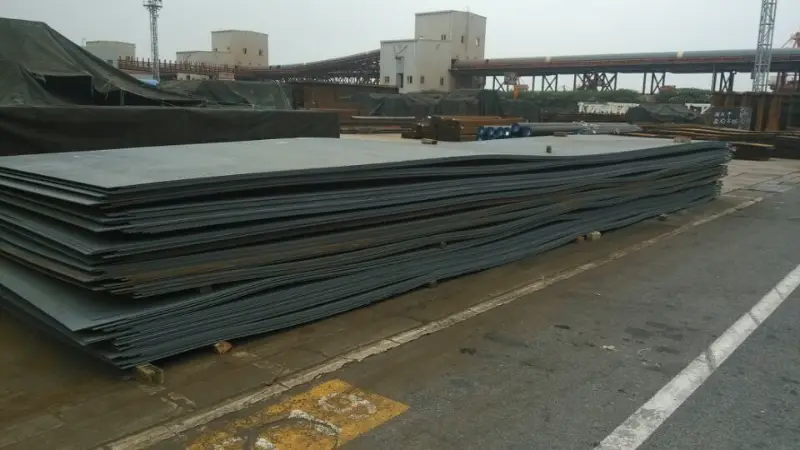
DIN 17102 EStE500
DIN 17102 EStE500 High-Strength Fine-Grain Automotive Structural Steel Plate
DIN 17102 EStE500 is a weldable fine-grain structural steel for automobile applications with minimum yield strength 500 MPa, offering excellent formability and toughness.
Cutting, welding, bending, cold forming, machining, hot forming
- Phone : +8618037372205
- Email : [email protected]
- WhatsApp: Contact via Whtsapp
- WeChat: +8618037372205
DIN 17102 EStE500 Introduction
EStE500 (also designated StE500) is a high-strength low-alloy structural steel specified in the former German standard DIN 17102 for hot-rolled plates, strips, wide flats and sections. The grade is microalloyed to achieve a minimum yield strength of 500 MPa while maintaining good weldability and sufficient ductility. It is intended primarily for welded structures in automotive manufacturing, where weight reduction and high load-bearing capacity are critical. The steel is typically delivered in the normalized or thermomechanically rolled condition, ensuring a fine-grain microstructure that provides a balanced combination of strength, toughness and bendability. Its chemical composition is carefully controlled with limits on carbon, manganese, phosphorus and sulfur, along with additions of aluminum, niobium, vanadium and/or titanium for grain refinement and precipitation strengthening.
DIN 17102 EStE500 Chemical Composition
The chemical composition complies with the limits of DIN 17102 for EStE500. Microalloying elements such as Nb, V and Ti are added to obtain the required strength through grain refinement and precipitation hardening. The carbon equivalent is restricted to ensure good weldability.
- Carbon equivalent (CEV) = C + Mn/6 + (Cr+Mo+V)/5 + (Ni+Cu)/15 typically ≤ 0.45.
- Aluminium content ensures sufficient deoxidation and grain refinement.
| Element | Maximum/Minimum Value | Remarks |
|---|---|---|
| Carbon (C) | ≤ 0.20% | Heat analysis |
| Silicon (Si) | ≤ 0.50% | |
| Manganese (Mn) | ≤ 1.70% | |
| Phosphorus (P) | ≤ 0.035% | |
| Sulfur (S) | ≤ 0.030% | |
| Aluminium (Altotal) | ≥ 0.020% | Minimum for fine-grain practice |
| Niobium (Nb) | ≤ 0.05% | Optional microalloy |
| Vanadium (V) | ≤ 0.12% | Optional microalloy |
| Titanium (Ti) | ≤ 0.05% | Optional microalloy |
| Nitrogen (N) | ≤ 0.015% | If not bound by Ti/Al |
DIN 17102 EStE500 Thermal, Electrical and Physical Properties
Physical properties are typical values for low-alloy structural steel at room temperature, unless otherwise indicated. These values are not specified in DIN 17102 but are widely accepted for design calculations. Properties may vary depending on the exact chemical composition and heat treatment condition.
| Property | Typical Value | Unit | Test Condition / Remarks |
|---|---|---|---|
| Density (ρ) | 7.85 | g/cm³ | At 20°C |
| Modulus of elasticity (E) | 210 | GPa | At 20°C |
| Shear modulus (G) | ≈ 81 | GPa | Calculated from E and ν |
| Poisson's ratio (ν) | 0.3 | — | Elastic range |
| Thermal expansion coefficient (α) | 12.0 × 10⁻⁶ | 1/K | 20–100°C |
| Thermal expansion coefficient (α) | 13.0 × 10⁻⁶ | 1/K | 20–200°C |
| Thermal conductivity (λ) | ≈ 50 | W/(m·K) | At 20°C |
| Specific heat capacity (cₚ) | ≈ 460 | J/(kg·K) | At 20°C |
| Electrical resistivity (ρₑ) | ≈ 0.15 | μΩ·m | At 20°C |
DIN 17102 EStE500 Mechanical Properties
The mechanical properties are specified according to DIN 17102 in the delivery condition (normalized or thermomechanically rolled) at room temperature. Values vary with product thickness; the table lists requirements for the most common gauge range. Transverse test pieces are used for plates and wide flats.
- Yield strength decreases with increasing thickness.
- Impact energy is guaranteed at -20°C for fine-grain steels.
- Bend test is performed with the specified mandrel diameter.
| Property | Specified Value | Unit | Test Condition |
|---|---|---|---|
| Yield strength (ReH) | ≥ 500 | MPa | t ≤ 16 mm, transverse |
| Yield strength (ReH) | ≥ 480 | MPa | 16 < t ≤ 40 mm, transverse |
| Yield strength (ReH) | ≥ 450 | MPa | 40 < t ≤ 63 mm, transverse |
| Tensile strength (Rm) | 550 – 700 | MPa | t ≤ 40 mm, transverse |
| Tensile strength (Rm) | 500 – 650 | MPa | 40 < t ≤ 63 mm, transverse |
| Elongation (A) | ≥ 17 | % | t ≤ 16 mm, L₀=5.65√S₀ |
| Elongation (A) | ≥ 16 | % | 16 < t ≤ 40 mm |
| Elongation (A) | ≥ 15 | % | 40 < t ≤ 63 mm |
| Bend test (mandrel diameter) | 3t | — | t ≤ 16 mm, 180° bend |
| Bend test (mandrel diameter) | 4t | — | 16 < t ≤ 40 mm, 180° bend |
| Charpy impact energy (KV₂) | ≥ 27 (longitudinal) | J | -20°C |
| Charpy impact energy (KV₂) | ≥ 27 (transverse) | J | -20°C |
DIN 17102 EStE500 Directly Equivalent Standards and Replacement Grades
| Country/Region | Standard | Grade | Remarks |
|---|---|---|---|
| Europe | EN 10149-2 | S500MC | Thermomechanically rolled high-strength steel for cold forming; direct equivalent for automotive structural use. |
| Europe | EN 10025-3 | S500N | Normalized fine-grain structural steel; comparable strength, but delivery condition may differ. |
| Germany (former) | DIN 17102 | EStE500 (StE500) | Original specification. |
DIN 17102 EStE500 Application Introduction
EStE500 steel is designed for welded structures in the automotive industry and engineering machinery, where a high strength-to-weight ratio is essential. It can be cold formed, cut, bent, and welded using standard procedures. Due to its fine-grain microstructure, it provides reliable toughness at low temperatures. Typical applications include:
Product Applications: Truck chassis frames and subframes, Car longitudinal and cross members, Automotive wheel rims and discs, Reinforcement panels and crash-safe structural parts, Boom sections and crane structural parts
Processed into products: Stamped and welded cross members in passenger cars, Cold-bent longitudinal beams in light commercial vehicles, Laser-cut and welded brackets for heavy equipment, Welded assemblies for bus frames, Formed structural brackets and gusset plates
Application industries: Automotive manufacturing, Commercial vehicle and trailer construction, Agricultural and construction machinery, Railway vehicle components, Engineering and welded structures
DIN 17102 EStE500 Similar / Alternative Materials with Comparable Properties
| Country/Region | Standard | Grade | Remarks |
|---|---|---|---|
| Europe | EN 10025-6 | S500Q | Quenched and tempered high-strength steel; higher toughness, minimum yield 500 MPa, used for heavy-duty welded structures. |
| Europe | EN 10149-2 | S550MC | Next strength level in thermomechanically rolled automotive steel; minimum yield 550 MPa, slightly reduced formability. |
| Europe | EN 10149-2 | S460MC | Lower strength alternative; minimum yield 460 MPa, offers better formability and weldability at reduced load capacity. |
| USA | ASTM A572/A572M | Grade 50 [345] | Lower strength level (345 MPa minimum yield). Not an equivalent for 500 MPa applications. |
| China | GB/T 1591 | Q500D | High-strength low-alloy structural steel; yield ≥ 500 MPa, similar chemistry with microalloying, good weldability. |
Notes:
- DIN 17102 has been withdrawn and replaced by European standards. For new designs, refer to EN 10149-2 or EN 10025-3.
- The steel is typically supplied with inspection certificate 3.1 according to EN 10204.
- Preheating for welding is generally not required at moderate thicknesses; however, the welding procedure should comply with recognized standards (e.g., EN 1011-2).
- For improved atmospheric corrosion resistance, a weathering steel variant (e.g., S500AW) may be considered if applicable.
- Share



