
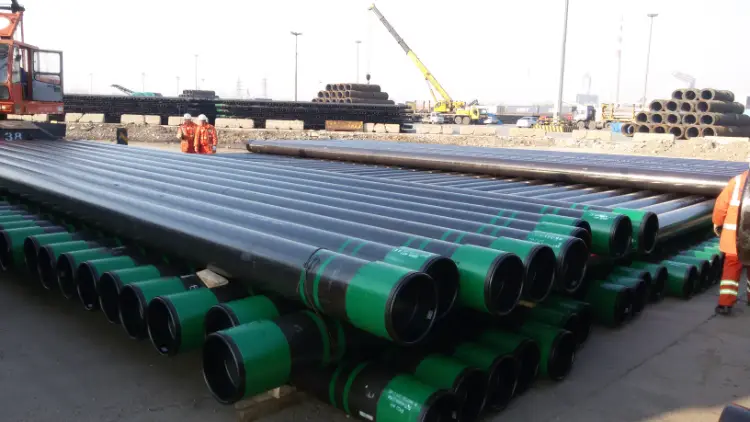
GB/T 9711-2011 PSL1 L360 ERW Pipe
GB/T 9711-2011 PSL1 L360 ERW Pipe: High-Strength Line Pipe Steel for Oil & Gas Transmission
Detailed material data for GB/T 9711-2011 PSL1 L360 electric resistance welded (ERW) steel pipe, including chemical composition, mechanical and physical properties, international equivalents, and application guidelines.
ERW (Electric Resistance Welding), cold forming, sizing
- Phone : +8618037372205
- Email : [email protected]
- WhatsApp: Contact via Whtsapp
- WeChat: +8618037372205
GB/T 9711-2011 PSL1 L360 ERW Pipe Introduction
GB/T 9711-2011 PSL1 L360 is a high-strength, low-alloy steel grade for electric resistance welded (ERW) line pipes used in oil and natural gas transportation. Equivalent to API 5L X52 (PSL1), it offers a minimum yield strength of 360 MPa and excellent weldability.
- Key features: Good combination of strength and toughness, suitable for moderate pressure applications; PSL1 requirements focus on basic chemical and mechanical properties without mandatory impact testing; ERW welding provides cost-efficient production.
- Typical delivery condition: Hot-rolled and ERW welded, normally as-welded or sized.
GB/T 9711-2011 PSL1 L360 ERW Pipe Chemical Composition
The chemical composition for L360 PSL1 ERW pipe is specified in accordance with GB/T 9711-2011 Table 5. Limits apply to product analysis. Carbon equivalent is not mandatory for PSL1 but typically controlled for weldability. Residual elements such as Cr, Ni, Cu may be present but are not restricted as long as the steel meets required mechanical properties.
| Element | Standard Value (max %) | Remarks |
|---|---|---|
| C | 0.28 | Maximum; for product analysis |
| Mn | 1.40 | Maximum |
| P | 0.030 | Maximum |
| S | 0.030 | Maximum |
| Si | Typically ≤0.45 | Not specified in PSL1; commonly controlled for deoxidation |
| Nb, V, Ti | May be added singly or in combination | Microalloying elements; report if intentionally added |
| CE IIW | Typically ≤0.43 | Carbon equivalent for reference; not mandatory for PSL1 |
GB/T 9711-2011 PSL1 L360 ERW Pipe Physical, Thermal, and Electrical Properties
The following data represent typical values for low-alloy line pipe steel equivalent to L360. These are not mandatory requirements of GB/T 9711-2011 but are widely used in design calculations. Properties may vary slightly with thermomechanical processing and microalloying.
| Property | Typical Value | Unit | Test Conditions / Notes |
|---|---|---|---|
| Density (ρ) | 7.85 | g/cm³ | At 20 °C |
| Elastic Modulus (E) | 205 – 210 | GPa | At room temperature |
| Shear Modulus (G) | 80 – 82 | GPa | Approximated as E / [2(1+ν)] |
| Poisson's Ratio (ν) | 0.3 | — | Elastic range |
| Thermal Expansion Coefficient (α) | 11.7 (20–100 °C), 12.5 (20–300 °C) | 10⁻⁶ /K | Mean linear coefficient |
| Thermal Conductivity (λ) | 45 – 52 | W/(m·K) | At 20 °C; decreases with temperature |
| Specific Heat Capacity | 460 – 500 | J/(kg·K) | Around room temperature |
| Electrical Resistivity (ρe) | 0.15 – 0.25 | µΩ·m | At 20 °C, depends on exact composition |
GB/T 9711-2011 PSL1 L360 ERW Pipe Mechanical Properties
Mechanical testing is performed on the pipe body in accordance with GB/T 9711-2011. The specified values are minimum unless a range is given. Impact testing is not required for PSL1 unless agreed upon. Bend test is mandatory for pipes with D<60.3 mm, and the weld shall remain intact after 180° bending.
| Property | Required Value | Unit | Test Condition |
|---|---|---|---|
| Yield Strength (ReH) | 360 – 530 | MPa | Transverse strip, 0.5% total extension; for D≥60.3 mm, alternatively API rectangular specimen |
| Tensile Strength (Rm) | 460 – 760 | MPa | As above |
| Elongation (A) | ≥ 22 | % | Gauge length 50mm, transverse strip; minimum value may increase for thicker walls per API 5L formula Af = 1940 * A0.2 / UTS0.9, but 22% is typical minimum for L360 |
| Bend Test | No cracks or openings in the weld after 180° bend | — | Bend angle 180°, mandrel diameter 2 × wall thickness (t ≤ 19.1 mm); weld at point of maximum bending; full-section specimen for D<60.3 mm |
| Charpy Impact (KV2) | Typically ≥ 27 J at 0 °C (if agreed) | J | PSL1 does not mandate impact test; value cited is common supplementary specification for L360 |
GB/T 9711-2011 PSL1 L360 ERW Pipe Fully Equivalent Standards and Replaceable Grades
| Country/Region | Standard | Grade | Remarks |
|---|---|---|---|
| International | ISO 3183:2012 | L360 (PSL1) | Identical technical content to API 5L; L360 is directly aligned |
| USA | API 5L (45th Ed./46th Ed.) | X52 (PSL1) | Complete equivalent; L360 = X52 |
| Europe | EN 10208-2:2009 | L360MB (similar concept) | EN grade with matching yield strength; PSL1 requirements similar to Annex M of EN 10208-2 |
| Russia | GOST R 53383-2009 | К52 (K52) | Equivalent strength grade for welded line pipe |
| Canada | CSA Z245.1-14 | Grade 359 (Cat I) | Comparable yield strength; PSL1 corresponds to Category I |
GB/T 9711-2011 PSL1 L360 ERW Pipe Application Introduction
L360 ERW pipe is widely employed in onshore and offshore pipeline systems due to its balanced strength, formability, and weldability. It is particularly suited for moderate pressure oil, gas, and water transmission. The ERW process ensures cost efficiency for small to medium diameters (<508 mm).
- Preferred for gathering lines, distribution networks, and flowlines.
- Can be used in structural applications where circular hollow sections with good toughness are required.
- Suitable for sour service only with additional hydrogen-induced cracking (HIC) testing, not typically covered by basic PSL1.
Product Applications: Onshore gas transmission pipelines, Crude oil gathering lines, Water injection pipelines, Firefighting pipe systems, Structural columns and trusses
Processed into products: Longitudinal welded line pipe segments, Pipe bends and elbows (hot or cold formed), Flanged joints and couplings, Tees and reducers, Pile casing and conductor pipe
Application industries: Oil and gas exploration and transportation, Petrochemical and refinery piping, Water and wastewater treatment, Marine and offshore structures (non-sour service), Civil engineering and structural applications
GB/T 9711-2011 PSL1 L360 ERW Pipe Similar / Alternative Material Recommendations
| Country/Region | Standard | Grade | Remarks |
|---|---|---|---|
| China | GB/T 9711-2011 | L360 (PSL2) | PSL2 version with tighter chemistry and mandatory toughness; higher reliability |
| USA | API 5L | X52 (PSL2) | PSL2 provides improved fracture control; suitable if Charpy requirements are needed |
| International | ISO 3183 | L360N / L360Q | Normalized or quenched+tempered variants with enhanced toughness |
| China | GB/T 8163-2018 | Q345 (20MnV) | Seamless steel pipe for fluid service with similar minimum yield strength (~345 MPa) but different application scope |
Notes:
Additional notes:
- ERW pipes are typically produced in diameters from 21.3 mm to 508 mm, wall thickness up to 16 mm; larger sizes require HFW (high-frequency welding) or seamless processes.
- Hydrostatic testing of each pipe is mandatory according to GB/T 9711-2011; test pressure calculated to produce a hoop stress of 60–85% of specified minimum yield strength.
- For sour service or low-temperature applications, supplementary requirements for HIC/SSC testing and Charpy impact must be agreed at the time of order, moving towards PSL2 or proprietary grades.
- Post-weld heat treatment (stress relieving) is not mandatory for L360 ERW pipe unless specified, but it can improve weld zone toughness.
- Carbon equivalent and additional microalloying (Nb, V, Ti) are often reported in the mill certificate even for PSL1 to aid weldability assessment.
- Share



