
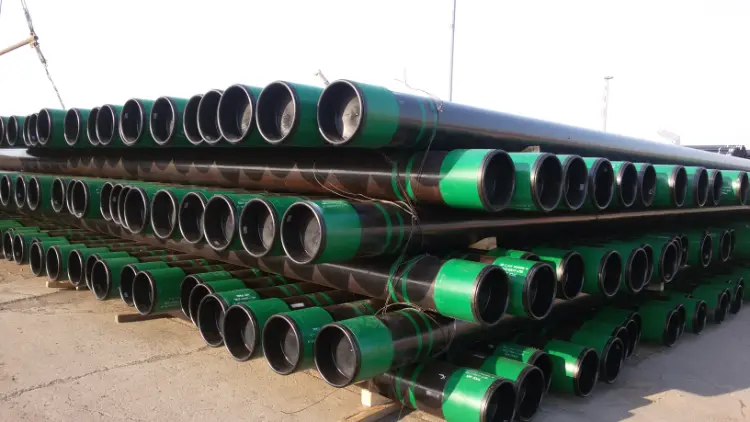
GB/T 9711-2011 PSL1 L390 ERW Pipe
GB/T 9711-2011 PSL1 L390 ERW Pipe: Durable Pipeline Steel for Energy Transportation
In-depth data of GB/T 9711-2011 PSL1 L390 ERW steel pipe: chemical composition, mechanical properties, thermal & electrical characteristics, equivalent grades, and application guidance for oil & gas pipelines.
ERW welding, cold forming, heat treating (stress relieving if required), cutting, beveling
- Phone : +8618037372205
- Email : [email protected]
- WhatsApp: Contact via Whtsapp
- WeChat: +8618037372205
GB/T 9711-2011 PSL1 L390 ERW Pipe Introduction
GB/T 9711-2011 PSL1 L390 ERW pipe is a high-strength steel line pipe manufactured by electric-resistance welding (ERW) and conforms to the Petroleum and natural gas industries — Steel pipe for pipeline transportation systems standard. The grade L390 indicates a minimum specified yield strength of 390 MPa, placing it in the category of microalloyed high-strength low-alloy (HSLA) steels. It is produced under PSL1 (product specification level 1), which defines essential requirements without mandatory notch-toughness testing.
- Excellent weldability and formability for efficient pipe fabrication
- Balanced strength and ductility for safe long-distance transmission of oil, gas, and other media
- Cost-effective solution for moderate-service onshore pipelines where low-temperature toughness is not a primary specification
- Available as ERW pipe with diameters typically from 114.3 mm to 610 mm and wall thicknesses up to 25.4 mm
L390 ERW pipe is widely adopted in gathering lines, distribution networks, and structural applications requiring reliable strength.
GB/T 9711-2011 PSL1 L390 ERW Pipe Chemical Composition
The following table lists the maximum permissible elements for L390 PSL1 steel according to GB/T 9711-2011 Table 5 (heat analysis). Microalloying elements Nb, V, and Ti are common for grain refinement and precipitation strengthening; their combined content is limited to 0.15% unless otherwise agreed. Silicon is not specified but typically present from deoxidation. Residual elements like Cr, Ni, Cu are not restricted under PSL1.
| Element | Max Value (%) | Remarks |
|---|---|---|
| Carbon (C) | 0.28 | Heat analysis |
| Silicon (Si) | — | Not specified; typically 0.15–0.35 |
| Manganese (Mn) | 1.40 | Heat analysis |
| Phosphorus (P) | 0.030 | Maximum |
| Sulfur (S) | 0.030 | Maximum |
| Vanadium (V) | — | Controlled when added (see V+Nb+Ti) |
| Niobium (Nb) | — | Controlled when added (see V+Nb+Ti) |
| Titanium (Ti) | — | Controlled when added (see V+Nb+Ti) |
| V+Nb+Ti | 0.15 | Sum of microalloys, unless otherwise agreed |
GB/T 9711-2011 PSL1 L390 ERW Pipe Thermal & Electrical Physical Properties
The following properties are typical for L390 pipeline steel (carbon-manganese, microalloyed). They are not part of GB/T 9711-2011 mandatory requirements but are representative for engineering calculations. These values can vary slightly with actual composition and processing.
| Property | Typical Value | Unit | Test Condition |
|---|---|---|---|
| Density (ρ) | 7850 | kg/m³ | At 20 °C |
| Modulus of Elasticity (E) | 207 | GPa | At 20 °C |
| Shear Modulus (G) | 80 | GPa | At 20 °C |
| Poisson's Ratio (ν) | 0.30 | – | Elastic range |
| Thermal Expansion Coefficient (α) | 11.7 | 10⁻⁶/K | 20–100 °C |
| Thermal Conductivity (λ) | 50 | W/(m·K) | At 20 °C |
| Specific Heat Capacity (cₚ) | 480 | J/(kg·K) | At 20 °C |
| Electrical Resistivity (ρₑ) | 0.18 | µΩ·m | At 20 °C |
GB/T 9711-2011 PSL1 L390 ERW Pipe Mechanical Properties
Mechanical properties of L390 PSL1 ERW pipe are listed per GB/T 9711-2011 Table 7 for PSL1. These represent the minimum requirements for room temperature tensile tests on transverse specimens. Bend test is mandatory for ERW pipe to verify weld ductility; the bend diameter is a function of wall thickness. PSL1 does not require Charpy impact testing, so KV values are omitted. The data correspond to pipe body (not weld), unless noted.
| Property | Required Value | Unit | Test Condition |
|---|---|---|---|
| Yield Strength (ReH) | 390 – 545 | MPa | Transverse, 0.5% total extension (or Rt0.5) |
| Tensile Strength (Rm) | 490 – 690 | MPa | Transverse, at room temperature |
| Elongation (A50mm) | ≥ 22 | % | Gauge length 50 mm, transverse strip specimen, wall thickness ≤ 25.4 mm |
| Bend Test (weld) | No cracks or open flaws | – | 180° bend, mandrel diameter = 3× wall thickness (t ≤ 12.7 mm) |
| Bend Test (weld) | No cracks or open flaws | – | 180° bend, mandrel diameter = 4× wall thickness (t > 12.7 mm) |
GB/T 9711-2011 PSL1 L390 ERW Pipe Direct Equivalent Standards & Replaceable Grades
| Country/Region | Standard | Grade Designation | Remarks |
|---|---|---|---|
| USA / International | API 5L (45th Ed.) / ISO 3183:2012 | L390 or X56 (PSL1) | Identical strength and chemistry concept; PSL1 ERW weldability requirements match |
| Europe | EN 10208-2:2009 | L390MB | Comparable piping steel for combustible fluids; PSL1 equivalent for non-sour service |
| International | ISO 3183:2012 | L390 | Harmonized with API 5L; same yield and tensile limits for PSL1 pipe |
| Russia / CIS | GOST R 52079-2003 (adapted) | K56 | Similar strength grade for welded line pipe, check exact chemical limits |
GB/T 9711-2011 PSL1 L390 ERW Pipe Application Introduction
L390 ERW pipe is primarily designed for oil and gas transmission under moderate pressures. Its weldability and formability also make it suitable for structural and mechanical uses.
- Oil & Gas Pipelines: Onshore gathering and transmission lines, gas distribution grids.
- Water & Slurry: Transport of non-corrosive water, slurries (with internal lining).
- Structural: Piling, bridge supports, building columns, and trusses when hollow sections are needed.
- Mechanical: Conveyor rollers, line shafting, and machinery frames.
Product Applications: Onshore oil pipelines, Natural gas trunk and urban distribution pipelines, High-pressure water transmission mains, Steel pipe piles for foundation works, Line pipe for utility services, Fencing and guardrail posts
Processed into products: Long-distance pipeline segments, Hot-induction bends and fittings (when fabricated from pipe), Flanged pipe spools, Reducers and tees, Welded structural columns and beams, Machine frames and roller tubes
Application industries: Oil and gas exploration and production, Pipeline transportation and distribution, Water supply and sewage (with coating or lining), Construction and civil engineering (piling, structural supports), Mining and slurry transport, Agricultural irrigation systems
GB/T 9711-2011 PSL1 L390 ERW Pipe Similar & Alternative Materials for Reference
| Country/Region | Standard | Grade | Remarks |
|---|---|---|---|
| USA / International | API 5L | X52 (L360) | Lower strength (360 MPa min YS); may substitute when design allows reduced pressure |
| USA / International | API 5L | X60 (L415) | Higher strength (415 MPa min YS); suitable for upgrading pipeline capacity |
| Europe | EN 10208-2 | L360MB | Next lower strength grade, sometimes interchangeable for less demanding segments |
| Europe | EN 10208-2 | L415MB | Next higher strength, often used when wall thickness reduction is desired |
| China | GB/T 9711-2011 | L360 (X52) | Equivalent to API X52; can be employed if L390 is not available, with design adjustment |
Notes:
PSL1 pipe generally does not require impact testing or strict sulfur limits for HIC. For sour service or low-temperature applications (e.g., -20 °C and below), consider PSL2 or additional specifications (such as NACE MR0175). ERW weld seam shall be fully normalized or heat-treated as per the standard to ensure consistent toughness. Dimensional tolerances and hydrostatic test requirements are defined in GB/T 9711-2011. Always verify with the latest standard revision for project-specific requirements.
- Share



