
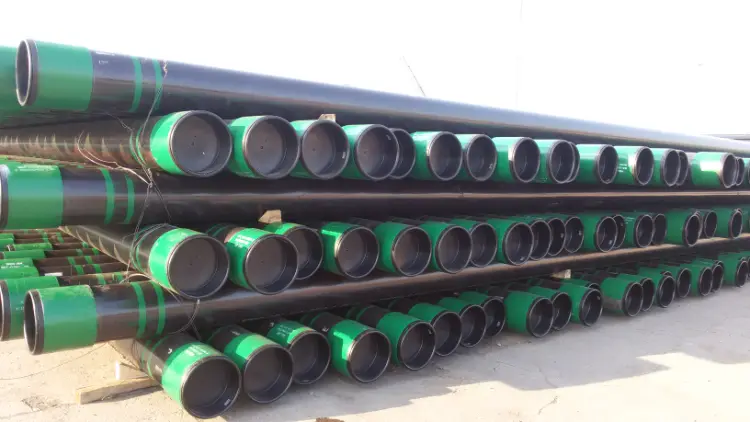
GB/T 9711-2011 PSL1 L415 ERW Pipe
GB/T 9711-2011 PSL1 L415 ERW Pipe: Equivalent to API 5L X60 Steel
Detailed material data for L415 ERW steel pipe per GB/T 9711-2011 PSL1, including chemical composition, mechanical and physical properties, international equivalents, and typical applications.
Electric resistance welding, cold forming, hot rolling, heat treatment (normalizing, TMCP), cutting, beveling, coating
- Phone : +8618037372205
- Email : [email protected]
- WhatsApp: Contact via Whtsapp
- WeChat: +8618037372205
GB/T 9711-2011 PSL1 L415 ERW Pipe Introduction
L415 steel pipe, defined in GB/T 9711-2011 (based on ISO 3183:2007), is a widely used carbon‑manganese steel for oil and gas transmission pipelines. Supplied in PSL1 product specification level, it is manufactured by the electric resistance welding (ERW) process. The main features include:
- Minimum yield strength of 415 MPa, offering a good strength‑to‑weight ratio for line pipe applications.
- Excellent weldability and formability, suitable for cold bending and field welding.
- Controlled chemical composition with low sulfur and phosphorus to ensure cleanliness and resistance to cracking.
- Typically delivered in as‑rolled, normalized‑rolled, normalizing, or thermomechanically controlled process (TMCP) condition, depending on thickness and end‑use requirements.
- International equivalents include API 5L X60 PSL1 and ISO 3183 L415, making it fully interchangeable in global pipeline projects.
This grade is not intended for sour service unless specially agreed, and PSL1 does not mandate impact testing.
GB/T 9711-2011 PSL1 L415 ERW Pipe Chemical Composition
Chemical requirements for PSL1 L415 as specified in GB/T 9711‑2011 Table 5. Values are maximums based on heat analysis; product analysis tolerances apply. Vanadium, niobium, and titanium are controlled as a sum. Carbon equivalent (CEV) may be agreed upon at the time of ordering but is not mandatory for PSL1.
| Element | Mass Fraction (%), max | Remarks |
|---|---|---|
| C | 0.20 | Heat analysis |
| Mn | 1.40 | Heat analysis |
| Si | 0.45 | Heat analysis |
| P | 0.025 | Heat analysis |
| S | 0.015 | Heat analysis |
| V+Nb+Ti | 0.15 | Sum of V, Nb and Ti |
GB/T 9711-2011 PSL1 L415 ERW Pipe Thermal and Electrical Physical Properties
Physical properties are not specified in GB/T 9711-2011. The data below are typical values for carbon‑manganese steel at room temperature, provided as a general engineering reference.
| Property | Typical Value | Unit | Test Condition / Remarks |
|---|---|---|---|
| Density (ρ) | 7.85 | g/cm³ | At 20 °C |
| Modulus of Elasticity (E) | 205 | GPa | At 20 °C |
| Shear Modulus (G) | 80 | GPa | Calculated from E and Poisson's ratio |
| Poisson's Ratio (ν) | 0.3 | — | Typical for steel |
| Thermal Expansion Coefficient (α) | 11.7 × 10⁻⁶ | /K | Between 20 °C and 100 °C |
| Thermal Conductivity (λ) | 50 | W/(m·K) | At 20 °C |
| Specific Heat Capacity | 460 | J/(kg·K) | At 20 °C |
| Electrical Resistivity (ρ_e) | 0.20 | Ω·mm²/m | At 20 °C |
GB/T 9711-2011 PSL1 L415 ERW Pipe Mechanical Properties
Mechanical property requirements for PSL1 L415 line pipe according to GB/T 9711-2011 Table 10. Tests are performed on transverse strip specimens taken from the pipe body. No impact test (KV) is required for PSL1. The minimum elongation is calculated using a formula based on the gauge length and cross‑sectional area, or taken from the standard table; typical values are shown below for reference.
| Property | Specified Value | Unit | Test Condition |
|---|---|---|---|
| Yield Strength (ReH) | 415 – 565 | MPa | Transverse, strip specimen, 0.5% total extension (ReH) |
| Tensile Strength (Rm) | 520 – 760 | MPa | Transverse, strip specimen |
| Elongation (A) | ≥ 22 (typical for t ≤ 20 mm) | % | Gauge length 50 mm, strip specimen; refer to standard formula for exact value |
| Bend Test | Not normally required for PSL1 | Unless specified, replaced by flattening test for ERW pipe |
GB/T 9711-2011 PSL1 L415 ERW Pipe Full Equivalent Material Standards and Substitutable Grades
| Country/Region | Standard | Grade | Remarks |
|---|---|---|---|
| USA | API 5L | X60 PSL1 | Identical requirements for PSL1, ERW pipe |
| International | ISO 3183:2007 | L415 | Basis for GB/T 9711-2011; full equivalence |
| Europe | EN 10208-2 | L415NB (or L415MB) | PSL2 grade but can substitute with additional requirements; confirm technical delivery conditions |
GB/T 9711-2011 PSL1 L415 ERW Pipe Application Introduction
L415 ERW pipe is primarily used in transportation of natural gas, crude oil, and refined petroleum products over long distances. It is also suitable for water and slurry transmission in mining and civil engineering projects. Thanks to its good formability and weldability, it can be fabricated into various pipeline components and structural supports.
Product Applications: Long‑distance cross‑country pipelines, Gathering lines for oil and gas fields, Flowlines in processing facilities, Water injection pipelines, Slurry transport pipelines, Utility piping systems
Processed into products: Straight pipe segments (pipe body), Induction bends and cold bends, Prefabricated spools and fittings, Teardrop reducers and caps, Flanges and connectors (by welding onto pipe ends), Support structures and riser pipes
Application industries: Oil and gas exploration and production, Pipeline transmission (onshore and offshore), Petrochemical and refinery plants, Water treatment and distribution, Mining and slurry transport, Construction and structural engineering
GB/T 9711-2011 PSL1 L415 ERW Pipe Similar / Closely Related Alternative Materials
The following grades have similar strength levels and are often considered for substitution when PSL1 L415 is not available or when different product specification levels are required. However, careful review of chemical composition, mechanical properties, and supplementary requirements is necessary.
| Country/Region | Standard | Grade | Remarks |
|---|---|---|---|
| USA | API 5L | X60 PSL2 | Higher specification level with tighter chemistry and mandatory toughness tests; can replace PSL1 if agreed. |
| USA | API 5L | X65 PSL1 | Slightly higher yield (450 MPa min); can be used if strength matching suits the design, but check weldability and strain‑based design criteria. |
| China | GB/T 9711-2011 | L450 | Next strength level; provides higher load capacity; substitution requires thickness recalculation. |
| Europe | EN 10208-2 | L415MB | Thermomechanically rolled, with more stringent phosphorus and sulfur limits; suitable for low‑temperature toughness applications when temperature requirements exist. |
Notes:
- PSL1 classification means that the pipe is intended for normal service conditions; it does not require notch toughness testing (Charpy V‑notch) or other supplementary tests unless agreed at the time of order.
- Weld seam inspection of ERW pipe is carried out by ultrasonic or electromagnetic methods, ensuring the longitudinal seam quality.
- Hydrostatic testing is mandatory according to the standard specification.
- For sour service (H₂S containing environments), a higher PSL (PSL2) or special grade with defined hardness and chemistry (e.g., L415MS) is required.
- Typical external coatings include 3‑layer polyethylene (3LPE), 3‑layer polypropylene (3LPP), or fusion‑bonded epoxy (FBE) for corrosion protection.
- Share



