
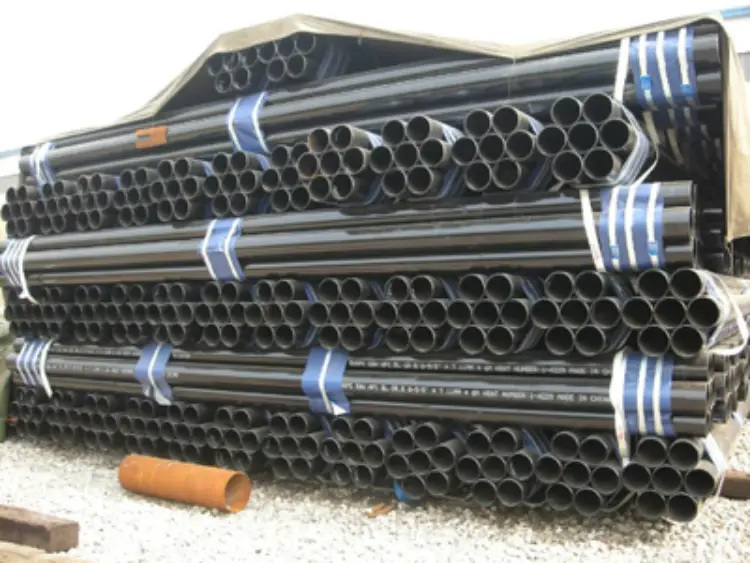
GB/T 9711-2011 PSL1 L450 ERW Pipe
L450 ERW Pipe Guide: GB/T 9711-2011 PSL1 Pipeline Steel (API X65 Equivalent)
Complete technical data for GB/T 9711-2011 PSL1 L450 ERW pipe: chemistry, mechanical & physical properties, international equivalents to API 5L X65, and application insights for oil and gas transmission pipelines.
Electric resistance welding (ERW), cold forming, sizing, optional heat treatment of weld seam
- Phone : +8618037372205
- Email : [email protected]
- WhatsApp: Contact via Whtsapp
- WeChat: +8618037372205
GB/T 9711-2011 PSL1 L450 ERW Pipe Introduction
L450 ERW pipe under GB/T 9711-2011 PSL1 is a high-strength low-alloy steel for welded line pipes used in the petroleum and natural gas industries. It corresponds to the API 5L grade X65 (PSL1) and ISO 3183 L450. The pipe is manufactured by electric resistance welding of hot-rolled steel strip, offering a minimum yield strength of 450 MPa (65 ksi) and excellent toughness. As a PSL1 product, it meets basic requirements for chemistry, tensile properties, and hydrostatic testing, making it suitable for onshore and offshore transmission pipelines, waterworks, and structural applications where cost-effectiveness and reliable service are required. Typical delivery condition includes as-welded with beveled ends and optional coating.
GB/T 9711-2011 PSL1 L450 ERW Pipe Chemical Composition
Chemical composition requirements for PSL1 L450 ERW pipe according to GB/T 9711-2011 Table 5. For welded pipe, carbon content is restricted to ≤0.22%. The micro-alloying elements vanadium, niobium, and titanium are typically added to achieve the required strength, with their combined content limited to 0.15%. Residual elements (copper, nickel, chromium, molybdenum) are controlled to ≤0.50% each unless otherwise agreed. All values are maximum unless a range is indicated.
| Element | Specified Value (Max, wt%) | Remarks |
|---|---|---|
| C | ≤0.22 | Heat analysis; for welded pipe |
| Mn | ≤1.40 | |
| P | ≤0.030 | |
| S | ≤0.030 | |
| V+Nb+Ti | ≤0.15 | Sum of micro-alloying elements (see note) |
| Cu | ≤0.50 | Residual element; may be modified by agreement |
| Ni | ≤0.50 | Residual element; may be modified by agreement |
| Cr | ≤0.50 | Residual element; may be modified by agreement |
| Mo | ≤0.50 | Residual element; may be modified by agreement |
GB/T 9711-2011 PSL1 L450 ERW Pipe Thermal and Electrical Physical Properties
The following physical properties are typical for low-alloy carbon steels such as L450/X65 and are not specified in GB/T 9711-2011. They are provided as reference data for engineering design. Values may vary slightly depending on exact composition, heat treatment, and temperature. The density, elastic modulus, and thermal expansion coefficient are representative at room temperature (20–25°C). Thermal conductivity and specific heat are given for ambient conditions unless otherwise noted.
| Property | Typical Value | Unit | Test Condition / Remarks |
|---|---|---|---|
| Density (ρ) | 7.85 | g/cm³ | Room temperature |
| Elastic Modulus (E) | 205 | GPa | Room temperature; static modulus |
| Shear Modulus (G) | 79.3 | GPa | Calculated from E = 205 GPa, ν = 0.30 |
| Poisson's Ratio (ν) | 0.30 | — | Within elastic range |
| Thermal Expansion Coefficient (α) 20–200°C | 12.5 | 10⁻⁶ /K | Average coefficient |
| Thermal Conductivity (λ) at 20°C | 50 | W/(m·K) | Approximate value |
| Specific Heat Capacity (cp) at 20°C | 486 | J/(kg·K) | Typical for HSLA steel |
| Electrical Resistivity (ρₑ) at 20°C | 0.15 | µΩ·m | Typical for carbon steel |
GB/T 9711-2011 PSL1 L450 ERW Pipe Mechanical Properties
Mechanical properties are based on transverse strip specimens taken from the pipe body. Yield strength is specified as ReH (upper yield) or Rp0.2 (proof strength) in case of continuous yielding. Elongation after fracture must satisfy the formula given in GB/T 9711-2011 (Clause 9.10.2.3): Amin = 1940 · Ax0,2 / U0,9, where Ax is the cross-sectional area of the test specimen (mm²) and U is the specified minimum tensile strength (535 MPa). For a typical full-thickness strip specimen (12.5 mm x 19 mm), the minimum elongation is approximately 17%. Bending and impact tests are not mandatory under PSL1 but may be supplemented by agreement.
| Property | Specified Value | Unit | Test Condition |
|---|---|---|---|
| Yield Strength (ReH/Rp0.2) | 450 - 600 | MPa | Transverse strip specimen, room temperature |
| Tensile Strength (Rm) | 535 - 760 | MPa | Transverse strip specimen, room temperature |
| Elongation after fracture (A) | Formula-based (see description) | % | Gauge length 50 mm (or 2 in); transverse specimen |
GB/T 9711-2011 PSL1 L450 ERW Pipe Fully Equivalent Material Standards and Replaceable Grades
| Country / Region | Standard | Grade | Remarks |
|---|---|---|---|
| International | API Spec 5L (45th Ed.) | X65 PSL1 | Direct equivalent for welded pipe |
| International | ISO 3183:2012 | L450 PSL1 | Harmonized with GB/T 9711-2011 |
| China | GB/T 9711-2011 | L450 PSL1 (ERW) | Original standard |
GB/T 9711-2011 PSL1 L450 ERW Pipe Application Introduction
L450 ERW pipe (PSL1) is widely used in the energy and infrastructure sectors. Its combination of medium strength, good weldability, and low-temperature toughness (when specified) makes it suitable for long-distance transmission lines. The pipe can be supplied as plain-end, threaded-end, or with special-end preparation and external/internal coatings to withstand corrosive environments.
Product Applications: Electric Resistance Welded (ERW) line pipe, Casing pipe for wells, Structural hollow sections, Pre-fabricated pipe spools and fittings, Road crossing sleeves and casings
Processed into products: Straight seam welded pipes (main line segments), Bend sections and elbows (hot or cold formed after bending test qualification), Tee connections and reducers manufactured from pipe material, Flanges (weld-neck) fabricated from the same heat of steel, End caps and closures
Application industries: Oil & Gas Transmission (onshore, gathering lines, distribution), Water Transportation (aqueducts, penstocks), Structural Engineering (piling, bracing, building frames), Mining (slurry transport, compressed air lines), Marine and Offshore (when additional impact requirements are added)
GB/T 9711-2011 PSL1 L450 ERW Pipe Similar or Closely Related Steel Grades for Reference
| Country / Region | Standard | Grade | Remarks |
|---|---|---|---|
| International | API Spec 5L | X65 PSL2 | Higher integrity level with lower sulfur, mandatory toughness, and narrower chemistry; still strength-matched |
| International | ISO 3183:2012 | L450 PSL2 | PSL2 counterpart with stricter control |
| Europe | EN 10208-2 | L450MB | Similar chemistry and strength, but often used with a PSL2 philosophy; M indicates thermomechanical rolled/controlled processed for base material |
| USA | ASTM A53 / A53M | Grade B | Lower strength (~240 MPa yield) but commonly used in pipe; cannot directly replace L450 unless wall thickness is heavily increased |
| China | GB/T 9711-2011 | L415 (X60) | Lower strength grade (415 MPa min yield) – sometimes considered when strength overmatch is not required |
Notes:
PSL1 vs PSL2: GB/T 9711-2011 PSL1 does not mandate Charpy V-notch impact testing, weld seam notch toughness, or maximum hardness for sour service. For applications requiring fracture toughness or sour gas resistance, consider specifying PSL2 L450 or supplementary requirements (e.g., SR5 for drop-weight tear testing).
Weld Seam: The ERW weld must demonstrate adequate integrity via hydrostatic testing, and if required, the seam may be normalized (heat treated) to reduce residual stresses. Refer to the standard for frequency of flattening tests and guided bend tests.
Typical Coating Options: 3LPE (three-layer polyethylene), FBE (fusion bonded epoxy), coal tar enamel, or concrete weight coating for subsea use. These are agreed upon at the time of order.
- Share



