
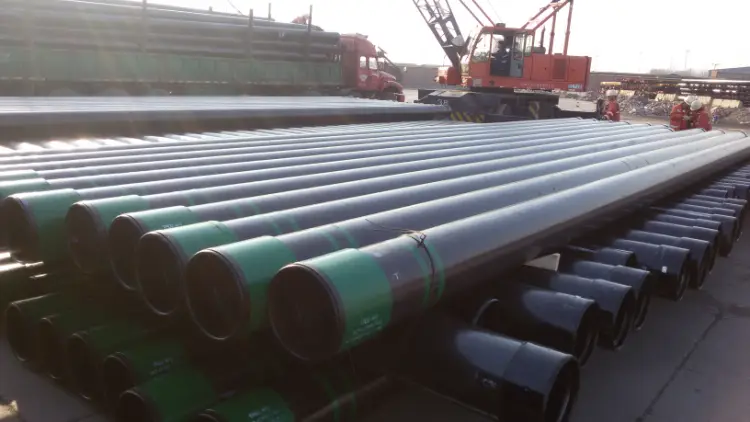
GB/T 9711-2011 PSL1 L485 ERW Pipe
GB/T 9711-2011 PSL1 L485 ERW Pipe: High-Strength Linepipe for Oil & Gas Transmission
Comprehensive material data for L485 PSL1 ERW pipe according to GB/T 9711-2011: chemical composition, mechanical properties, typical physical data, international equivalents, and application guidance.
Cold/hot forming of skelp, high-frequency ERW longitudinal welding, heat treatment of weld seam, hydrostatic testing, dimensional inspection; can be coated and lined externally.
- Phone : +8618037372205
- Email : [email protected]
- WhatsApp: Contact via Whtsapp
- WeChat: +8618037372205
GB/T 9711-2011 PSL1 L485 ERW Pipe Introduction
GB/T 9711-2011 PSL1 L485 ERW pipe is a high-strength electric resistance welded (ERW) linepipe intended for oil and gas transmission under non-sour service. It belongs to Specification Line Pipe, Product Specification Level 1 (PSL1), steel grade L485 (equivalent to API 5L X70). The steel exhibits a minimum yield strength of 485 MPa and excellent toughness at ambient temperatures. The pipe is manufactured from thermomechanically rolled coils, formed and longitudinally welded by high-frequency ERW process, then subjected to normalizing or stress-relieve heat treatment of the weld seam. PSL1 requirements involve less stringent testing frequencies compared to PSL2, making it suitable for less critical on-land transmission pipelines where additional ductility and fracture arrest properties are not mandatory but still provide reliable performance.
GB/T 9711-2011 PSL1 L485 ERW Pipe Chemical Composition
The following chemical composition limits apply to PSL1 L485 ERW pipe as per GB/T 9711-2011 Table 3. All values are maximum unless a range is indicated. Carbon equivalent (CE) shall not exceed 0.43% (CEIIW) or 0.25% (Pcm) depending on agreement. These limits guarantee weldability and base metal toughness for the finished weldment.
| Element | Specified Value (max, %) | Remarks |
|---|---|---|
| C | 0.26 | Heat analysis |
| Mn | 1.65 | Heat analysis |
| Si | 0.45 | Heat analysis |
| P | 0.025 | Heat analysis |
| S | 0.015 | Heat analysis |
| V | 0.10 | Heat analysis |
| Nb | 0.08 | Heat analysis; V+Nb ≤ 0.15 |
| Ti | 0.06 | Heat analysis |
| Cu | 0.35 | Heat analysis |
| Ni | 0.30 | Heat analysis |
| Cr | 0.30 | Heat analysis |
| Mo | 0.15 | Heat analysis |
| Al | 0.06 | Heat analysis; total aluminum |
| N | 0.012 | Heat analysis |
| B | 0.0005 | Heat analysis |
| CE (IIW) | 0.43 | Max. carbon equivalent CE = C + Mn/6 + (Cr+Mo+V)/5 + (Ni+Cu)/15 |
| Pcm | 0.25 | Max. cracking parameter Pcm = C + Si/30 + (Mn+Cu+Cr)/20 + Ni/60 + Mo/15 + V/10 + 5B (optional) |
GB/T 9711-2011 PSL1 L485 ERW Pipe Thermal and Electrical Physical Properties
The physical properties listed below are typical for low-alloy carbon-manganese steel such as L485/X70 grade. These values are not normative in GB/T 9711-2011 but are based on published industry reference data for pipeline steels of this category. Variations may occur depending on actual chemical composition, microstructure, and temperature. Use these for design calculations and general modelling purposes.
| Property | Typical Value | Unit | Test Condition |
|---|---|---|---|
| Density (ρ) | 7.85 | g/cm³ | At 20°C |
| Modulus of elasticity (E) | 210 | GPa | Room temperature |
| Shear modulus (G) | 81 | GPa | Room temperature |
| Poisson ratio (ν) | 0.30 | — | Room temperature |
| Coefficient of thermal expansion (α) | 11.7 | 10⁻⁶/K | Between 20°C and 100°C |
| Coefficient of thermal expansion (α) | 12.5 | 10⁻⁶/K | Between 20°C and 300°C |
| Thermal conductivity (λ) | 46 | W/(m·K) | At 20°C |
| Thermal conductivity (λ) | 40 | W/(m·K) | At 300°C |
| Specific heat capacity (Cp) | 460 | J/(kg·K) | At 20°C |
| Electrical resistivity (ρ_e) | 0.22 | Ω·mm²/m | At 20°C, typical for low-alloy steel |
| Melting range | 1460 – 1520 | °C | Approximate solidus to liquidus |
GB/T 9711-2011 PSL1 L485 ERW Pipe Mechanical Properties
Mechanical properties are extracted from GB/T 9711-2011 Table 5 for PSL1 L485 pipe. The stress values are transverse to the pipe axis, measured on full-thickness strip specimens or round bar specimens as appropriate. Elongation is calculated according to the formula in the standard using the actual tensile strength and cross-sectional area. Bend test (guided bend) is required; bend diameter depends on wall thickness (e.g., 180° bend over 3T or 4T as agreed). Impact testing is not mandatory for PSL1 unless specified by the purchaser (optional). Values given are guaranteed minimum/maximum ranges.
| Property | Specified Requirement | Unit | Test Condition |
|---|---|---|---|
| Yield Strength, Rt0.5 | 485 – 635 | MPa | Transverse, full-thickness strip or round bar; 0.5% total extension under load |
| Tensile Strength, Rm | 570 – 760 | MPa | Transverse, at ambient temperature |
| Elongation after fracture, Af | Af = C * A₀^0.2 / Rm^0.9 | % | C = 1944 (SI units); A₀ = original cross-sectional area in mm²; Rm = actual tensile strength in MPa. Specified minimum based on measured Rm and A₀. |
| Yield-to-tensile ratio, Rt0.5/Rm | ≤ 0.93 (optional agreement) | — | Not mandatory for PSL1; may be requested by purchaser. |
| Guided bend test | No cracks > 3 mm in any direction after 180° bending | — | Bend diameter: typically 3× wall thickness (or other as per manufacturing procedure specification). |
| Impact energy (KV) | Not specified for PSL1 (optional by agreement) | J | If required, usual values ≥ 40 J transverse at 0°C or design temperature. Test specimen 10×10×55 mm, Charpy V-notch. |
| Weld tensile strength (transverse) | ≥ min specified tensile strength of base metal | MPa | Tensile test on specimen containing weld, fracture must occur in base metal. |
| Flattening test (alternative to bend) | 0/180° without cracking until distance between plates reaches calculated value | — | For D < 219.1 mm; distance between plates = (1+c)*T / (c+T/D) where c is constant depending on D/T. |
GB/T 9711-2011 PSL1 L485 ERW Pipe International Equivalent Standards and Designations
The following standards specify steel grades that are directly equivalent to GB/T 9711-2011 PSL1 L485 ERW pipe in terms of chemical composition and mechanical properties. They can be used interchangeably for procurement and design.
| Country/Region | Standard | Grade/Designation | Remarks |
|---|---|---|---|
| International | API Spec 5L (45th Ed.) | PSL1 X70 | Most widely recognized equivalent; same mechanical requirements. |
| International | ISO 3183:2007 | L485 PSL1 | Identical base standard for GB/T 9711-2011. |
| Europe | EN 10208-2:2009 | L485MB | Requires additional technical delivery conditions; PSL equivalent to PSL2; PSL1 can be met with reduced testing. |
| Canada | CSA Z245.1-18 | Grade 483 (Category I) | Equivalent yield strength level; some chemistry differences may exist. |
| Russia / CIS | GOST 20295-85 | K60 | Comparable strength grade; produced as longitudinally welded pipes. |
| Brazil | ABNT NBR 12449 | Equivalent to X70 | Similar mechanical properties, may have slight variance in chemical requirements. |
GB/T 9711-2011 PSL1 L485 ERW Pipe Application Introduction
L485 (X70) ERW pipe is widely adopted in the construction of high-pressure long-distance transmission pipelines. Its balanced combination of high strength, adequate fracture toughness, and field weldability makes it the workhorse material for modern onshore oil and gas networks. The ERW manufacturing process ensures tight dimensional tolerances and superior surface quality, which is beneficial for external coating applications. It is also used for structural support in offshore topsides, compression station piping, and water injection lines.
Product Applications: Long-distance trunk pipelines (>500 km), Interconnecting flow lines, River crossings and swamp sections, Station pipework (within compressor/pump stations), Casing pipes for directional drilling, Submarine landfall segments (with additional external coatings)
Processed into products: Induction bends (hot formed to required angle and radius), Weld-on fittings (tees, reducers, caps) fabricated from matched plates or forgings, Flanges (weld neck ASTM A694 F70), forged flanges, Corrosion-resistant alloy clad pipes (mechanical bonding or welding overlay), Tubular structural members in offshore jackets and decks (provided toughness requirements are met), Pressure-containing components of skids and process modules
Application industries: Onshore oil & gas transmission (natural gas, crude oil), Oil & gas gathering systems, Water transmission and injection pipelines, Mining (slurry pipelines), Structural applications (piling, bracing members in platforms if toughness requirements allow), Hydrocarbon processing (utility lines)
GB/T 9711-2011 PSL1 L485 ERW Pipe Similar and Closely Related Alternative Grades
These grades provide comparable strength levels and are often used in similar applications. Differences in chemistry or impact requirements may need careful evaluation for substitution.
| Country/Region | Standard | Grade | Remarks |
|---|---|---|---|
| International | API Spec 5L | X65 (PSL1/PSL2) | Slightly lower yield strength (450 MPa min); may be used in less demanding transmission lines. |
| International | API Spec 5L | X80 (PSL1/PSL2) | Higher strength (555 MPa min); requires more stringent welding controls. |
| China | GB/T 9711-2011 | L450 (X65) | Next lower strength grade; chemistry and welding are similar with limited reduction in load-bearing capacity. |
| China | GB/T 9711-2011 | L555 (X80) | Next higher strength grade; more prone to heat-affected zone softening if not carefully processed. |
| Europe | EN 10208-2 | L450MB | Lower strength option; similar toughness and field weldability. |
| United States | ASTM A860 (Fittings) | WPHY 70 | Forged fittings matching X70 pipe properties; used when piping system components are required. |
Notes:
Additional remarks for PSL1 L485 ERW pipe per GB/T 9711-2011:
- Dimension tolerances comply with the standard's table for pipe body diameter, wall thickness, and out-of-roundness. For diameters ≤ 610 mm, the manufacturing process is typically high-frequency ERW with inline post-weld heat treatment.
- Non-destructive testing of the weld seam is mandatory; ultrasonic or electromagnetic inspection to detect longitudinal defects, with acceptance criteria defined in the standard.
- Hydrostatic test is required for each length of pipe at a minimum stress level of 60% of the specified minimum yield strength (SMYS) for PSL1, unless otherwise agreed.
- Coating or external protection, such as 3-layer polyethylene (3LPE), fusion bonded epoxy (FBE), or coal tar enamel, shall be as specified by the purchaser and is not covered by the base pipe standard.
- Supplementary requirements (e.g., sour service, HIC/SOHIC testing, DWT, Charpy impact) can be appended but then the pipe moves into a PSL2 or linepipe for special service category. The data provided refers solely to the basic PSL1 specification.
- Share



