
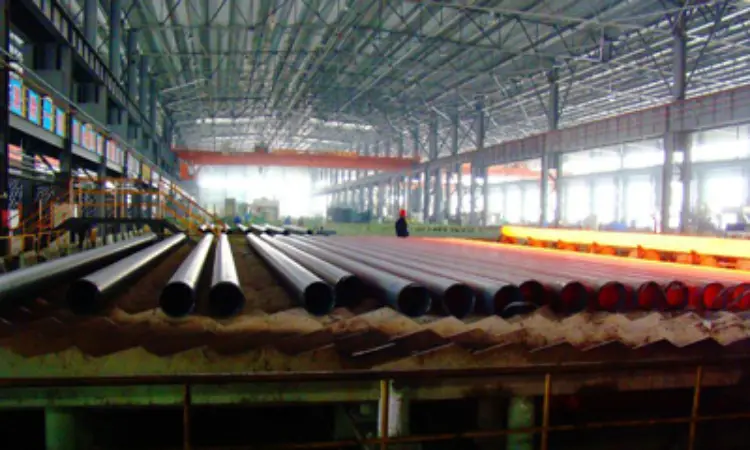
GB/T9711-2011 PSL1 L175 SSAW Pipe
GB/T 9711-2011 PSL1 L175 SSAW Steel Pipe for Pipeline Transportation Systems
Detailed material data for L175 grade spiral submerged arc welded (SSAW) pipe under GB/T 9711-2011 PSL1, including chemical composition, mechanical properties, and application guidance.
Hot-rolled steel strip/plate formed and welded (SSAW), heat treatment optional (normalized)
- Phone : +8618037372205
- Email : [email protected]
- WhatsApp: Contact via Whtsapp
- WeChat: +8618037372205
GB/T9711-2011 PSL1 L175 SSAW Pipe Introduction
GB/T 9711-2011 PSL1 L175 is a carbon steel grade for longitudinally or spirally welded line pipes used in pipeline transportation systems for the petroleum and natural gas industries. It is equivalent to ISO 3183:2007 PSL1 L175 and API 5L PSL1 Grade A25.
- Key characteristics: low strength, good weldability, suitable for low-pressure applications or non-critical services.
- Delivery condition: as-rolled or normalized (if required).
- Corrosion resistance: basic, without special alloying for sour service.
GB/T9711-2011 PSL1 L175 SSAW Pipe Chemical Composition
Chemical composition limits for PSL1 L175 steel according to GB/T 9711-2011, based on heat and product analysis. Maximum values are specified; carbon equivalent (CE) is not mandatory for PSL1 below L210 but may be reported.
| Element | Standard Value (max, %) | Remarks |
|---|---|---|
| Carbon (C) | 0.21 | Heat analysis; product analysis max 0.23% |
| Manganese (Mn) | 0.60 | Heat analysis; product analysis max 0.63% |
| Phosphorus (P) | 0.030 | Heat analysis; product analysis max 0.035% |
| Sulfur (S) | 0.030 | Heat analysis; product analysis max 0.035% |
| Silicon (Si) | 0.35 | Optional limit; shall be reported if required |
| Niobium (Nb) | 0.05 | Optional; sum of Nb + V + Ti ≤ 0.15% |
| Vanadium (V) | 0.04 | Optional; sum of Nb + V + Ti ≤ 0.15% |
| Titanium (Ti) | 0.04 | Optional; sum of Nb + V + Ti ≤ 0.15% |
GB/T9711-2011 PSL1 L175 SSAW Pipe Thermal and Electrical Physical Properties
GB/T 9711-2011 does not mandate thermal or electrical properties. The values below are typical for carbon steel (0.2% C) in as-rolled condition, applicable around room temperature. Actual properties may vary with manufacturing process.
| Property | Typical Value | Unit | Test condition |
|---|---|---|---|
| Density (ρ) | 7.85 | g/cm³ | 20 °C |
| Modulus of elasticity (E) | 210 | GPa | 20 °C |
| Shear modulus (G) | 81 | GPa | 20 °C |
| Poisson's ratio (ν) | 0.3 | — | 20 °C |
| Thermal expansion coefficient (α) | 12.2 | ×10⁻⁶/K | 20–200 °C |
| Thermal conductivity (λ) | 48 | W/(m·K) | 20 °C |
| Specific heat capacity | 486 | J/(kg·K) | 20 °C |
| Electrical resistivity (ρ_e) | 0.19 | Ω·mm²/m | 20 °C |
GB/T9711-2011 PSL1 L175 SSAW Pipe Mechanical Properties
Tensile properties for L175 PSL1 welded pipe according to GB/T 9711-2011. Requirements apply to transverse strip specimens taken from the pipe body at room temperature.
- Base metal tensile test, weld tensile strength not less than base metal specified minimum.
- Charpy impact test is not mandatory for PSL1 grades, but may be agreed.
- No bend test required for PSL1 unless specified.
| Property | Required Value | Unit | Test condition / Remarks |
|---|---|---|---|
| Yield strength (ReH / Rt0.5) | ≥ 175 | MPa | Tensile test, transverse strip; 0.5% total extension method Rt0.5 used for materials without yield plateau |
| Tensile strength (Rm) | ≥ 310 | MPa | Transverse strip; for pipe body |
| Elongation after fracture (A) | See formula | % | A = 1940 / Rm^0.2; for 5.65√S₀ gauge length. Minimum 17% for steel with Rm up to 310 MPa |
| Yield to tensile ratio | ≤ 0.93 | — | Optional requirement for certain services; not mandatory for L175 PSL1 |
| Weld tensile strength | ≥ 310 | MPa | Transverse weld specimen; base metal specified minimum applies |
GB/T9711-2011 PSL1 L175 SSAW Pipe Exactly Equivalent Material Standards and Substitute Grades
| Country/Region | Standard | Grade | Remarks |
|---|---|---|---|
| International | ISO 3183:2007 (PSL 1) | L175 | Identical technical content to GB/T 9711-2011 |
| United States | API 5L (PSL 1) | Grade A25 | Corresponding grade; slightly tighter C and Mn limits may apply |
GB/T9711-2011 PSL1 L175 SSAW Pipe Application Introduction
L175 SSAW pipe is used where low strength and good ductility are acceptable, primarily in low-pressure, non-sour, or non-critical fluid transportation. It is cost-effective due to simpler chemistry and less stringent testing.
Product Applications: Low-pressure onshore gas gathering systems, Water flooding and disposal pipelines, Structural pipe piles and columns, Fire water mains, Non-critical process piping within plants
Processed into products: Plain-end pipe segments for field welding, Beveled-end pipe for butt welding, Grooved-end pipe for mechanical couplings, Fittings (elbows, tees, reducers) matching wall thickness
Application industries: Oil & Gas (low-pressure gathering lines, water disposal lines), Water transmission (raw water, irrigation), Construction and structural (piling, casings), Mining (slurry pipelines)
GB/T9711-2011 PSL1 L175 SSAW Pipe Similar or Approximate Substitute Materials
| Country/Region | Standard | Grade | Remarks |
|---|---|---|---|
| China | GB/T 3091-2015 | Q195/Q215 | Lower carbon structural pipe; comparable strength; suitable for low-pressure water/gas conveyance, but not for line pipe certification |
| International | EN 10217-1 | P195TR1 | Similar yield strength (~195 MPa); electric welded tube; applications in pressure equipment |
| United States | ASTM A53/A53M | Type E Grade A | Similar strength level; for pressure and mechanical applications, but no line pipe PSL designation |
| International | ISO 3183:2007 (PSL 2) | L175 PSL2 | Higher requirements for toughness and NDT; possible substitute for more demanding service |
Notes:
L175 PSL1 does not require Charpy impact testing; the pipe is suitable for design temperatures down to -20°C only if impact testing is agreed upon. SSAW pipe may be ordered with a maximum permissible hardness (e.g., 22 HRC) for hydrogen-induced cracking resistance if specified. Coating options (3LPE, FBE) are separate from this material specification.
- Share



