
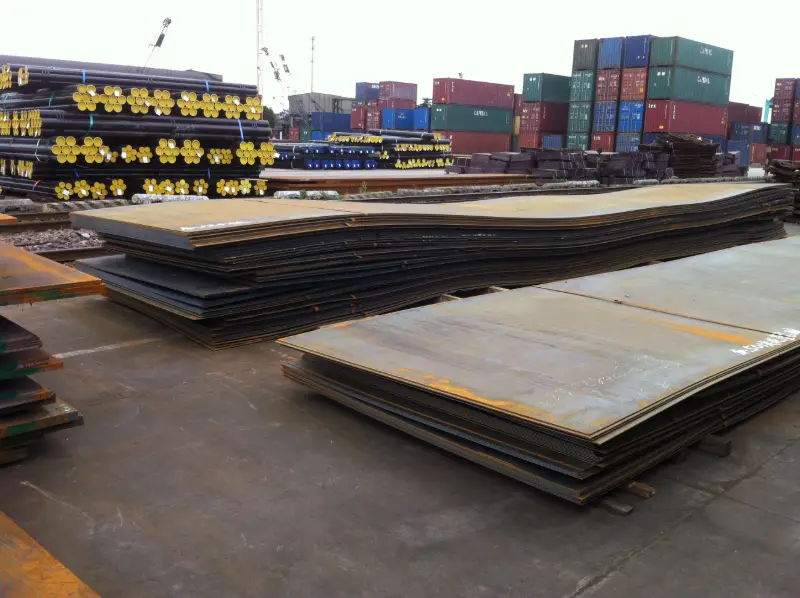
JIS G3101 SS330 Structural
JIS G3101 SS330 Carbon Structure Steel Plate – Composition, Properties, Equivalents
Explore JIS G3101 SS330 steel: chemical composition, mechanical and thermal properties, international equivalents, similar grades, and typical applications.
Cutting, bending, welding, bolting, hot/cold forming (no heat treatment required for base properties)
- Phone : +8618037372205
- Email : [email protected]
- WhatsApp: Contact via Whtsapp
- WeChat: +8618037372205
JIS G3101 SS330 Structural Introduction
JIS G3101 SS330 is a general structural hot-rolled carbon steel specified by the Japanese Industrial Standard JIS G3101. It belongs to the SS (Structural Steel) series and represents a basic grade for structural applications. The steel is characterized by its moderate tensile strength range (330–430 MPa) and guaranteed minimum yield strength that varies with plate thickness (typically ≥205 MPa for thickness ≤16 mm). SS330 is not designed for heat treatment and is usually supplied in the as-rolled condition. Due to its balanced combination of strength, ductility, and weldability, it is widely used in building frames, bridges, vehicles, ships, and general engineering structures. The chemical composition primarily limits phosphorus and sulfur to ensure good weldability and toughness, while carbon, manganese, and silicon levels are not specified by the standard and are controlled at the manufacturer's discretion to meet mechanical requirements.
JIS G3101 SS330 Structural Chemical Composition
According to JIS G3101, the standard only imposes maximum limits for phosphorus and sulfur. Other elements such as carbon, silicon, and manganese are not specified but are adjusted by the manufacturer to achieve the required mechanical properties. The absence of specified limits for these elements allows flexibility while maintaining weldability and ductility.
- Carbon (C) is typically ≤0.20% for SS330 grade.
- Manganese (Mn) is commonly around 0.50–1.40%.
- Silicon (Si) is generally ≤0.40%.
These typical values are not mandatory and may vary.
| Element | Specified Value (max, %) | Remarks |
|---|---|---|
| Phosphorus (P) | 0.050 | Maximum limit per standard |
| Sulfur (S) | 0.050 | Maximum limit per standard |
| Carbon (C) | Not specified | Typically ≤0.20% by manufacturers |
| Silicon (Si) | Not specified | Typically ≤0.40% |
| Manganese (Mn) | Not specified | Typically 0.50–1.40% |
JIS G3101 SS330 Structural Thermal and Electrical Physical Properties
These values are typical for plain carbon steel and are not part of JIS G3101. They are provided for design guidance. The properties are valid at room temperature unless otherwise noted. Density is ∼7.85 g/cm³. Elastic modulus ∼200 GPa. Thermal expansion around 12 µm/m·°C. Thermal conductivity ∼50 W/(m·K). Electrical resistivity 0.15–0.20 μΩ·m at 20°C. These values may vary slightly with exact composition and temperature.
| Property | Typical Value | Unit | Test Condition / Temperature |
|---|---|---|---|
| Density (ρ) | 7.85 | g/cm³ | 20°C |
| Elastic modulus (E) | 200 – 210 | GPa | Room temperature |
| Shear modulus (G) | 80 | GPa | Approximate, room temperature |
| Poisson's ratio (ν) | 0.30 | - | Linear elastic range |
| Thermal expansion coefficient (α) | 11.7 – 12.5 | µm/(m·°C) | 20 – 100°C |
| Thermal expansion coefficient (α) | 12.5 – 13.5 | µm/(m·°C) | 20 – 200°C |
| Thermal conductivity (λ) | 50 – 52 | W/(m·K) | 20°C |
| Specific heat capacity (cp) | 0.46 – 0.49 | kJ/(kg·K) | 50 – 100°C |
| Electrical resistivity (ρ_e) | 0.15 – 0.20 | μΩ·m | 20°C |
JIS G3101 SS330 Structural Mechanical Properties
Mechanical properties of SS330 are governed by JIS G3101 and depend on the product thickness. Tensile strength must fall within 330–430 MPa. Yield point/reh varies with thickness, and elongation is measured on different test pieces according to thickness ranges. A 180° bend test with specified mandrel diameters confirms formability. No impact test is required for this grade.
| Property | Specified Value | Unit | Test Condition / Remarks |
|---|---|---|---|
| Yield point or yield strength (ReH) | ≥205 | MPa | Plate thickness t ≤ 16 mm |
| Yield point or yield strength (ReH) | ≥195 | MPa | 16 mm < t ≤ 40 mm |
| Yield point or yield strength (ReH) | ≥175 | MPa | t > 40 mm |
| Tensile strength (Rm) | 330 – 430 | MPa | All thicknesses |
| Elongation (A) | ≥26 | % | t ≤ 5 mm, test piece No.1A |
| Elongation (A) | ≥21 | % | 5 mm < t ≤ 16 mm, test piece No.1A |
| Elongation (A) | ≥26 | % | 16 mm < t ≤ 50 mm, test piece No.2 |
| Elongation (A) | ≥28 | % | t > 40 mm, test piece No.3 |
| Bend test (180° bend) | d = 1.5a | - | t ≤ 16 mm, mandrel diameter (a = specimen thickness) |
| Bend test (180° bend) | d = 2.0a | - | t > 16 mm, mandrel diameter |
JIS G3101 SS330 Structural Fully Equivalent Standards and Replaceable Grades
| Country / Region | Standard | Grade | Remarks |
|---|---|---|---|
| Japan | JIS G3101 | SS330 | Original specification, identical material. |
| International | ISO 630-2 | E235C | Very close chemistry and mechanical properties; often considered technically equivalent. |
JIS G3101 SS330 Structural Application Introduction
JIS G3101 SS330 is a general-purpose structural steel suitable for a wide range of load-bearing applications. It is easily weldable, formable, and machinable. Typical industries include construction, transportation, machinery manufacturing, and shipbuilding. The material is commonly used for components that require moderate strength and good ductility. It is not intended for pressure vessel or low-temperature applications requiring impact toughness certification.
Product Applications: Building frameworks (beams, columns), Bridge girders and floor plates, Truck frames and trailer chassis, Ship hull plates and stiffeners, Supports, brackets, and scaffolding, Machine bases and frames
Processed into products: Welded structural sections (I-beams, channels, angles), Bolted connections and gusset plates, Flanges and stiffeners, Mounting plates and bearing pads, General welded fabrications
Application industries: Construction and civil engineering, Bridge building, Railway vehicle manufacturing, Shipbuilding, General machinery and equipment, Storage tanks and silos
JIS G3101 SS330 Structural Similar / Alternative Material Recommendations
| Country / Region | Standard | Grade | Remarks |
|---|---|---|---|
| USA | ASTM A36/A36M | A36 | Similar tensile range (400-550 MPa) but SS330 has lower strength; often interchangeable for general structures with thickness considerations. |
| EU | EN 10025-2 | S235JR | Yield strength ≥235 MPa at ≤16mm, comparable to SS330; widely used substitute. |
| China | GB/T 700 | Q235B | Very similar carbon structural steel, equivalent mechanical properties. |
| India | IS 2062 | E250A / Fe410WA | E250 offers minimum yield 250 MPa, slightly higher than SS330 but suitable substitution. |
Notes:
- SS330 is only guaranteed for the specified tensile and yield properties; any additional requirements (e.g., impact toughness, through-thickness properties) must be agreed upon at the time of ordering.
- Welding procedures should consider the typical carbon equivalent of SS330 (usually around 0.26–0.30%) to avoid cold cracking; preheating is generally not necessary for thin sections.
- When substituting with ASTM A36 or S235JR, check the exact yield and tensile requirements for the application, as A36 has a higher tensile range.
- No mandatory heat treatment applies; SS330 can be used in the as-rolled condition.
- Share



