
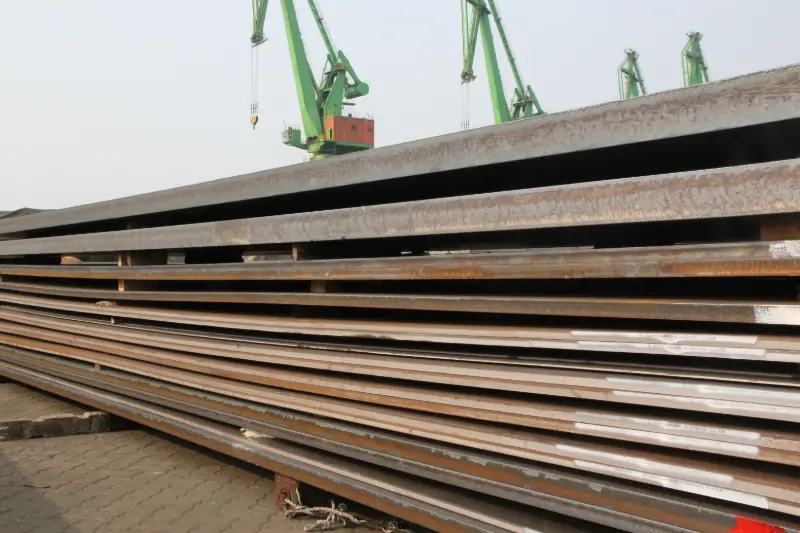
JIS G3101 SS400 Carbon Steel Plate
JIS G3101 SS400 Carbon Steel Plate - Properties, Equivalents & Application Guide
Comprehensive technical data for SS400 carbon steel plate under JIS G3101, including chemical composition, mechanical and physical properties, international equivalents, and application guidance.
Welding, forming, machining, cutting, bending, drilling
- Phone : +8618037372205
- Email : [email protected]
- WhatsApp: Contact via Whtsapp
- WeChat: +8618037372205
JIS G3101 SS400 Carbon Steel Plate Introduction
SS400 is a general structural carbon steel defined by Japanese Industrial Standard JIS G3101. It is widely used for welded structures, bridges, buildings, and general engineering purposes. SS400 offers a balanced combination of strength and weldability, with a minimum yield strength of 245 MPa for thicknesses up to 16 mm and tensile strength between 400–510 MPa. The material does not have strict chemical composition limits for carbon and manganese, relying instead on performance requirements, which makes it versatile and easy to source. It is typically supplied in the as-rolled condition and can be formed, welded, and machined with standard methods.
JIS G3101 SS400 Carbon Steel Plate Chemical Composition
The chemical composition of SS400 is regulated only for phosphorus and sulfur; carbon, silicon, and manganese contents are not specified in the standard but are adjusted by the manufacturer to meet the required mechanical properties. Typical mass fractions are provided as reference.
| Element | Standard Requirement | Remarks |
|---|---|---|
| C (Carbon) | – | Not specified; typical ≤0.25% |
| Si (Silicon) | – | Not specified; typical ≤0.55% |
| Mn (Manganese) | – | Not specified; typical ≤1.60% |
| P (Phosphorus) | ≤0.050% | Mandatory requirement |
| S (Sulfur) | ≤0.050% | Mandatory requirement |
JIS G3101 SS400 Carbon Steel Plate Thermal and Electrical Physical Properties
Physical properties are not mandated by JIS G3101 but are typical for low-carbon structural steels. Values are highly dependent on temperature and measurement conditions and should be used as general guidelines only.
| Property | Typical Value | Unit | Testing Condition |
|---|---|---|---|
| Density (ρ) | 7.85 | g/cm³ | Room temperature |
| Modulus of Elasticity (E) | ≈205 | GPa | Room temperature |
| Shear Modulus (G) | ≈79 | GPa | Room temperature |
| Poisson's Ratio (ν) | ≈0.3 | – | Room temperature |
| Thermal Expansion Coefficient (α) | 11.7 × 10⁻⁶ | /K | 20°C – 100°C |
| Thermal Conductivity (λ) | 51.9 | W/(m·K) | 100°C |
| Specific Heat Capacity | 486 | J/(kg·K) | 20°C |
| Electrical Resistivity (ρₑ) | 0.15 | μΩ·m | 20°C |
JIS G3101 SS400 Carbon Steel Plate Mechanical Properties
Mechanical properties are dependent on plate thickness. The data below apply to flat products in the as-rolled condition. Elongation values vary with specimen type and thickness. Bend test is performed at 180° without cracking. Impact test is not required unless specially agreed.
| Property | Standard Requirement | Unit | Testing Condition |
|---|---|---|---|
| Yield Strength (ReH) | ≥245 | N/mm² | t ≤ 16 mm |
| Yield Strength (ReH) | ≥235 | N/mm² | 16 mm < t ≤ 40 mm |
| Yield Strength (ReH) | ≥215 | N/mm² | 40 mm < t ≤ 100 mm |
| Tensile Strength (Rm) | 400 – 510 | N/mm² | All thicknesses |
| Elongation (A) | ≥21 | % | t ≤ 5 mm, JIS No.5 specimen |
| Elongation (A) | ≥17 | % | 5 mm < t ≤ 16 mm, JIS No.1A specimen |
| Elongation (A) | ≥21 | % | 16 mm < t ≤ 50 mm, JIS No.1A specimen, longitudinal |
| Elongation (A) | ≥24 | % | 50 mm < t ≤ 100 mm, JIS No.1A specimen, longitudinal |
| Bend Test (Mandrel Diameter) | 1.5 × t, 180° | – | t ≤ 16 mm |
| Bend Test (Mandrel Diameter) | 2.0 × t, 180° | – | 16 mm < t ≤ 100 mm |
JIS G3101 SS400 Carbon Steel Plate Identical/Equivalent Material Standards and Replaceable Grades
| Country/Region | Standard | Grade | Remarks |
|---|---|---|---|
| China | GB/T 700 | Q235B | Close match in chemical and mechanical requirements; widely used domestic equivalent |
| USA | ASTM A36/A36M | A36 | Identical strength range; slightly different chemical limits |
| European Union | EN 10025-2 | S235JR | Comparable yield and tensile properties; detailed chemistry control |
| International | ISO 630-2 | Fe360B | Aligned with SS400 performance grade |
JIS G3101 SS400 Carbon Steel Plate Application Introduction
SS400 is a versatile structural steel widely utilized across industries due to its good weldability, machinability, and reliable mechanical properties. Typical products include plates, sheets, bars, and structural sections. It is suitable for both static and dynamically loaded structures provided the design temperature is not extremely low. Recommended processing involves conventional welding, thermal cutting, bending, and machining.
Product Applications: Steel plates and sheets for building frames, platforms, and flooring, H-beams, I-beams, channels, angles, and other structural sections, Bars and rods for reinforcement and mechanical parts, Welded pipes and tubes for structural and low-pressure applications, Prefabricated steel buildings and warehouses, Bridge girders, support columns, and truss elements
Processed into products: Load-bearing beams and columns, Base plates and mounting brackets, Ship hull stiffeners and bulkheads, Vehicle chassis and frames, Machine bases and supports, Flanges and gusset plates, Lifting lugs and pad eyes, Handrails, walkways, and ladders
Application industries: Construction and civil engineering, Bridge building, Shipbuilding and marine engineering, Railway vehicle manufacturing, Storage tank and pressure vessel fabrication, General machinery and equipment manufacturing
JIS G3101 SS400 Carbon Steel Plate Similar/Comparable Material Recommendations
| Country/Region | Standard | Grade | Remarks |
|---|---|---|---|
| Japan | JIS G3101 | SS330 | Lower strength grade within same standard; use for less demanding applications |
| China | GB/T 700 | Q235A | Lower guarantee on impact properties; similar strength but less strict quality |
| USA | ASTM A283/A283M | Grade C | Structural carbon steel with comparable tensile strength |
| European Union | EN 10025-2 | S235J0 | Same strength class with guaranteed impact energy at 0°C |
Notes:
Thickness tolerance and surface quality shall be in accordance with JIS G3193 for plates. SS400 may be supplied with optional supplementary requirements such as impact testing (e.g., Charpy V-notch values) when agreed at the time of order. The material is not recommended for heavily loaded low-temperature service without proper testing. For structural applications outside Japan, verify acceptance under local building codes when substituting with equivalent grades.
- Share



