
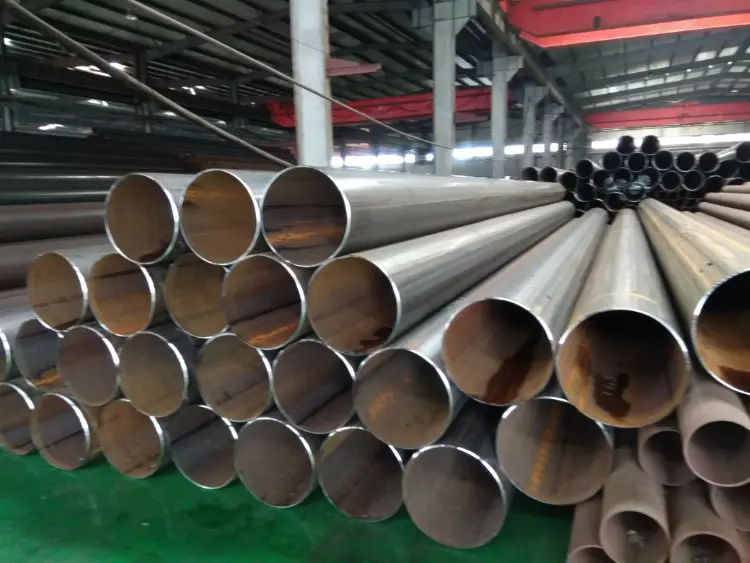
GB/T 9711 PSL2 L555 ERW Pipeline Steel Pipe
GB/T 9711 PSL2 L555 ERW Pipeline Steel Pipe - Comprehensive Material Data
Explore complete specifications for L555 (X80) grade ERW steel pipe according to GB/T 9711-2011 PSL2: chemical composition, mechanical properties, thermal and electrical data, equivalent standards, and typical applications in oil and gas transmission.
Electric resistance welding (ERW), with possible expansion and heat treatment
- Phone : +8618037372205
- Email : [email protected]
- WhatsApp: Contact via Whtsapp
- WeChat: +8618037372205
GB/T 9711 PSL2 L555 ERW Pipeline Steel Pipe Introduction
GB/T 9711-2011 PSL2 L555 is a high-strength microalloyed steel for welded line pipes, widely used in oil and gas transportation systems. This grade, equivalent to API 5L X80, features a minimum yield strength of 555 MPa and excellent toughness, weldability, and resistance to hydrogen-induced cracking (HIC). The specification covers electric resistance welded (ERW) pipes manufactured from hot-rolled coils, with strict requirements on chemical composition, tensile properties, impact toughness, and dimensional tolerances under Product Specification Level 2 (PSL2). The steel utilizes controlled rolling and accelerated cooling to achieve a fine ferrite-bainite microstructure, providing a balanced combination of strength and ductility. It is suitable for high-pressure pipelines, sour service if additional tests are specified, and cold climates due to its low-temperature toughness. Typical delivery condition is as-welded or with stress-relief heat treatment, and pipe ends may be further prepared for field welding.
GB/T 9711 PSL2 L555 ERW Pipeline Steel Pipe Chemical Composition
The chemical composition for L555 PSL2 steel is tightly controlled to ensure strength, toughness, and weldability. Carbon equivalent values (CE_IIW or CE_Pcm) are also limited to guarantee field welding performance. Microalloying elements such as Nb, V, and Ti are added singly or in combination for grain refinement and precipitation strengthening. A maximum sulfur content of 0.015% and phosphorus ≤0.025% are required for optimal cleanliness and HIC resistance.
| Element | Maximum Value (wt%) | Remarks |
|---|---|---|
| C | 0.22 | Maximum; typical 0.06–0.12 for good weldability |
| Si | 0.45 | Maximum |
| Mn | 1.85 | Maximum; typical 1.5–1.8 for strength |
| P | 0.025 | Maximum |
| S | 0.015 | Maximum; lower for sour service |
| V+Nb+Ti | 0.15 | Sum of microalloying elements |
| Cu | 0.50 | Maximum (optional) |
| Ni | 0.50 | Maximum (optional) |
| Cr | 0.50 | Maximum (optional) |
| Mo | 0.50 | Maximum (optional) |
| Al (total) | 0.015–0.060 | Usually for grain refinement |
| N | 0.012 | Maximum |
| CE_IIW | 0.43 | Typical limit for PSL2 |
| CE_Pcm | 0.25 | Typical limit for X80 |
GB/T 9711 PSL2 L555 ERW Pipeline Steel Pipe Thermal and Electrical Physical Properties
These physical properties are typical for high-strength low-alloy pipeline steels such as L555/X80. They are provided for design calculations and may vary slightly depending on exact chemical composition and processing route. Thermal expansion, conductivity, and heat capacity are important for pipeline installation and operation at varying temperatures.
| Property | Reference Value | Unit | Condition |
|---|---|---|---|
| Density (ρ) | 7.85 | g/cm³ | Room temperature |
| Elastic Modulus (E) | 200–210 | GPa | Room temperature |
| Shear Modulus (G) | 80 | GPa | Calculated from E and ν |
| Poisson's Ratio (ν) | 0.30 | - | Elastic range |
| Thermal Expansion Coefficient (α) | 12.5 × 10⁻⁶ | 1/°C | 20–100 °C range |
| Thermal Conductivity (λ) | 45–50 | W/(m·K) | At 20 °C |
| Specific Heat Capacity (cp) | 475 | J/(kg·K) | At 20 °C |
| Electrical Resistivity (ρ_e) | 0.20–0.25 | µΩ·m | At 20 °C |
GB/T 9711 PSL2 L555 ERW Pipeline Steel Pipe Mechanical Properties
Mechanical tests are performed on transverse specimens from the pipe body and weld joint as per GB/T 9711-2011 PSL2. Tensile properties (yield strength, tensile strength, elongation) and yield-to-tensile ratio are mandatory. Impact toughness is measured using Charpy V-notch specimens at a temperature agreed between purchaser and manufacturer, commonly 0 °C or -20 °C. Bend test and hardness measurements ensure ductility and weld integrity. All values conform to PSL2 requirements, which are stricter than PSL1.
| Property | Requirement | Unit | Test Condition |
|---|---|---|---|
| Yield Strength (Rt0.5) | 555–757 | MPa | Transverse, 0.5% total extension |
| Tensile Strength (Rm) | 625–825 | MPa | Transverse |
| Yield/Tensile Ratio (Rt0.5/Rm) | ≤0.93 | - | Mandatory for PSL2 |
| Elongation (A) | ≥22 | % | 50 mm gauge length, strip test piece, S0=original area |
| Charpy Impact Energy (KV2) | ≥27 (typical) | J | At 0 °C (or as specified); full-size specimen, transverse |
| Shear Area (impact) | ≥85 | % | At specified temperature |
| Hardness (HV10) | ≤250 | HV10 | On base metal and weld zone |
| Bend Test | No cracks | - | 180° bend around mandrel diameter = 6x wall thickness (typical) |
GB/T 9711 PSL2 L555 ERW Pipeline Steel Pipe Completely Equivalent Materials – Standards and Grades
| Country/Region | Standard | Grade | Remarks |
|---|---|---|---|
| International | ISO 3183:2012 | L555X (PSL2) | Seamless and welded pipe for pipeline transportation systems |
| USA | API 5L (46th Edition) | X80 | PSL2; used globally |
| Europe | EN 10208-2:2009 | L555MB | Steel pipes for combustible fluids – delivery condition |
| Russia/CIS | GOST R 52079 | К65 | Close to X80, verification needed |
| Brazil | N-2685 | X80 | Petrobras standard equivalent |
GB/T 9711 PSL2 L555 ERW Pipeline Steel Pipe Application Introduction
L555 ERW pipes are primarily used in onshore and offshore pipeline systems for transporting crude oil, natural gas, and petroleum products over long distances under high pressure. They are also employed in water injection lines, gathering systems, and some structural applications. The ERW process results in a narrow heat-affected zone and uniform wall thickness, making it suitable for moderate wall thicknesses up to about 25 mm. Typical components include line pipe segments, induction bends, tees, reducers, and flanges, often with external and internal anti-corrosion coatings.
Product Applications: Long-distance transmission pipelines, Gathering lines, Flowlines, Riser pipes, Casings for deep wells
Processed into products: Pipe joints (12 m typical), Hot induction bends, Tee fittings, Reducers, Flanges (WN, SW), Pup pieces, Repair sleeves
Application industries: Oil & gas transportation, Petrochemical, Water treatment and injection, Offshore engineering, Piping for power plants
GB/T 9711 PSL2 L555 ERW Pipeline Steel Pipe Similar or Nearby Alternative Materials
| Country/Region | Standard | Grade | Remarks |
|---|---|---|---|
| International | ISO 3183 | L485M (X70) | Lower strength class, often used where X80 is not required |
| USA | API 5L | X90 | Higher strength grade, may be considered for thinner wall design |
| China | GB/T 9711 | L625 (X90) | Typically quenched-and-tempered, for ultrahigh pressure |
| Europe | EN 10208-2 | L555MB | Same strength, slightly different composition limits |
Notes:
For sour service applications, additional testing such as HIC (TM0284) and SSC (NACE TM0177) is required and must be agreed upon at the time of order. The ERW weld shall be heat treated (post-weld normalizing) to ensure hardness and toughness in the heat-affected zone. Supplementary requirements (SR) from GB/T 9711-2011 may apply for specific projects. All values provided are based on GB/T 9711-2011 PSL2 for L555 grade; actual values may vary depending on manufacturer's internal specifications and pipe dimensions.
- Share



