
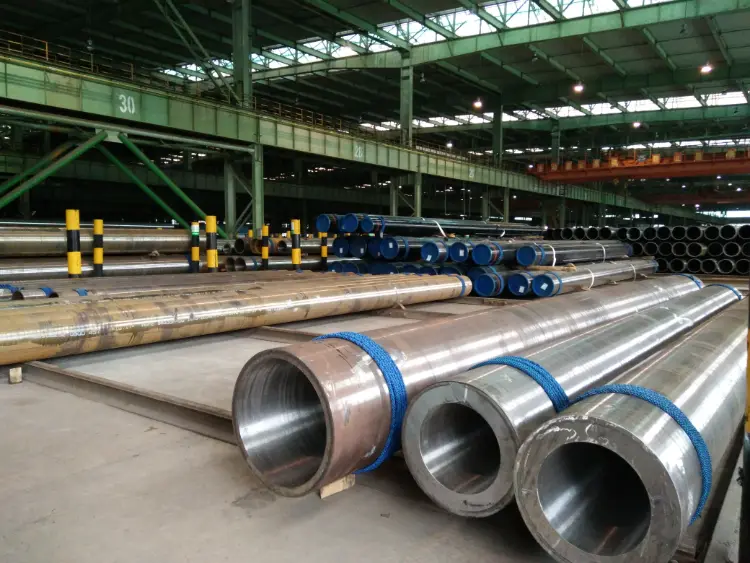
GB/T 9711-2011 PSL2 L485 ERW Pipeline Steel Pipe
In-Depth Material Data for GB/T 9711-2011 PSL2 L485 ERW Pipeline Steel Pipe
Complete technical specifications, chemical composition, mechanical properties, and international equivalents for L485 grade ERW steel pipe according to GB/T 9711-2011 PSL2.
Electric resistance welding (ERW), hot-rolled strip forming, cold expansion, post-weld heat treatment as required
- Phone : +8618037372205
- Email : [email protected]
- WhatsApp: Contact via Whtsapp
- WeChat: +8618037372205
GB/T 9711-2011 PSL2 L485 ERW Pipeline Steel Pipe Introduction
L485 is a high-strength low-alloy steel grade for longitudinally welded pipes in the oil and gas transmission industry. It is defined in GB/T 9711-2011 PSL2 and corresponds to API 5L X70. The material is characterized by excellent weldability, high yield strength (≥485 MPa), superior toughness, and good resistance to sour environments. Produced by electric resistance welding (ERW) from hot-rolled coils, it meets stringent requirements for uniform mechanical properties and strict dimensional tolerances. PSL2 specification imposes additional controls on chemical composition, notch toughness, and non-destructive testing, ensuring reliable service under high pressure and low-temperature conditions.
GB/T 9711-2011 PSL2 L485 ERW Pipeline Steel Pipe Chemical Composition
Limits as per GB/T 9711-2011, Table 4, for PSL2 L485 steel. Mill shall ensure fine grain practice and may use micro-alloying elements (Nb, V, Ti) singly or in combination. Carbon equivalent (Pcm) is controlled for weldability: Pcm ≤ 0.22% (for wall thickness ≤25 mm). These values ensure a balanced ferrite-pearlite microstructure for high strength and toughness.
| Chemical Element | Standard Value (wt%) | Remarks |
|---|---|---|
| C (Carbon) | ≤ 0.12 | Lower carbon improves weldability and toughness |
| Si (Silicon) | ≤ 0.45 | Deoxidizer; controlled to avoid detrimental inclusions |
| Mn (Manganese) | ≤ 1.60 | Contributes to strength and hardenability |
| P (Phosphorus) | ≤ 0.025 | Strict limit to prevent cold brittleness |
| S (Sulphur) | ≤ 0.015 | Extremely low for excellent HIC/SSC resistance |
| V (Vanadium) | ≤ 0.06 | Micro-alloy; total V+Nb+Ti ≤ 0.15% |
| Nb (Niobium) | ≤ 0.06 | Grain refiner and precipitation hardener |
| Ti (Titanium) | ≤ 0.06 | Grain refinement and nitrogen fixation |
| Cu (Copper) | ≤ 0.50 | Residual element; can improve corrosion resistance |
| Ni (Nickel) | ≤ 0.50 | Residual element |
| Cr (Chromium) | ≤ 0.50 | Residual element; not added intentionally |
| Mo (Molybdenum) | ≤ 0.50 | Residual element |
| N (Nitrogen) | ≤ 0.012 | Maximum unless stabilised by Al or Ti |
| Pcm (Carbon equivalent) | ≤ 0.22 | Applicable for wall thickness ≤ 25 mm; Pcm = C + Si/30 + (Mn+Cu+Cr)/20 + Ni/60 + Mo/15 + V/10 + 5B |
GB/T 9711-2011 PSL2 L485 ERW Pipeline Steel Pipe Physical & Electrical Properties
The following typical values are based on generic properties of low-alloy pipeline steels (0.06-0.12% C, micro-alloyed), as specific limits are not mandated in GB/T 9711-2011. These data are widely accepted for design calculations and vary slightly with microstructure and temperature. Density and modulus are essential for weight and stress analysis.
| Property | Typical Value | Unit | Test Condition |
|---|---|---|---|
| Density (ρ) | 7.85 | g/cm³ | Room temperature |
| Elastic Modulus (E) | 205 | GPa | Room temperature; dynamic or static |
| Shear Modulus (G) | 79 | GPa | Calculated from E and ν |
| Poisson's Ratio (ν) | 0.29 - 0.30 | – | In the elastic range |
| Thermal Expansion Coefficient (α) | 12.0 × 10⁻⁶ | K⁻¹ | Average 20–100°C |
| Thermal Conductivity (λ) | 45 | W/(m·K) | At 20°C; decreases with rising temperature |
| Specific Heat Capacity | 485 | J/(kg·K) | At 20–100°C |
| Electrical Resistivity (ρₑ) | 0.23 | µΩ·m | Room temperature |
GB/T 9711-2011 PSL2 L485 ERW Pipeline Steel Pipe Mechanical Properties
Values apply to the pipe body, transverse direction, at room temperature unless otherwise stated. Charpy tests are mandatory per PSL2; temperature and acceptance criteria to be agreed, but typical minimum limits are shown. DWT tests are also required for certain wall thicknesses. Weld seam shall meet the same tensile and impact requirements as the pipe body.
| Property | Standard Requirement | Unit | Test Condition |
|---|---|---|---|
| Yield Strength (ReH) | 485 - 635 | MPa | ISO 6892-1, transverse strip sample |
| Tensile Strength (Rm) | 570 - 760 | MPa | ISO 6892-1, transverse strip sample |
| Yield/Tensile Ratio | ≤ 0.93 | – | Maximum allowed ratio to ensure strain capacity |
| Elongation after fracture (A) | Determined by formula: A = 1940 × A_x^{0.2} / Rm^{0.9} (typical minimum 18% for thin wall) | % | Gauge length 50 mm; formula per standard Annex |
| Charpy Impact Energy (KV₂) | ≥ 27 (min. avg. full-size); ≥ 40 J at -20°C typical agreement | J | Transverse, temperature per specification; full-size 10×10 mm |
| Bend Test (bend diameter) | No cracks after 180° bending | – | Mandrel diameter according to standard table; weld and HAZ tested |
| Shear Area (DWTT) | ≥ 85% (minimum avg.) | % | At specified design temperature; full-thickness specimens |
GB/T 9711-2011 PSL2 L485 ERW Pipeline Steel Pipe Full-Equivalent Material Standards & Substitutable Grades
| Country/Region | Standard | Grade | Remarks |
|---|---|---|---|
| China | GB/T 9711-2011 PSL2 | L485 | Original specification; ERW pipe |
| USA / International | API 5L, 46th Ed., PSL2 | X70 | Technically identical; also available as ERW or SAW |
| International | ISO 3183:2012 (PSL 2) | L485 | Same designation; based on API 5L |
| Europe | EN 10208-2:2009 | L485MB | M for thermomechanically rolled; also L485ME for normalized |
| Russia/CIS | GOST R 52079-2003 (or TU) | К60 (K60) | Strength class close to X70, often used for pipelines |
GB/T 9711-2011 PSL2 L485 ERW Pipeline Steel Pipe Application Introduction
L485 (X70) ERW pipe is the backbone of modern high-pressure transmission pipelines. Its balance of strength, toughness, and weldability enables cost-effective construction and long service life.
- Oil & Gas sector – used for onshore and offshore trunklines, gathering lines, and produced water injection lines.
- Petrochemical industry – transfer lines for hydrocarbon products.
- Structural engineering – pile pipes, jacket legs, and structural supports where high strength-to-weight ratio is needed.
- Water transmission – large-diameter water mains in demanding terrain.
Product Applications: Long-distance crude oil and natural gas trunklines, High-pressure gas distribution networks, Subsea flowlines and export pipelines, Station piping (compressor, pump stations), Piling pipes for marine terminals and bridges
Processed into products: Straight ERW pipe segments (standard lengths), Induction bends (hot formed from L485 pipe), Tees, reducers, and caps (forged or fabricated from L485 plate), Flanges and connectors (welded to pipe ends), Weld neck and slip-on flanges for pipeline valves and fittings
Application industries: Onshore oil and gas pipeline transportation, Offshore pipeline and riser systems, Petrochemical and refinery piping, Water and slurry transmission, Civil and structural engineering
GB/T 9711-2011 PSL2 L485 ERW Pipeline Steel Pipe Similar / Neighbouring Grade Alternatives
| Country/Region | Standard | Grade | Remarks |
|---|---|---|---|
| China | GB/T 9711-2011 PSL2 | L450 (X65) | Lower strength (450 MPa min yield); for less demanding pressure design |
| China | GB/T 9711-2011 PSL2 | L555 (X80) | Higher strength (555 MPa min yield); increased hardenability, may require stricter welding controls |
| USA | API 5L PSL2 | X65 | Equivalent to L450; interchangeable in many pipeline projects |
| USA | API 5L PSL2 | X80 | Equivalent to L555; used for very high pressure transmission |
| Europe | EN 10208-2 | L450MB | Parallel lower grade with similar weldability and toughness |
| Europe | EN 10208-2 | L555MB | Higher grade; requires careful assessment of weldability and drop weight tear performance |
Notes:
PSL2 L485 ERW pipe requires mandatory post-weld heat treatment of the weld seam (normalizing) unless proven equivalent toughness is achieved. Non-destructive testing (NDT) is mandatory for the entire weld: 100% ultrasonic or electromagnetic inspection. Hydrostatic test is compulsory for each pipe, typically holding pressure corresponding to 95% of SMYS. Mill certificates shall include chemical analysis, mechanical test results per batch, and NDT records. When specified for sour service (H₂S environments), supplementary requirements for HIC/SSC testing (NACE TM0284/TM0177) should be included in the purchase order.
- Share



