
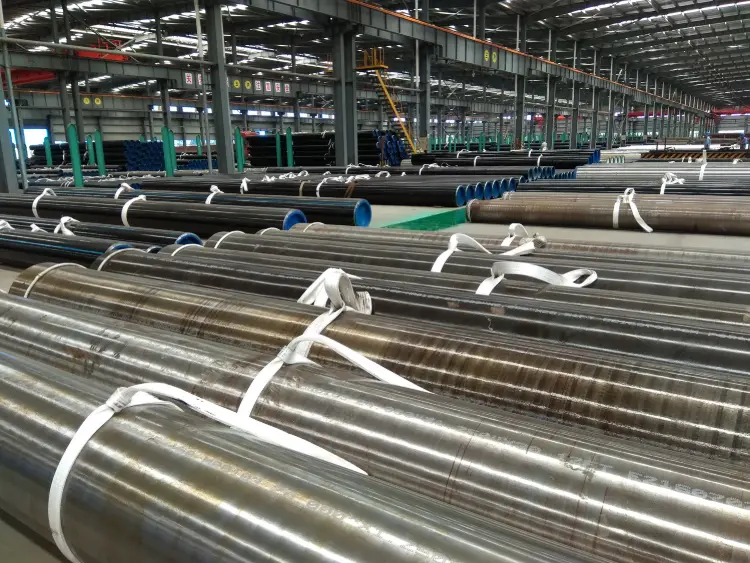
GB/T 9711-2011 PSL2 L450 ERW Steel Pipe
GB/T 9711-2011 PSL2 L450 ERW Pipe: High-Strength Pipeline Steel for Oil & Gas
Comprehensive data sheet for L450 PSL2 ERW pipe as per GB/T 9711-2011, including chemical composition, mechanical and physical properties, equivalent grades, and applications in oil and gas transportation.
Electric resistance welding (ERW), with options for cold expansion and heat treatment of weld seam; suitable for bending, cutting, and welding
- Phone : +8618037372205
- Email : [email protected]
- WhatsApp: Contact via Whtsapp
- WeChat: +8618037372205
GB/T 9711-2011 PSL2 L450 ERW Steel Pipe Introduction
L450 PSL2 ERW pipe is a high-strength welded steel pipe designed for onshore and offshore pipeline systems in accordance with GB/T 9711-2011 (equivalent to ISO 3183:2007 and API 5L). The material belongs to the L450 (X65) grade with PSL2 requirements, ensuring stricter chemical composition limits, higher notch toughness, and mandatory non-destructive testing compared to PSL1. Manufactured by the electric resistance welding (ERW) process, the pipe offers excellent formability, weldability, and consistent mechanical properties. Key characteristics include:
- Minimum yield strength of 450 MPa with high tensile strength
- Good low-temperature impact toughness for safe service in harsh environments
- Controlled carbon equivalent (CE) for superior field weldability
- Compliance with sour service and offshore requirements when specified
This grade is widely used for transporting crude oil, natural gas, and refined products over long distances.
GB/T 9711-2011 PSL2 L450 ERW Steel Pipe Chemical Composition
Chemical composition limits for GB/T 9711-2011 PSL2 L450 pipe (product analysis). Maximum values unless otherwise stated. The steel is microalloyed with Nb, V, and/or Ti to achieve fine grain size and high strength.
- Carbon equivalent CEPcm and CEIIW limits apply for PSL2 to ensure good weldability.
- For sour service, additional restrictions on S and hardness may be required.
| Element | Specified Value (max %) | Remarks |
|---|---|---|
| C | 0.22 (0.12 for seamless pipe) | PSL2: lower C improves toughness and weldability |
| Si | 0.45 | For deoxidation and strength |
| Mn | 1.65 | Higher Mn content allowed for strength with controlled CE |
| P | 0.025 | Low phosphorus for improved ductility |
| S | 0.015 | Low sulfur for enhanced formability and toughness |
| Nb | 0.05 | Microalloying for grain refinement |
| V | 0.10 | Optional microalloying element |
| Ti | 0.04 | Optional for grain size control |
| Altotal | 0.020 - 0.040 (if added) | Total aluminum for deoxidation |
| N | 0.012 | Max unless sufficient Al/Ti to fix N |
| CEPcm | 0.19 (for pipe wall ≤25 mm) | Typical limit for PSL2 pipe; formula: C+Si/30+(Mn+Cu+Cr)/20+Ni/60+Mo/15+V/10+5B |
| CEIIW | 0.43 (typical) | IIW carbon equivalent for weldability control |
GB/T 9711-2011 PSL2 L450 ERW Steel Pipe Thermal and Electrical Physical Properties
Typical physical properties for low-alloy pipeline steel grade L450 (X65) at room temperature unless stated otherwise. These values are not specified in GB/T 9711-2011 but are representative for design calculations.
- Density is taken as 7.85 g/cm³ for carbon-manganese steels.
- Thermal expansion and conductivity values vary with temperature; values provided for 20°C to 300°C range.
| Property | Typical Value | Unit | Test Condition / Remarks |
|---|---|---|---|
| Density (ρ) | 7.85 | g/cm³ | At 20°C |
| Modulus of Elasticity (E) | 210 | GPa | Tensile loading, room temperature |
| Shear Modulus (G) | 81 | GPa | Calculated from E and ν=0.30 |
| Poisson's Ratio (ν) | 0.30 | - | Elastic range |
| Thermal Expansion Coefficient (α) | 11.7 (20-100°C) / 12.5 (20-300°C) | 10⁻⁶/K | Average linear coefficient |
| Thermal Conductivity (λ) | 46 | W/(m·K) | At 20°C; decreases with increasing temperature |
| Specific Heat Capacity (c) | 460 | J/(kg·K) | At 20°C |
| Electrical Resistivity (ρₑ) | 0.18 | µΩ·m | At 20°C, typical for carbon-manganese steel |
GB/T 9711-2011 PSL2 L450 ERW Steel Pipe Mechanical Properties
Mechanical properties of GB/T 9711-2011 PSL2 L450 ERW pipe based on standard requirements.
- Tensile testing transverse to weld direction.
- Elongation formula: E=1940 Axc0.2/Rm0.9 (min %).
- Impact test temperature typically 0°C or lower depending on specification; minimum average absorbed energy 27 J for PSL2.
| Property | Standard Requirement | Unit | Test Condition |
|---|---|---|---|
| Yield Strength (ReH) | 450 - 600 | MPa | Transverse, 0.5% total extension under load |
| Tensile Strength (Rm) | 535 - 760 | MPa | Transverse |
| Ratio ReH / Rm | 0.93 (max) | - | For wall thickness ≤25 mm; ensures strain capacity |
| Elongation (A) | As per formula (min) | % | Gauge length 50 mm (2 in); depends on actual Rm and specimen area |
| Bend Test (Mandrel Diameter) | No cracks or defects | - | 180° bend, mandrel diameter = 6t (t=wall thickness) |
| Charpy Impact (KV) | ≥40 (avg), ≥30 (single) | J | Transverse, 0°C, full-size 10×10 mm; for body of pipe |
| Charpy Impact (KV) | ≥60 (avg), ≥45 (single) | J | Transverse, 0°C, full-size 10×10 mm; for weld seam (ERW) |
| Hardness (HV10) | ≤250 | HV | PSL2 requires hardness testing; weld seam and HAZ may have max 300 HV if agreed |
GB/T 9711-2011 PSL2 L450 ERW Steel Pipe Completely Equivalent Material Standards and Recommended Substitute Grades
| Country/Region | Standard | Grade | Remarks |
|---|---|---|---|
| International | ISO 3183:2007 | L450 PSL2 | Identical technical requirements; PSL2 increases safety level |
| USA | API 5L 46th Ed. | X65 PSL2 | Direct equivalent for both seamless and welded pipe |
| European Union | EN 10208-2:2009 | L450MB | Option for onshore pipeline; M=thermo-mechanically rolled, B=PSL2 equivalent |
| Russia/GOST | GOST R 52079 (K52) | Strength class K52 | Similar requirements; may need additional qualification for PSL2 |
| India | IS 3589 | Fe 410 / X65 | Substitute only after engineering approval due to some test variations |
GB/T 9711-2011 PSL2 L450 ERW Steel Pipe Application Introduction
L450 PSL2 ERW pipe is designed for high-pressure oil and gas transportation under demanding conditions. Its combination of high strength, good low-temperature toughness, and strict manufacturing controls makes it ideal for critical pipelines in extreme environments. Key advantages include:
- High yield-to-tensile ratio for line-pipe safety
- Good girth weldability with standard cellulosic or low-hydrogen electrodes
- Suitability for sour service when ordered with HIC/SSC testing
Product Applications: Onshore cross-country oil & gas pipelines, Subsea flowlines and risers, Gathering and distribution lines, Storage tank pipework, Pipe piles for marine structures
Processed into products: Line pipe segments (12 m or 24 m lengths), Hot induction bends (field bends up to 3D radius), Tees, reducers, and caps (fabricated from pipe or plate), Flanges and connectors (weld-neck flanges in matching material), Anchor forgings and pup pieces
Application industries: Oil & Gas upstream and midstream, Pipeline transmission companies, Offshore platform construction, Petrochemical and refining, Water transmission and hydrotransport
GB/T 9711-2011 PSL2 L450 ERW Steel Pipe Similar or Closely Related Material Recommendations
| Country/Region | Standard | Grade | Remarks |
|---|---|---|---|
| China | GB/T 9711-2011 | L450 PSL1 | Same strength but less stringent toughness and NDT; suitable for less critical applications |
| International | API 5L | X65 PSL1 | Common alternative with relaxed requirements |
| International | API 5L | X65Q (PSL2) | Quenched and tempered variant with higher strength and improved toughness |
| China | GB/T 21237-2018 | L450Q | Quenched and tempered pipe for high-pressure gas transmission |
| Europe | EN 10208-2 | L450MB | Thermo-mechanically rolled plate used for spiral welded pipe; nearly identical strength |
Notes:
Special requirements:
- PSL2 pipe must be shipped with material test certificates (EN 10204 3.1) showing chemical analysis, tensile, impact, and nondestructive testing results.
- Longitudinal ERW weld must be 100% inspected by ultrasonic or electromagnetic methods.
- For sour service (NACE MR0175/ISO 15156), additional S content ≤0.002%, hardness ≤ 248 HV, and HIC/SSC tests are mandatory.
- Pipe ends are typically beveled to 30°±5° for butt welding; other end preparations available.
- Share



