
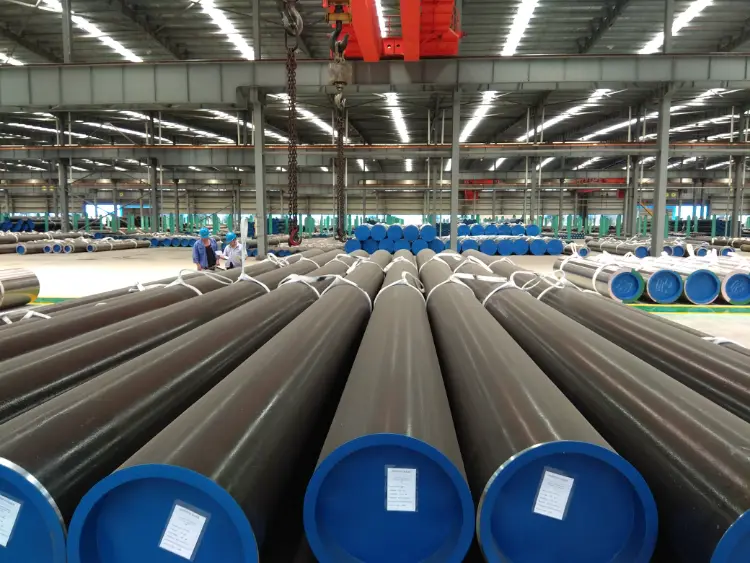
GB/T 9711-2011 PSL2 L415 ERW Pipe
GB/T 9711-2011 PSL2 L415 ERW Pipe - Chemical, Mechanical & Equivalent Data
Comprehensive material data for L415 grade ERW pipe according to GB/T 9711-2011 PSL2, including chemical composition, mechanical properties, thermal and electrical physical properties, international equivalents and application guide.
ERW welding, cold forming of strip, possible post‑weld normalizing or heat treatment
- Phone : +8618037372205
- Email : [email protected]
- WhatsApp: Contact via Whtsapp
- WeChat: +8618037372205
GB/T 9711-2011 PSL2 L415 ERW Pipe Introduction
GB/T 9711-2011 PSL2 L415 ERW pipe is a high‑quality electric‑resistance‑welded steel pipe intended for oil and gas pipeline transportation systems. This grade belongs to the L415 category (equivalent to API 5L X60) and is supplied to Product Specification Level 2 (PSL2), which imposes more stringent requirements on chemical composition, mechanical properties, non‑destructive testing, and toughness compared to PSL1.
Main characteristics include:
- Good strength: minimum yield strength 415 MPa, tensile strength between 520 and 760 MPa with controlled yield‑to‑tensile ratio.
- Excellent weldability thanks to low‑carbon and micro‑alloyed design (Nb, V, Ti).
- Reliable low‑temperature toughness, typically tested at 0 °C or lower with minimum impact energy of 27 J.
- Suitable for manufacturing ERW pipes by electric resistance welding of hot‑rolled coils or plates, followed by post‑weld heat treatment if required.
This material is widely used in long‑distance oil and gas transmission pipelines, gas distribution networks, and structural applications where a combination of good ductility and weldability is needed.
GB/T 9711-2011 PSL2 L415 ERW Pipe Chemical Composition per GB/T 9711‑2011 PSL2
The table lists the specified chemical elements for L415 grade under PSL2. Limits are based on heat analysis; product analysis tolerances apply as per the standard. The micro‑alloying sum V+Nb+Ti ensures fine grain size and adequate strength. Carbon equivalent (CEIIW) and Pcm are often specified by supplementary agreement but are not mandatory in the base standard.
| Element | Specified Value (max %) | Remarks |
|---|---|---|
| Carbon (C) | 0.22 | For wall thickness ≤ 25 mm; otherwise as agreed |
| Manganese (Mn) | 1.40 | For wall thickness ≤ 25 mm; otherwise as agreed |
| Phosphorus (P) | 0.025 | PSL2 limit |
| Sulfur (S) | 0.015 | PSL2 limit |
| V + Nb + Ti | 0.15 | Sum of micro‑alloy elements; individually V, Nb, Ti ≤ 0.06 % each unless otherwise agreed |
GB/T 9711-2011 PSL2 L415 ERW Pipe Thermal and Electrical Physical Properties
These values are not part of the GB/T 9711‑2011 standard but represent typical engineering data for low‑alloyed steel of this type. Actual values may vary slightly depending on exact chemical composition and heat treatment condition.
| Property | Typical Value | Unit | Test Condition / Remarks |
|---|---|---|---|
| Density (ρ) | 7.85 | g/cm³ | At room temperature |
| Modulus of elasticity (E) | 205 – 210 | GPa | At room temperature |
| Shear modulus (G) | ≈ 80 | GPa | Calculated from E and Poisson's ratio |
| Poisson's ratio (ν) | 0.28 – 0.30 | — | At room temperature |
| Thermal expansion coefficient (α) | 11.5 – 12.5 (avg. 11.7) | ×10⁻⁶/K | Between 20 °C and 100 °C |
| Thermal conductivity (λ) | 48 – 55 (avg. 52) | W/(m·K) | At 100 °C |
| Specific heat capacity (cp) | 460 – 500 (avg. 480) | J/(kg·K) | Around room temperature to 100 °C |
| Electrical resistivity (ρe) | 0.14 – 0.18 (avg. 0.16) | μΩ·m | At 20 °C |
GB/T 9711-2011 PSL2 L415 ERW Pipe Mechanical Properties
Mechanical testing is performed on pipe body base metal according to GB/T 9711‑2011 requirements for PSL2 L415. Tensile tests are carried out at ambient temperature on transverse specimens. Impact tests are conducted with Charpy V‑notch specimens; typical requirement is at 0 °C or lower. Bending test requires full flattening or guided bend without cracking.
| Property | Standard Requirement Value | Unit | Test Condition |
|---|---|---|---|
| Yield Strength (Rt0.5) | 415 – 565 | MPa | Transverse, room temperature; 0.5 % total extension under load |
| Tensile Strength (Rm) | 520 – 760 | MPa | Transverse, room temperature |
| Yield/Tensile Ratio (Rt0.5/Rm) | ≤ 0.93 | — | Unless otherwise agreed |
| Elongation after fracture (A50) | ≥ 22 (for t ≤ 12.7 mm) | % | Transverse, 50 mm gauge length; for thinner walls value is calculated or tabulated. Example: ~22 % for t = 6 – 12.7 mm. |
| Impact Energy (KV2) | ≥ 27 (full‑size specimen) | J | Charpy V‑notch, transverse; at 0 °C (or as agreed, e.g. -10 °C, -20 °C) |
| Bending test (180°) | No cracks | — | Mandrel diameter = 2 × t for t ≤ 12.7 mm; 3 × t for t > 12.7 mm; t = wall thickness |
GB/T 9711-2011 PSL2 L415 ERW Pipe Fully Equivalent Material Standards and Substitutable Grades
| Country / Region | Standard | Grade Designation | Remarks |
|---|---|---|---|
| International (API) | API Spec 5L | X60 PSL2 (L415) | Equivalent chemical and mechanical properties; ERW pipe covered. |
| International (ISO) | ISO 3183:2019 | L415 PSL2 | Direct equivalent to GB/T 9711 L415. |
| Europe | EN 10208‑2:2009 | L415MB | Steel for pipelines; MB = welded pipe (ERW/HFI) with base material in TMCP or normalised‑rolled condition. |
| Russia / CIS | GOST 31447‑2012 | К60 (K60) | Pipe steel with minimum yield strength ~420 MPa, relatively close equivalent. |
GB/T 9711-2011 PSL2 L415 ERW Pipe Application Introduction
ERW L415 pipe under GB/T 9711‑2011 PSL2 is primarily designed for high‑pressure oil and gas transportation. Its balanced combination of strength, toughness and weldability makes it suitable for both onshore and offshore pipelines. PSL2 quality ensures reliability under low‑temperature conditions and in aggressive environments where resistance to crack propagation is important.
Typical applications include:
Product Applications: Long‑distance crude oil pipelines, Natural gas transmission trunk lines, High‑pressure flowlines and gathering lines, City gas distribution networks, Water injection lines in oil fields, Steel casing and tubing for wells (suitable for certain grades, but L415 mainly for line pipe)
Processed into products: Pipe bodies (straight sections), Pipe fittings: elbows, tees, reducers (made from the same grade), Flanges (weld‑neck, slip‑on) matching L415 pipe, Valve bodies and pipeline accessories (when fabricated from ERW pipe), Heat‑exchanger shells (if corrosion and temperature conditions permit), Structural hollow sections in offshore platforms
Application industries: Oil & gas exploration and production, Pipeline transportation and distribution, Offshore and subsea engineering, Petrochemical plant piping, Water transmission (large‑diameter mains), Structural (e.g. piling, jackets, conductor casing)
GB/T 9711-2011 PSL2 L415 ERW Pipe Similar / Neighbouring Alternative Materials
| Country / Region | Standard | Grade Designation | Remarks |
|---|---|---|---|
| International (API) | API 5L PSL2 | X52 (L360) | Lower strength grade; YS 360 – 530 MPa, TS 460 – 760 MPa. Used for less demanding pressure conditions. |
| International (API) | API 5L PSL2 | X65 (L450) | Higher strength grade; YS 450 – 600 MPa, TS 535 – 760 MPa. Suitable for higher operating pressures. |
| Europe | EN 10208‑2 | L415MB (already listed as equivalent) | Same strength level; may be considered an alternative in European projects. |
| China | GB/T 9711-2011 PSL1 | L415 | PSL1 version with less stringent requirements on toughness, chemistry and NDT. Suitable for non‑critical service. |
Notes:
- All chemical and mechanical data are taken from GB/T 9711‑2011 (Petroleum and natural gas industries – Steel pipe for pipeline transportation systems) PSL2 requirements.
- ERW pipes may be supplied with a supplementary post‑weld heat treatment (normalising) when extra toughness or corrosion resistance is needed; this must be agreed at the time of order.
- The carbon equivalent (CEIIW or Pcm) is often limited by the purchaser to guarantee field weldability; typical PSL2 limits are CE ≤ 0.43 % or Pcm ≤ 0.25 %, but they are not mandatory in the base standard.
- For ERW weld seam, the weld zone shall achieve the same minimum tensile strength as the base metal; Charpy impact tests on the weld are only required if specified in the purchase order.
- All values are provided for information and preliminary design; the actual material certificate shall always be referenced for final verification.
- Share



