
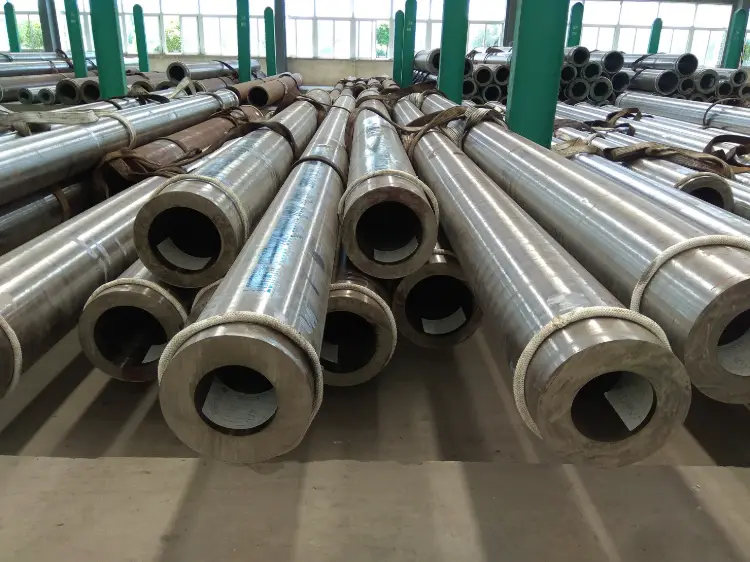
GB/T 9711-2011 PSL2 L390 ERW Pipe
GB/T 9711-2011 PSL2 L390 ERW Pipe: Comprehensive Material Data & Substitution Guide
Detailed material properties, chemical composition, mechanical and thermal data for GB/T 9711-2011 PSL2 L390 ERW pipe, with equivalent grades and application insights.
Hot-rolled strip, cold forming, high-frequency resistance welding, post-weld heat treatment (normalising or stress relieving), sizing, hydrostatic testing
- Phone : +8618037372205
- Email : [email protected]
- WhatsApp: Contact via Whtsapp
- WeChat: +8618037372205
GB/T 9711-2011 PSL2 L390 ERW Pipe Introduction
L390 is a high-strength low-alloy (HSLA) steel grade defined in GB/T 9711-2011 for petroleum and natural gas pipeline systems, classified under PSL2 (Product Specification Level 2) with enhanced mandatory requirements for toughness, chemical composition, and non-destructive inspection. Key properties: minimum yield strength 390 MPa, excellent weldability, good low-temperature toughness, and controlled carbon equivalent (CEV) for field weldability. The material is delivered in the form of electric resistance welded (ERW) pipes, typically with a normalised or stress-relieved weld seam. Typical applications include
- Onshore and offshore oil & gas transmission pipelines
- Sour service and high-pressure transport
- Structural pipe works in harsh environments
GB/T 9711-2011 PSL2 L390 ERW Pipe Chemical Composition
Requirements as per GB/T 9711-2011 PSL2 for grade L390. The composition is designed to achieve the specified mechanical properties while ensuring good weldability and resistance to cracking.
- Carbon content is limited to maintain toughness and field weldability.
- Microalloying elements (V, Nb, Ti) are added singly or in combination for grain refinement and precipitation strengthening.
- Phosphorus and sulfur are strictly controlled to minimise inclusions and improve ductility and HIC resistance.
- Carbon equivalent CEIIW is typically ≤0.43% for PSL2 to ensure satisfactory welding without preheat.
| Element | Standard Value (max, % unless noted) | Remarks |
|---|---|---|
| Carbon, C | 0.16 | PSL2 heat analysis max; product analysis 0.19 max |
| Silicon, Si | 0.45 | Commonly 0.15–0.35 |
| Manganese, Mn | 1.60 | Product analysis 1.75 max |
| Phosphorus, P | 0.020 | PSL2 requirement, product analysis 0.025 max |
| Sulfur, S | 0.010 | PSL2 requirement, product analysis 0.015 max |
| Vanadium, V | 0.10 | Optional microalloy; sum V+Nb+Ti ≤ 0.15% |
| Niobium (Columbium), Nb | 0.05 | Optional; usually ≤0.05% for L390 |
| Titanium, Ti | 0.04 | Optional; if combined with other microalloys, total ≤0.15% |
| Copper, Cu | 0.35 | Residual element; sum Cu+Ni+Cr+Mo ≤ 0.35% typical |
| Nickel, Ni | 0.30 | Residual |
| Chromium, Cr | 0.30 | Residual |
| Molybdenum, Mo | 0.15 | Residual |
| Nitrogen, N | 0.012 | Optional, not intentionally added unless using Nb |
| Aluminium, Al | 0.060 | Total Al, typical for grain refinement; often 0.015–0.060% |
| Carbon equivalent, CE(IIW) | ≤0.43 (typical) | Calculated: C + Mn/6 + (Cr+Mo+V)/5 + (Ni+Cu)/15 |
GB/T 9711-2011 PSL2 L390 ERW Pipe Thermal and Electrical Physical Properties
Physical properties are representative of low-carbon microalloyed steel (Fe-0.16C-1.5Mn-0.1V/Nb). Values are valid at room temperature unless noted otherwise.
- Density is standard for most pipeline steels.
- Thermal expansion and conductivity influence welding procedures and pipeline design in exposed environments.
- Electrical resistivity is relevant for induction welding and corrosion protection.
| Property | Standard Value | Unit | Test Condition |
|---|---|---|---|
| Density (ρ) | 7.85 | g/cm³ | 20°C |
| Modulus of elasticity (E) | 205 | GPa | 20°C, static |
| Shear modulus (G) | 80 | GPa | Calculated from E and ν |
| Poisson's ratio (ν) | 0.30 | — | Elastic range |
| Thermal expansion coefficient (α) | 11.7×10⁻⁶ | K⁻¹ | 20–100°C |
| Thermal conductivity (λ) | 45 | W/(m·K) | 20°C |
| Specific heat capacity (cₚ) | 460 | J/(kg·K) | 20°C |
| Electrical resistivity (ρₑ) | ~0.22 | μΩ·m | 20°C, typical for low-alloy steel |
GB/T 9711-2011 PSL2 L390 ERW Pipe Mechanical Properties
Tested on base metal of welded pipes, transverse or longitudinal orientation according to standard. Yield strength (ReH) is based on 0.5% total extension under load for pipe with yield point. Tensile testing performed at room temperature. Impact toughness is measured on Charpy V-notch specimens at specified temperature, typically transverse for pipe body. Bend test conducted per GB/T 9711-2011 to verify no cracks or defects.
- The pipe shall meet the minimum average impact energy of 27 J (transverse) at 0°C.
- Elongation is reported on gauge length accounting for specimen geometry.
- All tests are destructive and performed per lot.
| Property | Standard Value | Unit | Test Condition |
|---|---|---|---|
| Yield strength (ReH) | 390 – 545 | MPa | Transverse test, 0.5% under load |
| Tensile strength (Rm) | 490 – 690 | MPa | Transverse test, room temperature |
| Yield/Tensile ratio (ReH/Rm) | ≤0.93 | — | PSL2 requirement for L390/X56 |
| Elongation after fracture (A) | ≥22 (longitudinal), ≥21 (transverse) | % | Full-thickness flat specimen, gauge length 50 mm |
| Bend test | No cracks, 180° bend | — | Mandrel diameter as per GB/T 9711-2011 formula; typically ~3t–5t depending on wall thickness |
| Charpy impact energy (KV₂, transverse) | ≥27 average / ≥23 single | J | Full-size (10×10 mm) specimen, 0°C |
| Charpy impact energy (KV₂, longitudinal) | ≥41 average / ≥35 single | J | Full-size specimen, 0°C (when required) |
| Hardness | ≤250 HV10 or ≤22 HRC | — | If specified for sour service or PSL2 supplemental |
GB/T 9711-2011 PSL2 L390 ERW Pipe Fully Equivalent Material Standards and Recommended Substitute Grades
| Country/Region | Standard | Grade | Remarks |
|---|---|---|---|
| International | API 5L (46th Ed.) | X56 PSL2 | Identical strength and toughness requirements; technical delivery conditions harmonised |
| International | ISO 3183:2019 | L390 PSL2 | Same designation system, directly aligns with GB/T 9711-2011 |
| Europe | EN 10208-2:2009 | L390GA / L390NB | With additional impact requirements (e.g., -10°C, 27 J); check precise sub-designation |
| Russia/CIS | GOST R 52203-2004 | K56 (type 06G2FB) | Chemical composition slightly different; verify properties |
GB/T 9711-2011 PSL2 L390 ERW Pipe Application Introduction
L390 ERW pipe under GB/T 9711-2011 PSL2 is engineered for critical pipeline applications requiring reliable strength, toughness, and weldability. Typical usage scenarios:
- High-pressure oil and gas trunk lines
- Gathering systems where PSL2 extra toughness is mandatory
- Sour service lines (with supplementary HIC/SSC testing when specified by purchaser)
- Water injection and brine disposal pipelines
- Offshore riser pipes and topside piping (with additional coating)
- Structural tubulars for bridges, piling, and conveyance
Product Applications: Oil and gas gathering lines (flowlines), Long-distance transmission pipelines, Offshore platform piping, Fuel gas distribution networks, Drill water and mud transport pipes, Steel pipe piles and sheet piling, Conduits for cables and optical fibers in infrastructure
Processed into products: Pipe fittings (seamless or welded elbows, tees, reducers, caps) fabricated from similar material, Barred tees and strainers for pipeline pig launchers/receivers, Flanges (WNRF) made from L390 or companion flange material of equivalent strength, Structural bracing members, pipe trusses, and bridge supports, Offshore jacket legs and braces, Pump stations and compressor station piping
Application industries: Oil and gas exploration, transmission and distribution (upstream and midstream), Petrochemical and chemical processing, Water management (desalination, water supply), Civil engineering and construction (foundations, structural supports), Mining (slurry and dewatering lines)
GB/T 9711-2011 PSL2 L390 ERW Pipe Closely Related Substitute Materials for Performance Reference
| Country/Region | Standard | Grade | Remarks |
|---|---|---|---|
| China | GB/T 9711-2011 | L360 (X52) | Lower strength (min yield 360 MPa), otherwise similar weldability and toughness; can be used if lower pressure rating acceptable |
| China/Intl | API 5L / GB/T 9711 | L415 (X60) | Higher strength (min yield 415 MPa); requires higher forming capacity and may reduce ductility slightly |
| Europe | EN 10208-2 | L360MB | Equivalent to X52 PSL2; check impact requirements |
| Japan | JIS G 3444 | STK 540 | Structural carbon steel tube, min tensile 540 MPa but not intended for pressure pipeline; strength comparable |
| USA | ASTM A53 / A106 | Grade B | Min yield 240 MPa only; not a pressure equivalent but sometimes used for low-pressure lines (not directly substitute) |
Notes:
- For sour service applications (e.g., NACE MR0175/ISO 15156), supplementary requirements for HIC (Hydrogen Induced Cracking) and SSC (Sulphide Stress Cracking) resistance must be specified, and the chemical composition (S ≤ 0.002% typically) and hardness (≤ 248 HV) need tighter control.
- ERW pipe diameter range commonly from outside diameter 21.3 mm up to 660 mm (or larger to 24 inches) with wall thickness up to 25 mm, subject to mill capability.
- Weld seam and heat-affected zone toughness should be verified if specified for Arctic service (impact test temperature may be lowered to -10°C or -20°C with minimum 27 J average).
- Standard hydrostatic test pressure: minimum 95% of specified minimum yield strength for pipe body, or to mill pressure table per standard.
- Supplementary non-destructive testing (ultrasonic or eddy current) for weld seam and body is mandatory for PSL2.
- Share



