
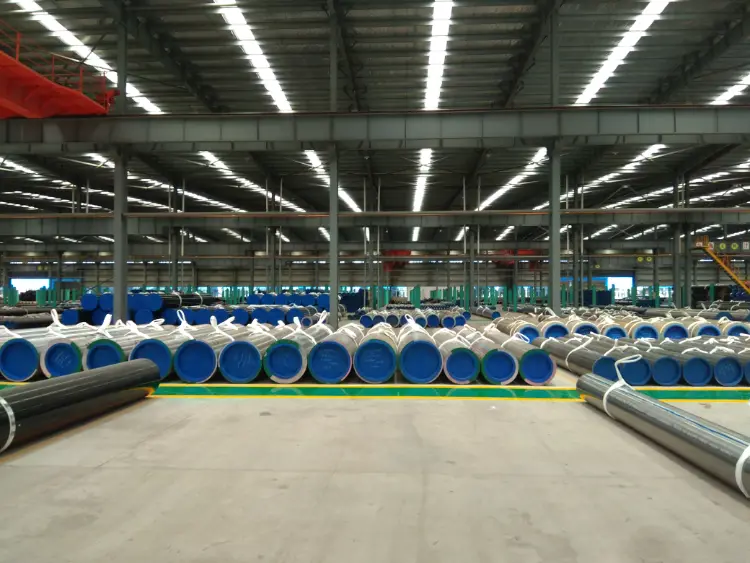
GB/T 9711-2011 PSL2 L360 ERW Line Pipe
GB/T 9711-2011 PSL2 L360 ERW Line Pipe - Chemical, Mechanical & Physical Properties
Detailed material data for GB/T 9711-2011 PSL2 L360 electric resistance welded (ERW) steel pipe used in oil and gas transportation, including chemical composition, mechanical properties, and physical properties.
ERW (Electric Resistance Welding), cold expansion, heat treatment as required
- Phone : +8618037372205
- Email : [email protected]
- WhatsApp: Contact via Whtsapp
- WeChat: +8618037372205
GB/T 9711-2011 PSL2 L360 ERW Line Pipe Introduction
GB/T 9711-2011 PSL2 L360 ERW pipe is a Chinese national standard line pipe for petroleum and natural gas industries. L360 designates a minimum yield strength of 360 MPa, equivalent to API 5L X52. The PSL2 (Product Specification Level 2) imposes stricter requirements on chemical composition, notch toughness, and non-destructive testing compared to PSL1. ERW (electric resistance welded) manufacturing produces a strong, cost-effective pipe with a longitudinal weld seam. Key features:
- Excellent weldability and formability, suitable for cold bending.
- Strict control of carbon equivalent (CE) to ensure field weldability.
- Guaranteed impact toughness at low temperatures (typically 27 J at -10 °C or lower).
- Widely used for onshore and offshore transmission pipelines conveying gas, oil, and water.
GB/T 9711-2011 PSL2 L360 ERW Line Pipe Chemical Composition – Mass Fraction %
Chemical composition limits for PSL2 L360 according to GB/T 9711-2011. Maximum values are given unless a range is stated. The main elements are controlled to ensure strength, toughness, and weldability. A carbon equivalent (CEpcm) formula is specified to limit hardenability.
- Residual elements like Cr, Ni, Cu, Mo combined shall not exceed the specified limits.
- For fine grain practice, acid-soluble aluminium or other grain-refining elements may be added.
| Element | Standard Value (max %) | Remarks |
|---|---|---|
| Carbon (C) | 0.22 | For wall thickness ≤ 25.0 mm; 0.24 for > 25.0 mm |
| Silicon (Si) | 0.45 | Deoxidiser; typical range 0.15–0.30 |
| Manganese (Mn) | 1.40 | Key strength and toughness element |
| Phosphorus (P) | 0.025 | Strict control for toughness |
| Sulfur (S) | 0.015 | Stringent limit for low inclusion content |
| Vanadium (V) | 0.05 | Micro-alloying |
| Niobium (Nb) | 0.05 | Micro-alloying; same max as V |
| Titanium (Ti) | 0.04 | Grain refinement |
| Copper (Cu) | 0.50 | Residual element |
| Nickel (Ni) | 0.50 | Residual element |
| Chromium (Cr) | 0.50 | Residual element |
| Molybdenum (Mo) | 0.50 | Residual element |
| Nitrogen (N) | 0.012 | Maximum unless sufficient Al is present for binding |
| Boron (B) | 0.0005 | Optional; limited for weldability |
| Aluminium (Al) | 0.060 (total Al) | If grain refining, acid soluble Al ≥ 0.015 |
| Carbon Equivalent CEpcm | 0.25 (typical max) | CEpcm = C + Si/30 + (Mn+Cu+Cr)/20 + Ni/60 + Mo/15 + V/10 + 5B |
GB/T 9711-2011 PSL2 L360 ERW Line Pipe Physical Properties – Thermal and Electrical
Physical properties are not specified in GB/T 9711-2011 but are representative of carbon-manganese micro-alloyed steel used for L360 ERW pipes. These values vary slightly with temperature. Thermal conductivity decreases and specific heat capacity increases with temperature.
- The density is assumed at room temperature.
- Electrical resistivity is relevant for corrosion rate calculations and induction heating processes.
| Property | Typical Value | Unit | Test Condition / Remarks |
|---|---|---|---|
| Density (ρ) | 7.85 | g/cm³ | Room temperature |
| Modulus of Elasticity (E) | 210 | GPa | Room temperature |
| Shear Modulus (G) | 81 | GPa | Room temperature |
| Poisson's Ratio (ν) | 0.3 | – | Room temperature |
| Thermal Expansion Coefficient (α) | 11.7 × 10⁻⁶ | 1/K | 20 – 100 °C |
| Thermal Conductivity (λ) | 50 | W/(m·K) | At 20 °C; decreases to ~40 at 400 °C |
| Specific Heat Capacity (cp) | 486 | J/(kg·K) | At 20 °C; increases to ~550 at 400 °C |
| Electrical Resistivity (ρe) | 0.16 × 10⁻⁶ | Ω·m | Room temperature |
GB/T 9711-2011 PSL2 L360 ERW Line Pipe Mechanical Properties
Mechanical properties for PSL2 L360 ERW pipe per GB/T 9711-2011. Transverse test specimens are taken from the pipe body. The values apply to room temperature unless otherwise indicated. For weld seam, specific bend and impact tests are required.
- For pipe subjected to cold expansion, the yield strength reduction (Bauschinger effect) is compensated by using a thermo-mechanical rolling process.
- Impact test temperature is typically -10 °C but may be lowered depending on the service condition and wall thickness.
| Property | Standard Requirement | Unit | Test Condition |
|---|---|---|---|
| Yield Strength (ReH) | 360 – 530 | MPa | Transverse, 0.5% total extension |
| Tensile Strength (Rm) | 460 – 760 | MPa | Transverse |
| Elongation (A) | ≥ 20 (min) | % | On 50 mm gauge length, round bar or strip specimen |
| Bend Test (Weld) | No cracking or opening > 2 mm | – | Bend angle 180°; former diameter = 3 × wall thickness for t ≤ 12.7 mm |
| Charpy V-Notch Impact Energy (KV) | ≥ 27 (average) / ≥ 22 (single) | J | Transverse, -10 °C; full-size 10×10 mm specimen |
| Shear Area (Impact) | ≥ 85 (average) | % | -10 °C, full-size specimen |
| Hardness (Max) | 250 HV10 or HRC 22 | – | Applicable to weld metal, HAZ, and parent metal |
GB/T 9711-2011 PSL2 L360 ERW Line Pipe Exact Equivalent Material Standards and Substitute Grades
| Country/Region | Standard | Grade | Remarks |
|---|---|---|---|
| China | GB/T 9711-2011 | L360 PSL2 | Original specification |
| International | ISO 3183:2007 | L360 (PSL 2) | Equivalent designation |
| USA/Global | API Spec 5L (45th Ed.) | X52 (PSL 2) | Commonly used designation |
| Europe | EN 10208-2:2009 | L360NB | Seamless or welded; NB = normalised or formed |
| Russia | GOST R 52079 | K52 | Close match, but check limits |
| Canada | CSA Z245.1 | Grade 359 (Cat II) | Comparable strength level |
| Brazil | ABNT NBR 15827 | L360 | Same designation |
GB/T 9711-2011 PSL2 L360 ERW Line Pipe Application Introduction
L360 ERW pipe is a versatile line pipe used in the oil and gas industry for onshore and offshore applications. PSL2 certification ensures reliable mechanical properties and weldability for critical services.
- Typical product forms: bare, 3LPE/3LPP coated, or FBE coated pipes.
- Can be supplied as threaded and coupled, or butt-welded joints.
Product Applications: Cross-country transmission pipelines, Subsea flowlines and risers (if suitable for the environment), Gathering systems and distribution networks, Process piping in refineries and gas plants, Station piping (compressor, pump, metering stations)
Processed into products: Pipe body (straight sections), Induction bends and cold bends, Tees, reducers, and caps manufactured from pipe, Flanges and weldolets attached to the pipe, Anchor flanges for buried restraint
Application industries: Oil & Gas Exploration and Production, Pipeline Transportation (Crude oil, natural gas, refined products), Water and Wastewater Transmission, Chemical and Petrochemical Plant Piping, Construction (Piling, structural supports)
GB/T 9711-2011 PSL2 L360 ERW Line Pipe Similar/Comparable Substitute Materials
| Country/Region | Standard | Grade | Remarks |
|---|---|---|---|
| China | GB/T 9711-2011 | L290 (X42) / L415 (X60) | Lower/higher strength line pipe grades; can be considered with design adjustment |
| USA/Global | API Spec 5L | X46 / X56 | Intermediate strength grades with similar chemistry and toughness |
| Europe | EN 10208-2 | L290NB / L415NB | Substitute for lower/higher pressure applications |
| Germany | DIN EN ISO 3183 | L360 (PSL2) | Same grade, different origin |
Notes:
This data is based on GB/T 9711-2011 (Petroleum and natural gas industries – Steel pipe for pipelines) and typical physical property values. For specific project requirements, supplementary specifications (e.g., HIC resistance, Sour service per NACE MR0175) may be needed. ERW pipe is subject to weld seam ultrasonic or electromagnetic inspection per PSL2. The actual pipe can be supplied with a minimum pressure test according to the standard or as agreed. Dimensional tolerances and end finishes shall comply with GB/T 9711-2011.
- Share



