
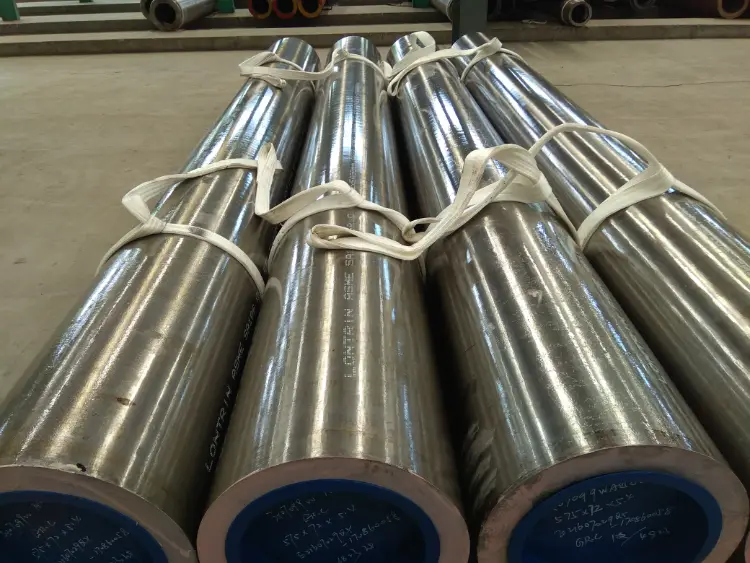
GB/T 9711-2011 L320 PSL2 ERW Steel Pipe
GB/T 9711-2011 L320 PSL2 ERW Steel Pipe: High-Strength Line Pipe for Oil & Gas Transmission
Comprehensive material data for L320 PSL2 ERW pipe per GB/T 9711-2011, including chemical composition, mechanical properties, physical properties, and international equivalents.
Electric resistance welding (ERW; high-frequency induction or contact welding), cold/hot forming, welding, sizing, heat treatment, hydrostatic testing, NDE
- Phone : +8618037372205
- Email : [email protected]
- WhatsApp: Contact via Whtsapp
- WeChat: +8618037372205
GB/T 9711-2011 L320 PSL2 ERW Steel Pipe Introduction
GB/T 9711-2011 L320 PSL2 ERW pipe is a high-quality carbon-manganese steel line pipe produced by electric resistance welding, conforming to the Chinese national standard for petroleum and natural gas industries.
- Designated as PSL2 (Product Specification Level 2), it offers tighter chemical and mechanical requirements, mandatory notch toughness, and non-destructive inspection compared to PSL1.
- The L320 grade corresponds to a minimum yield strength of 320 MPa (46 ksi), providing an excellent balance of strength, weldability, and toughness for long-distance pipelines.
- ERW manufacturing ensures precise dimensions and cost efficiency for medium-diameter pipe applications.
Typical applications include onshore/offshore oil and gas transmission, water pipelines, and structural uses where both pressure containment and external loads are present.
GB/T 9711-2011 L320 PSL2 ERW Steel Pipe Chemical Composition
The chemical composition is specified in GB/T 9711-2011 Table 1 for PSL2 pipe. The steel is fully killed and fine-grained. Microalloying elements such as V, Nb, and Ti are typically added for strength and toughness improvement. Carbon equivalent (CEIIW) and Pcm limits ensure good field weldability.
| Chemical Element | Required Value (%) | Remarks |
|---|---|---|
| C (Carbon) | Max 0.22 | Max limit; typical 0.10–0.18 for good weldability |
| Si (Silicon) | Max 0.45 | Deoxidation element |
| Mn (Manganese) | Max 1.30 | Main solid-solution strengthener; typical 0.90–1.20 |
| P (Phosphorus) | Max 0.025 | Residual element; kept low for toughness |
| S (Sulfur) | Max 0.015 | Residual element; kept low for resistance to hot cracking |
| V (Vanadium) | — | No individual maximum; limitation through V+Nb+Ti sum |
| Nb (Niobium) | — | No individual maximum; limitation through V+Nb+Ti sum |
| Ti (Titanium) | — | No individual maximum; limitation through V+Nb+Ti sum |
| V + Nb + Ti | Max 0.15 | Sum of microalloying elements, when intentionally added |
| Al (Aluminum) | Report only | No mandatory limits; used for grain refinement and deoxidation |
| CEIIW (Carbon equivalent) | Max 0.43 | IIW formula: CE = C + Mn/6 + (Cr+Mo+V)/5 + (Ni+Cu)/15 |
| Pcm (Cold cracking parameter) | Max 0.25 | Optional requirement; usually specified for sour service or heavy-wall pipe; Pcm = C + Si/30 + (Mn+Cu+Cr)/20 + Ni/60 + Mo/15 + V/10 + 5B |
GB/T 9711-2011 L320 PSL2 ERW Steel Pipe Thermal and Electrical Physical Properties
The physical properties are not specified in GB/T 9711-2011; they are typical values for low-carbon line pipe steel (approx. 0.1–0.2% C) at room temperature unless otherwise noted. These values serve as a reasonable estimate for engineering calculations.
| Property | Typical Value | Unit | Test Condition / Remarks |
|---|---|---|---|
| Density (ρ) | 7.85 | g/cm³ | At 20 °C |
| Elastic modulus (E) | 210 | GPa | At 20 °C, static |
| Shear modulus (G) | 81 | GPa | Calculated from E and Poisson's ratio |
| Poisson's ratio (ν) | 0.30 | — | Elastic range |
| Thermal expansion coefficient (α) | 12.0 × 10⁻⁶ | /K | 20–100 °C range |
| Thermal conductivity (λ) | 50 | W/(m·K) | At 20 °C |
| Specific heat capacity (cp) | 460 | J/(kg·K) | At 20 °C |
| Electrical resistivity (ρₑ) | 0.20 | μΩ·m | At 20 °C |
| Melting range | ~1470 – 1520 | °C | Approximate |
GB/T 9711-2011 L320 PSL2 ERW Steel Pipe Mechanical Properties
Mechanical testing is performed on the pipe body and on the weld for ERW pipe. Yield strength is determined as ReH (upper yield) or Rt0.5 (0.5% total extension) depending on the stress-strain curve type. Tensile testing is carried out on transverse strip specimens. Notch toughness tests (Charpy V-notch) are mandatory for PSL2 at a temperature agreed between purchaser and manufacturer; the values below are typical for 0 °C. Bend tests on the weld ensure adequate ductility of the ERW seam.
| Property | Required Value | Unit | Test Condition / Remarks |
|---|---|---|---|
| Yield Strength (ReH or Rt0.5) | 320 – 525 | MPa | Transverse strip test; upper limit may be reduced to 0.85×Rm by agreement |
| Tensile Strength (Rm) | 435 – 655 | MPa | Transverse strip test |
| Elongation after fracture (A), 50 mm gauge | Min 22 | % | For transverse strip specimen with gauge length L0 = 50 mm, wall thickness ≤ 20 mm |
| Elongation after fracture (A), proportional | Min 2000/√Rm (approx. 25–27) | % | For transverse strip specimen with gauge length L0 = 5.65√S0 |
| Yield to tensile ratio (ReH/Rm) | Max 0.85 (by agreement) | — | For design against plastic collapse or when specified |
| Charpy V-notch impact energy (KV), weld & base – average | Min 27 (at specified temperature, e.g., 0 °C) | J | Full-size specimen (10×10 mm); transverse direction; PSL2 requirement |
| Charpy V-notch impact energy (KV), weld & base – single value | Min 20 | J | Same temperature batch |
| Guided bend test (weld seam) | No cracks >3 mm in any direction; complete 180° bending | — | Bend diameter typically 6×t for t ≤ 12.7 mm (or as agreed); weld center in bend area |
| Hardness (weld and HAZ) | Max 250 HV10 (unless otherwise agreed) | HV | Applied for sour service or when specified |
| Hydrostatic test | 90% SMYS (specified minimum yield strength) hoop stress | — | Mandatory for PSL2; holding time 5–10 seconds |
GB/T 9711-2011 L320 PSL2 ERW Steel Pipe Completely Equivalent Material Standards and Substitutable Grades
| Country/Region | Standard | Grade | Remarks |
|---|---|---|---|
| International | ISO 3183:2007 / 2012 / 2019 | L320 PSL2 | Identical technical requirements; GB/T 9711-2011 is based on ISO 3183 |
| USA / International | API Spec 5L (45th & 46th Edition) | Grade X46 PSL2 | X46 is the traditional API designation; L320 and X46 have the same minimum YS of 320 MPa |
| Russia | GOST R 52079-2003 / K48 | A 320 (approximate) | Not identical; close strength class with adjustments for climate |
| European (EN) | EN 10208-2:2009 (steel pipe for combustible fluids) | L320MB (similar) | EN L320MB may have different PSL level; verify PSL2 equivalent requirements |
GB/T 9711-2011 L320 PSL2 ERW Steel Pipe Application Introduction
L320 PSL2 ERW pipe is predominantly used in the oil and gas industry for long-distance transmission pipelines. Its balance of strength and toughness makes it suitable for both onshore buried lines and low-pressure offshore risers.
- ERW pipe is preferred for diameters up to ~24 inch (610 mm) for cost efficiency and consistent wall thickness.
- PSL2 guarantees stringent fracture toughness, ensuring safe operation at low temperatures and under dynamic loading.
- Typical coating systems (FBE, 3LPE, 3LPP) are applied for corrosion protection.
Product Applications: Onshore & Offshore Pipeline Systems (transmission lines, gathering lines, flowlines), Casing and Tubing for Low-Pressure Wells (secondary use), Water Injection Lines, Compressed Air and Fire Main Piping, Pipe Piles and Structural Columns (when converted as main load-bearing member)
Processed into products: Straight Lengths of ERW Pipe (plain end, beveled end), Pipe Bends (hot induction or cold bending), Tees, Reducers, and Caps (fabricated from pipe), Flanges (weld neck, slip-on) matched to L320 pipe, Reinforcing Sleeves and Repair Shells, Line Pipe Spools (prefabricated)
Application industries: Oil & Gas (Upstream, Midstream, Downstream), Petrochemical, Water and Wastewater, Mining and Slurry Transport, Civil Construction and Infrastructure, Fire Protection Systems
GB/T 9711-2011 L320 PSL2 ERW Steel Pipe Similar/Equivalent Alternative Materials
| Country/Region | Standard | Grade | Remarks |
|---|---|---|---|
| China / International | GB/T 9711-2011 / API 5L | L290 (X42) PSL2 | Lower strength grade (min YS 290 MPa); may be considered for less demanding pressure or structural loads |
| China / International | GB/T 9711-2011 / API 5L | L360 (X52) PSL2 | Higher strength grade (min YS 360 MPa); provides greater pressure capacity but may require increased welding preheat |
| China | GB/T 8163-2018 (seamless pipe for liquid service) | Q345B (seamless) | Approximate YS 345 MPa; used in structural and fluid applications; not an exact line pipe standard but can replace L320 in some low-consequence situations |
Notes:
PSL2 additional requirements: mandatory non-destructive examination (NDE) of the weld seam (ultrasonic or electromagnetic inspection), full-body normalizing or stress-relieving may be ordered. Purchaser may specify additional testing such as sour service testing (HIC/SSC) if material is intended for H₂S-containing environments; carbon equivalent and hardness limits would then be tightened. The data presented is based on GB/T 9711-2011 PSL2 L320 generic requirements; always verify with the specific purchase specification and mill certificate.
- Share



