
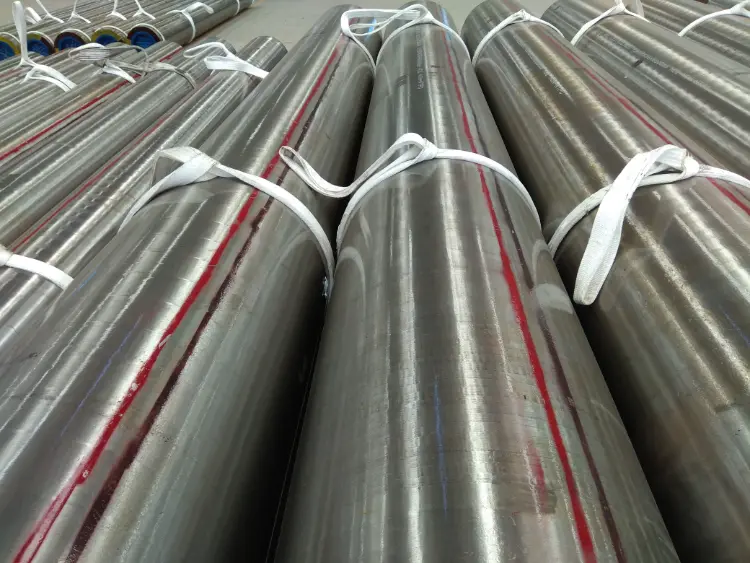
GB/T 9711-2011 PSL2 L290 ERW Pipe
GB/T 9711-2011 PSL2 L290 ERW Pipe: High-Strength Line Pipe for Oil & Gas Transport
Comprehensive material data for L290 PSL2 ERW pipe per GB/T 9711-2011, including chemical composition, mechanical properties, physical properties, international equivalents, and application guide.
Electric Resistance Welded (ERW)
- Phone : +8618037372205
- Email : [email protected]
- WhatsApp: Contact via Whtsapp
- WeChat: +8618037372205
GB/T 9711-2011 PSL2 L290 ERW Pipe Introduction
L290 steel pipe, manufactured according to GB/T 9711-2011 with product specification level PSL2, is a welded line pipe primarily used in oil and gas transportation systems. The ERW (Electric Resistance Welded) process ensures a consistent, high-quality weld seam. L290 grade offers a minimum yield strength of 290 MPa, combined with good weldability and adequate toughness even at low temperatures. Thanks to controlled carbon content and carbon equivalent limits, it can be welded in the field without preheating under normal conditions. The PSL2 specification mandates stricter chemical and mechanical testing, including mandatory Charpy impact tests, compared to PSL1. Typical applications include long-distance onshore and offshore pipelines, gathering lines, and water injection lines. Its balance of strength and ductility allows reliable operation under high pressure and in environments requiring resistance to crack propagation.
GB/T 9711-2011 PSL2 L290 ERW Pipe Chemical Composition per GB/T 9711-2011 PSL2 for L290
The chemical composition limits for L290 PSL2 are set to achieve the required mechanical properties while ensuring excellent field weldability. Elements are reported as maximum percentages (unless a range is given). The carbon equivalent CEIIW = C + Mn/6 + (Cr+Mo+V)/5 + (Ni+Cu)/15 is controlled to ⩽0.43% to avoid cold cracking. Micro-alloying elements (V, Nb, Ti) may be used for grain refinement and strengthening.
| Element | Specified Value (max. %) | Remarks |
|---|---|---|
| C | 0.22 | Lower carbon ensures good weldability |
| Mn | 1.20 | Improves strength and toughness |
| P | 0.025 | Controlled to maintain ductility |
| S | 0.015 | Low sulfur reduces risk of hot cracking |
| Si | 0.45 | Deoxidizer, contributes to strength |
| V + Nb + Ti | 0.15 | Sum of micro-alloying elements for grain refinement |
| CEIIW | 0.43 | Carbon equivalent (International Institute of Welding formula) limit for PSL2 |
GB/T 9711-2011 PSL2 L290 ERW Pipe Physical Properties
The following physical property values represent typical data for low-carbon, low-alloy steel of the L290 grade. They are not mandatory requirements of GB/T 9711-2011 but serve as engineering reference. Density, elastic modulus, and thermal expansion are essential for pipeline design (e.g., buoyancy, strength, thermal stress). Thermal conductivity and specific heat govern heat transfer and cooling rates. All values are approximate and valid for the temperature range normally encountered in pipeline service (-20 °C to 200 °C) unless otherwise stated.
| Property | Typical Value | Unit | Test Conditions / Remarks |
|---|---|---|---|
| Density (ρ) | 7.85 | g/cm³ | At 20 °C |
| Modulus of Elasticity (E) | 207 | GPa | At 20 °C; tensile mode |
| Shear Modulus (G) | 80 | GPa | Calculated from E and ν |
| Poisson's Ratio (ν) | 0.3 | At 20 °C | |
| Coefficient of Thermal Expansion (α) | 12.1 × 10⁻⁶ | 1/K | Between 20 °C and 100 °C |
| Thermal Conductivity (λ) | 51 | W/(m·K) | At 20 °C |
| Specific Heat Capacity (cp) | 486 | J/(kg·K) | At 20 °C |
| Electrical Resistivity (ρe) | 0.15 – 0.20 | Ω·mm²/m | At 20 °C, typical range |
GB/T 9711-2011 PSL2 L290 ERW Pipe Mechanical Properties per GB/T 9711-2011 PSL2 for L290
Mechanical testing is conducted on specimens taken transverse to the weld seam, from the pipe body. Yield strength is the stress at 0.5% total elongation (Rt0.5). The tensile strength range ensures adequate capacity. Elongation after fracture is reported on a gauge length of 50 mm or 5.65√S0, and the minimum required value is calculated based on the formula 1940·A0.2/Rm0.9, where A is the specimen cross-sectional area (mm²) and Rm is the measured tensile strength. Charpy V-notch impact testing is mandatory for PSL2 pipes; the average energy per set of three specimens must meet the specified value at 0 °C.
| Property | Specified Requirement | Unit | Test Conditions |
|---|---|---|---|
| Yield Strength (Rt0.5) | 290 - 495 | MPa | Transverse; strip or round specimen |
| Tensile Strength (Rm) | 415 - 655 | MPa | Transverse; same specimen type |
| Elongation after fracture (A) | ≥ (calculated value); typically ≥20 | % | Gauge length 50 mm or 5.65√S₀; transverse |
| Guided Bend Test | No cracks or ruptures >3 mm after 180° bending | Mandrel diameter = 180 / (ratio) per standard; weld and HAZ tested | |
| Charpy V-notch Impact Energy | Average ≥ 27; Individual ≥ 18 | J | At 0 °C; transverse, from pipe body (base metal) |
GB/T 9711-2011 PSL2 L290 ERW Pipe Completely Equivalent Material Standards and Substitutable Grades
| Country/Region | Standard | Grade | Remarks |
|---|---|---|---|
| China | GB/T 9711-2011 PSL2 | L290 (ERW) | Base specification; L290 is a PSL2 steel grade for line pipe |
| USA / Global | API 5L (46th Ed.) PSL2 | X42 (ERW) | API 5L X42 PSL2 is chemically and mechanically equivalent to L290 |
| International | ISO 3183:2012 (PSL2) | L290 (ERW) | ISO 3183 L290 is identical in concept; former ISO 3183-2/-3 covered this grade |
| Russia | GOST R 52079-2003 / K48 / K50 | K42 (approximately L290) | GOST class K42 is close; verify exact PSL2 requirements |
| Europe | EN 10208-2:2009 | L290MB | L290MB in EN 10208-2 for pipes with PSL2 equivalent properties |
GB/T 9711-2011 PSL2 L290 ERW Pipe Application Introduction
L290 PSL2 ERW pipe is engineered for safe and efficient transport of liquids and gases under pressure. Its assured toughness and weldability simplify field construction. The following outlines typical uses.
Product Applications: Onshore and offshore hydrocarbon transmission pipelines, Gathering and distribution networks, Flowlines and trunklines, Water injection and produced water lines, Piping for fire-fighting systems
Processed into products: Line pipe segments (straight sections), Induction bends and elbows (hot-induction formed), Tees and reducers (matched with pipe grade), Flanges and connectors (welded to pipe ends), Valve bodies and manifolds (when fabricated from plate of equivalent grade), Casing and riser pipes in shallow sections
Application industries: Oil and gas exploration and production (upstream, midstream), Petrochemical and refining, Water and wastewater treatment (long-distance water transfer), Structural engineering (supports, offshore platforms), Slurry pipelines (mining)
GB/T 9711-2011 PSL2 L290 ERW Pipe Similar / Alternative Material Grades with Comparable Performance
| Country/Region | Standard | Grade | Remarks |
|---|---|---|---|
| China | GB/T 9711-2011 PSL2 | L245 / L245R (ERW) | Lower yield strength (≥245 MPa) but often interchangeable for lower pressure services |
| China | GB/T 9711-2011 PSL2 | L360 (ERW) | Higher yield strength (≥360 MPa); suitable for higher pressure; check compatibility |
| USA | API 5L PSL2 | X46, X52 (ERW) | Next higher strength classes; may be used with caution (higher CE, need adapted welding procedure) |
| Europe | EN 10208-2 | L245MB, L360MB | European equivalents of L245 and L360; alternative when strength margins allow |
Notes:
- PSL2 requires stricter non-destructive weld inspection (e.g., ultrasonic or electromagnetic) compared to PSL1.
- Hydrostatic test pressure is calculated based on specified minimum yield strength and pipe geometry, typically 60% to 85% of SMYS.
- For sour service applications, additional HIC/SSC testing per NACE MR0175 may be required; L290 is not inherently sour-service grade unless specially manufactured and tested.
- Welding consumables and procedures should match the carbon equivalent; low-hydrogen processes are recommended for field welding.
- Share



