
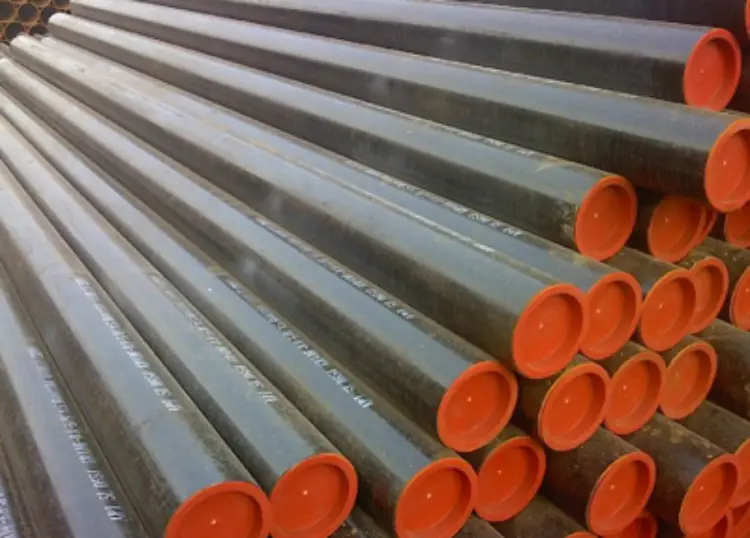
GB/T 9711-2011 PSL2 L245 SSAW Pipe
GB/T 9711-2011 PSL2 L245 SSAW Pipe: Comprehensive Material Data & Performance Analysis for Pipeline Engineers
In-depth material data for L245 grade spiral submerged arc welded pipe under GB/T 9711-2011 PSL2. Includes chemical composition, mechanical & thermal properties, international equivalents, and application guidance for oil & gas transmission pipelines.
Hot rolling, controlled rolling, normalizing rolling, thermo-mechanical controlled processing (TMCP); suitable for welding, cold forming, and hot induction bending
- Phone : +8618037372205
- Email : [email protected]
- WhatsApp: Contact via Whtsapp
- WeChat: +8618037372205
GB/T 9711-2011 PSL2 L245 SSAW Pipe Introduction
L245 is a pipeline steel grade defined in GB/T 9711-2011 (Petroleum and natural gas industries – Steel pipe for pipeline transportation systems). It represents the minimum yield strength of 245 MPa and is commonly used for welded pipes, particularly Spiral Submerged Arc Welded (SSAW) pipes, under Product Specification Level 2 (PSL2). This grade offers an optimal balance of strength, weldability, and toughness, ensuring reliable performance in oil and gas transmission systems, water pipelines, and structural applications. The PSL2 designation imposes stricter controls on chemical composition (lower sulfur and phosphorus), mandatory notch toughness testing, and non-destructive inspection requirements, enhancing safety and service life under demanding operating conditions.
GB/T 9711-2011 PSL2 L245 SSAW Pipe Chemical Composition
Chemical composition according to GB/T 9711-2011, Table A.1 (PSL2 requirements for L245 pipe body). Values apply to ladle analysis. For SSAW pipes, the same requirements apply to both pipe body and weld seam. Carbon equivalent (CE) limits are specified to ensure good weldability.
- Max CE(IIW) = 0.43% (for C ≤ 0.12% use CE(Pcm)).
- V + Nb + Ti ≤ 0.15%.
- Residual elements like Cu, Ni, Cr, Mo are restricted only when added intentionally; otherwise, they remain within typical scrap levels.
| Element | Standard Value (max, %) | Remarks |
|---|---|---|
| C (Carbon) | 0.22 | Heat analysis |
| Si (Silicon) | 0.45 | For killed steel, typical range 0.15–0.35% |
| Mn (Manganese) | 1.20 | Higher Mn may be acceptable if CE meets limits |
| P (Phosphorus) | 0.025 | PSL2 limit |
| S (Sulfur) | 0.015 | PSL2 limit |
| V (Vanadium) | 0.05 | Each, max |
| Nb (Niobium) | 0.05 | Each, max |
| Ti (Titanium) | 0.04 | Each, max |
| V+Nb+Ti | 0.15 | Sum of micro-alloying elements |
| Cu (Copper) | 0.50 | If intentionally added |
| Ni (Nickel) | 0.50 | If intentionally added |
| Cr (Chromium) | 0.50 | If intentionally added |
| Mo (Molybdenum) | 0.50 | If intentionally added |
GB/T 9711-2011 PSL2 L245 SSAW Pipe Thermal and Electrical Physical Properties
Physical properties are typical values for L245 pipeline steel at room temperature, unless otherwise noted. These are not specification requirements but are essential for design calculations, heat transfer analysis, and electrical considerations. Values conform to generic carbon-manganese steel data and are confirmed by published literature for similar grades.
- Density used for weight and inertia calculations.
- Thermal expansion coefficient aids in pipeline stress analysis over temperature ranges.
- Resistivity is relevant for cathodic protection design.
| Property | Typical Value | Unit | Test Condition / Temperature |
|---|---|---|---|
| Density (ρ) | 7.85 | g/cm³ | 20 °C |
| Elastic Modulus (E) | 205 – 210 | GPa | 20 °C (dynamic or static) |
| Shear Modulus (G) | ~ 81 | GPa | 20 °C (calculated from E and ν) |
| Poisson's Ratio (ν) | 0.3 | – | 20 °C (elastic range) |
| Thermal Expansion Coeff. (α) | 11.7 – 12.5 | 10⁻⁶/K | 20–100 °C |
| Thermal Expansion Coeff. (α) | 12.4 – 13.5 | 10⁻⁶/K | 20–200 °C |
| Thermal Expansion Coeff. (α) | 13.3 – 14.3 | 10⁻⁶/K | 20–400 °C |
| Thermal Conductivity (λ) | 50 – 52 | W/(m·K) | 20 °C |
| Thermal Conductivity (λ) | 45 – 48 | W/(m·K) | 200 °C |
| Thermal Conductivity (λ) | 38 – 42 | W/(m·K) | 400 °C |
| Specific Heat Capacity (cp) | 460 – 480 | J/(kg·K) | 20–100 °C |
| Specific Heat Capacity (cp) | 500 – 540 | J/(kg·K) | 200 °C |
| Specific Heat Capacity (cp) | 560 – 620 | J/(kg·K) | 400 °C |
| Electrical Resistivity (ρe) | 0.15 – 0.20 | μΩ·m | 20 °C |
GB/T 9711-2011 PSL2 L245 SSAW Pipe Mechanical Properties
Mechanical properties required by GB/T 9711-2011 for L245 PSL2 pipe body (transverse specimens, unless otherwise noted). For SSAW pipes, weld tensile strength must be ≥ pipe body minimum. Bend test requirements: no cracks or ruptures after 180° bending around a mandrel of specified diameter. Charpy impact testing is mandatory for PSL2, typically at 0°C with transverse specimens (full-size 10×10 mm).
- Yield strength range applies for wall thickness ≤ 25 mm; for thicker walls, lower minimum ReH may apply per agreement.
- Elongation A is calculated on a gauge length of 50 mm (2 in) using minimum value formula A=1940 Axc0.2/Rm0.9, or from tables if product specific.
| Property | Required Value | Unit | Test Condition |
|---|---|---|---|
| Yield Strength (ReH) | 245 – 450 | MPa | Transverse, t ≤ 25 mm |
| Tensile Strength (Rm) | 415 – 760 | MPa | Transverse, all thicknesses |
| Elongation after fracture (A) | ≥ 20 (typical min. range) | % | Gauge 50 mm, minimum calculated per formula |
| Yield to tensile ratio (ReH/Rm) | ≤ 0.93 (typical max.) | – | PSL2 requirement |
| Bend test (180°) | No cracks – mandrel diameter = 3× wall thickness | – | For wall thickness ≤ 12.7 mm; larger t use larger mandrel |
| Charpy V-notch impact energy (KV2) | ≥ 27 (average) / ≥ 20 (single) | J | Transverse, 0°C, full-size 10×10 mm |
| Shear area (impact) | ≥ 85 (average) / ≥ 70 (single) | % | Transverse, 0°C, if specified |
| Weld tensile strength | ≥ 415 | MPa | Transverse weld specimen, all thicknesses |
GB/T 9711-2011 PSL2 L245 SSAW Pipe Completely Equivalent Material Standards & Replaceable Grades
| Country/Region | Standard | Grade | Remarks |
|---|---|---|---|
| International | ISO 3183:2019 | L245 | PSL2, identical yield designation |
| USA | API Spec 5L (46th Ed.) | Grade B (PSL2) | Substance equivalent; strength range overlaps |
| European Union | EN 10208-2:2009 | L245MB | For pipes in combustible fluids; M = thermomechanical rolled |
| Canada | CSA Z245.1-18 | Grade 290 Cat II | PSL2 equivalent, minimum yield 290 MPa |
| Russia/CIS | GOST R 52057-03 | K48 | Nominal yield 245 MPa category |
| Brazil | ABNT NBR 12712 | Grade B | Similar pipeline steel grade |
GB/T 9711-2011 PSL2 L245 SSAW Pipe Application Introduction
L245 SSAW pipes under GB/T 9711-2011 PSL2 are extensively used where moderate strength combined with excellent weldability and cost-effectiveness is required. The spiral welding process allows for large diameters and long pipe lengths, making them ideal for long-distance transmission pipelines. Typical applications span the oil & gas, water, and civil engineering sectors.
Product Applications: Spiral welded line pipe (SSAW) – outside diameters from 219 mm to over 3000 mm, Straight seam submerged arc welded (LSAW) pipe using same steel grade, ERW/HFI welded pipe from hot-rolled L245 strip, Seamless line pipe (for smaller diameters), Coated line pipe (3LPE, FBE, coal tar enamel), Insulated pipe (for district heating)
Processed into products: Pipe fittings: elbows, tees, reducers, caps fabricated from L245 pipe, Flanges and connectors (welded neck, blind, slip-on) for pipeline assembly, Hot induction bends for direction change in transmission lines, Casing pipes for road and railway crossings, Tubular piles and structural columns, Manifold piping sections, Pig launcher/receiver barrels
Application industries: Onshore and offshore oil & gas transmission, City gas distribution networks, Water treatment and supply systems, Piling and structural supports for docks and bridges, Fire-fighting main pipelines, Mining slurry transportation, Geothermal and district heating networks
GB/T 9711-2011 PSL2 L245 SSAW Pipe Similar/Comparable Substitute Material Recommendations
| Country/Region | Standard | Grade | Remarks |
|---|---|---|---|
| China | GB/T 9711-2011 | L245NB | Normalized rolling variant, similar strength but different delivery condition |
| USA | ASTM A53/A53M | Grade B | General-purpose welded pipe, slightly lower toughness requirements |
| USA | ASTM A106/A106M | Grade B | Seamless carbon steel pipe for high-temperature service |
| European Union | EN 10217-1 | P235GH | Welded pressure vessel pipe, similar strength, different application |
| International | ISO 3183 | L290 (X42) | Next higher strength grade in same standard, yield 290 MPa |
| Japan | JIS G3452 | SGP | General carbon steel pipe for ordinary piping, lower strength |
Notes:
For SSAW pipes manufactured to GB/T 9711-2011 PSL2 L245, additional requirements may apply depending on the end-user specification:
- Hydrostatic testing to specified percentage of SMYS.
- Non-destructive testing (UT or RT) of the weld seam over full length.
- Dimensional tolerances per standard (diameter, wall thickness, out-of-roundness).
- Weld repair conditions and limitations.
- Supplementary notch toughness testing at lower temperatures (e.g., -5 °C, -10 °C) if specified.
- Sour service (HIC/SWC) requirements per NACE MR0175/ISO 15156 may require additional chemical restrictions and testing, which are not normally covered by this standard grade without further qualification.
- The information provided is based on the base material L245; actual pipe properties also depend on welding consumables and procedures used in SSAW manufacturing.
- Share



