
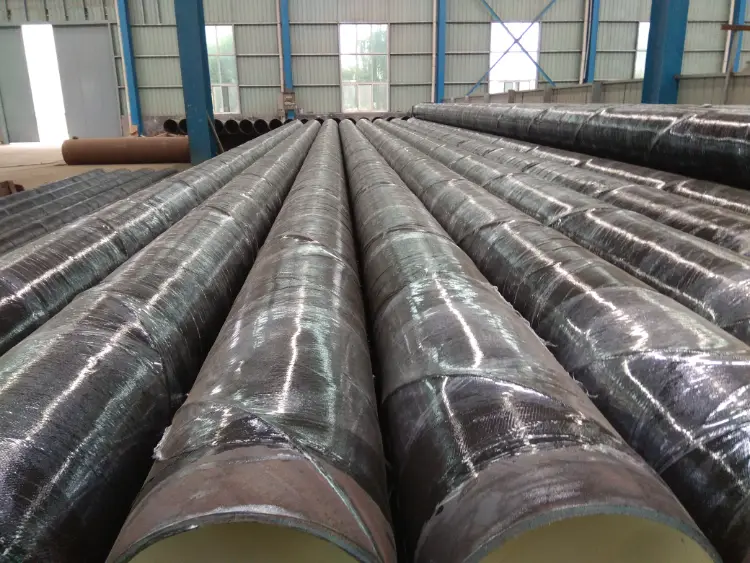
GB/T 9711 PSL2 L485 SSAW Steel Pipe
GB/T 9711 PSL2 L485 SSAW Steel Pipe: Composition, Properties & Global Equivalents
Comprehensive technical data for GB/T 9711-2011 PSL2 L485 SSAW pipeline steel pipe, including chemical composition, mechanical properties, thermal and electrical physical properties, international equivalent grades, and application guidance.
Spiral submerged arc welding (SSAW) from thermomechanically rolled (TMCP) strip/plate
- Phone : +8618037372205
- Email : [email protected]
- WhatsApp: Contact via Whtsapp
- WeChat: +8618037372205
GB/T 9711 PSL2 L485 SSAW Steel Pipe Introduction
L485 (X70) PSL2 steel is an advanced low-carbon, microalloyed pipeline material produced in accordance with GB/T 9711-2011 / ISO 3183:2007. It is supplied as SSAW (Spiral Submerged Arc Welded) pipe for high-pressure oil and gas transmission. The steel offers a minimum yield strength of 485 MPa with excellent toughness and weldability, achieved through controlled thermomechanical rolling and optimized microalloy additions (Nb, V, Ti). PSL2 imposes stricter requirements on chemical composition, carbon equivalent, notch toughness, and non-destructive testing compared to PSL1, ensuring reliability in sour service and low-temperature environments.
GB/T 9711 PSL2 L485 SSAW Steel Pipe Chemical Composition
The chemical composition of PSL2 L485 is tightly controlled to ensure weldability, strength, and toughness. Limits are given for both heat analysis and product analysis according to GB/T 9711-2011 Table 6. Elements Nb, V, Ti may be added singly or in combination, but their sum shall not exceed the specified maximum unless otherwise agreed. Carbon equivalent CEPcm ≤ 0.25% is typical for welded pipe to prevent cold cracking.
| Element | Heat Analysis (max, wt%) | Remarks |
|---|---|---|
| Carbon (C) | 0.12 | ≤ 0.12 for product analysis |
| Silicon (Si) | 0.45 | ≤ 0.45 |
| Manganese (Mn) | 1.70 | ≤ 1.70; may be raised to 1.75 for seamless, but SSAW typically 1.70 |
| Phosphorus (P) | 0.025 | Strictly limited for PSL2 |
| Sulfur (S) | 0.015 | Low sulfur for enhanced toughness |
| Vanadium (V) | 0.05 | Maximum unless otherwise agreed; Nb+V+Ti ≤ 0.15% |
| Niobium (Nb) | 0.05 | Same sum limitation |
| Titanium (Ti) | 0.04 | Same sum limitation |
| Copper (Cu) | 0.50 | Commonly ≤ 0.50, but not mandatory in GB/T 9711; provided as guidance |
| Nickel (Ni) | 0.50 | Same as above |
| Chromium (Cr) | 0.50 | Same as above |
| Molybdenum (Mo) | 0.50 | Same as above |
| Carbon Equivalent (Pcm) | 0.25 | Pcm = C + Si/30 + (Mn+Cu+Cr)/20 + Ni/60 + Mo/15 + V/10 + 5B; ≤ 0.25% |
GB/T 9711 PSL2 L485 SSAW Steel Pipe Thermal and Electrical Physical Properties
These values are typical for L485 type low-alloy pipeline steel at room temperature. Actual properties may vary slightly depending on exact processing and microstructure. The data are provided as engineering design references and are not part of mandatory certification according to GB/T 9711-2011.
| Property | Typical Value | Unit | Test Condition / Remarks |
|---|---|---|---|
| Density (ρ) | 7.85 | g/cm³ | 20°C |
| Modulus of Elasticity (E) | 210 | GPa | 20°C, longitudinal |
| Shear Modulus (G) | 81 | GPa | 20°C, calculated from E and ν |
| Poisson's Ratio (ν) | 0.3 | – | Within elastic range |
| Coefficient of Thermal Expansion (α) | 11.7 | 10⁻⁶/K | 20–100°C; 12.5 for 20–200°C, 13.2 for 20–400°C |
| Thermal Conductivity (λ) | 48 | W/(m·K) | 20°C; decreases with increasing temperature |
| Specific Heat Capacity (c) | 460 | J/(kg·K) | 20°C |
| Electrical Resistivity (ρe) | 0.22 | μΩ·m | 20°C |
GB/T 9711 PSL2 L485 SSAW Steel Pipe Mechanical Properties
Mechanical testing is performed on transverse strip tensile specimens or on pipe body specimens as per GB/T 9711-2011. PSL2 requires Charpy V-notch impact testing at -10°C (or lower if specified). The bending test mandates a 180° bend without cracking. Elongation depends on specimen dimensions and is calculated using the standard formula: A = 1940 * S0^0.2 / Rm^0.9 (or table values). Values below represent full-thickness specimens with a gauge length of 50 mm or 2 inches.
| Property | Specified Value | Unit | Test Condition |
|---|---|---|---|
| Yield Strength (ReH or Rt0.5) | 485–635 | MPa | Transverse direction, 0.5% total extension under load |
| Tensile Strength (Rm) | 570–760 | MPa | Transverse direction, room temperature |
| Yield-to-Tensile Ratio (ReH/Rm) | ≤ 0.93 | – | PSL2 requirement (may be relaxed for some applications) |
| Elongation (A) | ≥ 22 (min) | % | 50 mm gauge length, full-section strip specimen (wall thickness ≤ 10 mm); varies with wall thickness |
| Bend Test (180° bend) | Crack-free | – | Bend diameter = 3t for t ≤ 12.7 mm, other criteria per standard |
| Charpy Impact Energy (KV) | ≥ 27 (average) | J | Transverse, -10°C, full-size specimen (10×10 mm); single value ≥ 20 J |
| Hardness (optional) | ≤ 250 HV10 | HV | Usually for sour service or weld zone; not mandatory for standard PSL2 |
GB/T 9711 PSL2 L485 SSAW Steel Pipe Fully Equivalent Material Standards & Substitute Grades
| Country / Region | Standard | Grade | Remarks |
|---|---|---|---|
| International | ISO 3183:2012 / ISO 3183:2007 | L485 (PSL2) | Exact counterpart of GB/T 9711; L485ME or L485MB depending on delivery condition |
| United States | API Specification 5L, 46th Ed. | X70 (PSL2) | Dimensionally and chemically interchangeable; PSL2 SSAW pipe |
| European Union | EN 10208-2:2009 | L485MB | Seamless and welded steel pipes for pipelines for combustible fluids; optional sour service |
| Canada | CSA Z245.1-18 | Grade 483 (483 MPa min YS) | Line pipe standard; matches X70 strength level |
| Germany (DNV) | DNVGL-ST-F101 | S485 | Submarine pipeline systems; 485 MPa SMYS |
| Russia / CIS | GOST R 52079-2003 or GOST 20295-85 type | K56–K60 | Similar strength class; K56 is closest to L485 |
GB/T 9711 PSL2 L485 SSAW Steel Pipe Application Introduction
L485 (X70) SSAW pipe is the workhorse material for mainline transmission pipelines. It is suitable for both onshore and offshore applications. The combination of microalloying and TMCP provides an excellent balance of strength, toughness, and weldability, allowing efficient field girth welding. PSL2 designation adds mandatory fracture toughness testing and stricter NDT requirements, making it preferred for critical service.
Product Applications: Spiral submerged arc welded (SSAW) steel pipe from Ø219 mm (8 inch) up to Ø2540 mm (100 inch), Line pipe for API 5L / GB/T 9711 certified projects, Offshore pipeline systems with anti-corrosion coatings (3LPE, 3LPP, FBE), Pipe piles for coastal structures (strength and weldability)
Processed into products: Mainline pipe sections for gas/oil transmission (straight pipe segments and field bends), Induction bends and forged fittings (tees, reducers, caps), Flanges and welded branch connections, Pig launchers/receivers and other pressure vessels manufactured from identical material, Riser pipes and J-tubes for offshore platforms
Application industries: Oil & Gas Exploration and Production, Long-distance Pipeline Transportation (Crude oil, natural gas, refined products), Offshore Engineering (Subsea flowlines and risers), Water Transmission and High-pressure Water Injection, CO₂ transportation in carbon capture projects
GB/T 9711 PSL2 L485 SSAW Steel Pipe Similar / Alternative Grades for Design Reference
| Country / Region | Standard | Grade | Remarks |
|---|---|---|---|
| International | ISO 3183 / API 5L | L450 (X65) | Lower strength (450 MPa min YS); may be substituted if design allows |
| International | ISO 3183 / API 5L | L555 (X80) | Higher strength (555 MPa min YS); used for higher pressure or thinner wall design |
| European Union | EN 10208-2 | L450MB / L555MB | L450 is weaker, L555 is stronger; similar microalloyed concept |
Notes:
Supplementary requirements may apply for H₂S-containing (sour) environments: in that case, NACE MR0175/ISO 15156 compliance, hardness limits (e.g., ≤ 250 HV), and HIC/SSC testing are often required. Weld seam properties must also meet the base metal requirements for PSL2, including transverse tensile and impact testing. Delivery condition for SSAW pipe is as-welded; if stress relief or normalizing is required, it must be specified in the purchase order. The carbon equivalent (Pcm) limit of 0.25% ensures excellent field weldability without preheating for typical wall thicknesses. For pipe with wall thickness > 25 mm, additional fracture toughness testing (CTOD) may be specified.
- Share



