
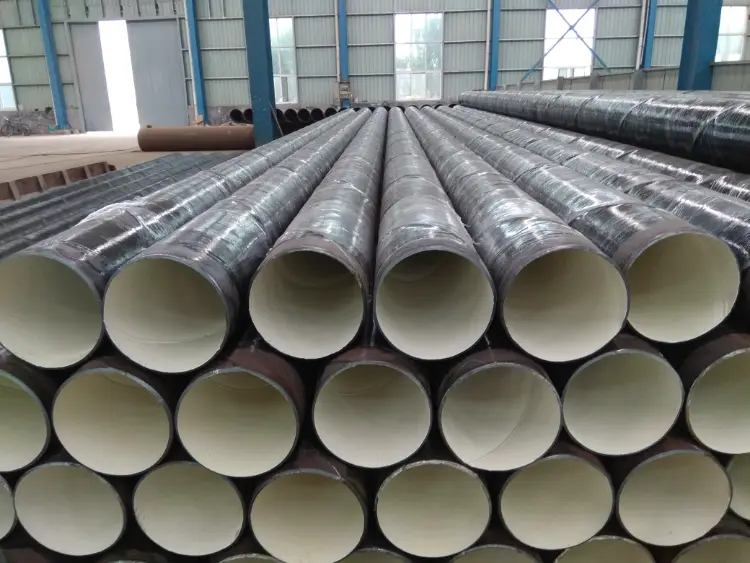
GB/T 9711-2011 PSL2 L450 SSAW Pipe
GB/T 9711-2011 PSL2 L450 SSAW Pipe Material Data Analysis
Comprehensive analysis of material data for GB/T 9711-2011 PSL2 L450 spiral submerged arc welded (SSAW) pipe, including chemical composition, mechanical properties, equivalent grades, and application guide.
Spiral submerged arc welding (SSAW), cold forming, normalising or TMCP as required, coating
- Phone : +8618037372205
- Email : [email protected]
- WhatsApp: Contact via Whtsapp
- WeChat: +8618037372205
GB/T 9711-2011 PSL2 L450 SSAW Pipe Introduction
L450 is a high-strength low-alloy (HSLA) steel grade specified in GB/T 9711-2011 (equivalent to ISO 3183:2012 and API 5L) for pipeline transportation systems. It belongs to PSL2 (Product Specification Level 2), which imposes stricter requirements on chemical composition, mechanical properties, and non-destructive testing compared to PSL1. SSAW pipes made from L450 steel are widely used in long-distance oil and gas transmission lines due to their excellent combination of high strength, good ductility, and impressive weldability. The steel is microalloyed with elements like Nb, V, and Ti to achieve refined grain structure and balanced tensile properties. Typical yield strength is at least 450 MPa, and the material can be supplied in as-rolled, normalised, or thermomechanically rolled condition. Careful control of carbon equivalent (CE) ensures that field welding can be performed without excessive preheat, while resistance to hydrogen-induced cracking (HIC) can be achieved for sour service applications when specified.
GB/T 9711-2011 PSL2 L450 SSAW Pipe Chemical Composition
The chemical composition of L450 PSL2 is tightly controlled to meet the high strength and toughness requirements of line pipe applications. Limits for impurity elements (P, S) and microalloying additions (Nb, V, Ti) are specified to ensure weldability and resistance to cracking. A maximum carbon equivalent (CEIIW ≤0.43%) is commonly required for field weldability. The values below are the maximum limits according to GB/T 9711-2011, Table A.2 for PSL2 pipes.
| Element | Max. Content (wt%) | Remarks |
|---|---|---|
| C | ≤0.22 | For sour service, lower C may be required |
| Si | ≤0.45 | Deoxidation element |
| Mn | ≤1.45 | Strengthening and deoxidation |
| P | ≤0.025 | Stringent control for toughness |
| S | ≤0.015 | Low sulfur for HIC resistance |
| V | ≤0.05 | Microalloying; sum V+Nb+Ti ≤0.15% |
| Nb | ≤0.05 | Grain refinement and precipitation hardening |
| Ti | ≤0.04 | Deoxidation and grain size control |
| Al (total) | ≤0.060 | Deoxidation; soluble Al typically <0.020% |
| N | ≤0.012 | Nitrogen content limit |
| Cu | ≤0.50 | Residual element; may be specified for sour service |
| Ni | ≤0.50 | Residual element |
| Cr | ≤0.50 | Residual element |
| Mo | ≤0.50 | Residual element; may be restricted for sour grade |
| B | ≤0.0005 | Optional for hardenability; requires precise control |
| Ca | Usually added for shape control of sulfides | Not a standard limit but often specified |
GB/T 9711-2011 PSL2 L450 SSAW Pipe Thermal and Electrical Physical Properties
The following physical properties are typical for L450 microalloyed carbon steel and are not mandatory parts of GB/T 9711-2011. They are provided for engineering calculations such as heat transfer, stress analysis, and electrical resistivity estimation. Actual values may vary slightly with composition and heat treatment condition.
| Property | Typical Value | Unit | Test Condition / Remarks |
|---|---|---|---|
| Density (ρ) | 7.85 | g/cm³ | 20°C |
| Elastic modulus (E) | 205 | GPa | Room temperature |
| Shear modulus (G) | 80 | GPa | Estimated from E and Poisson ratio |
| Poisson ratio (ν) | 0.29 | — | Room temperature |
| Thermal expansion coefficient (α) | 11.7 | 10⁻⁶ /°C | 20 – 100°C |
| Thermal expansion coefficient (α) | 12.6 | 10⁻⁶ /°C | 20 – 200°C |
| Thermal conductivity (λ) | 45 | W/(m·K) | 20°C |
| Specific heat capacity (c) | 500 | J/(kg·K) | Room temperature |
| Electrical resistivity (ρe) | 0.20 | μΩ·m | 20°C |
GB/T 9711-2011 PSL2 L450 SSAW Pipe Mechanical Properties
Tensile tests are performed on transverse specimens from the pipe body or weld. For PSL2, both yield strength (Rt0.5) and tensile strength (Rm) have upper limits to prevent excessive hardness. Charpy V-notch impact testing at 0°C is mandatory for all PSL2 pipes. The elongation requirement follows a formula based on specimen cross-section, typical minimum values are listed below. Hardness testing (HV10) is often specified to ensure resistance to stress corrosion cracking.
| Property | Specified Value | Unit | Test Condition |
|---|---|---|---|
| Rt0.5 (Yield Strength) | 450 – 570 | MPa | Transverse strip or round bar, pipe body |
| Rm (Tensile Strength) | 535 – 760 | MPa | Transverse, pipe body |
| A (Elongation after fracture) | ≥23 (typical for 12.7 mm x 50.8 mm gauge) | % | 50 mm gauge length, transverse; formula-dependent |
| Charpy V-notch impact (KV2) average | ≥27 | J | 0°C, 10×10 mm specimen, transverse |
| Charpy V-notch impact (KV2) single | ≥21 | J | 0°C, individual minimum |
| Hardness (HV10) | ≤250 | HV10 | Pipe body and weld; when specified |
GB/T 9711-2011 PSL2 L450 SSAW Pipe Fully Equivalent Material Standards and Replaceable Grades
| Country/Region | Standard | Grade | Remarks |
|---|---|---|---|
| China | GB/T 9711-2011 | L450 PSL2 | Base specification for SSAW pipe |
| International (ISO) | ISO 3183:2012 | L450 (M or N) | Identical technical content; M = TMCP, N = normalized |
| USA | API Spec 5L (45th Ed.) | X65 PSL2 | Direct equivalent; widely used globally |
| Europe | EN 10208-2:2009 | L450MB / L450NB | MB = TMCP, NB = normalized; fully aligned with ISO 3183 |
| Canada | CSA Z245.1-14 | Grade 450 Category II | Comparable PSL2 requirements |
| Russia | GOST R 52079-2003 | K56 | Class K56 corresponds to X65 equivalent |
| Brazil | ABNT NBR 15280 | X65 PSL2 | Based on API 5L |
GB/T 9711-2011 PSL2 L450 SSAW Pipe Application Introduction
L450 SSAW pipes are primarily employed in long-distance oil and gas transmission systems. The combination of high strength, good toughness, and reliable weldability makes them suitable for both onshore and offshore pipelines. PSL2 ensures enhanced integrity through rigorous testing, allowing operation under high pressure and in sour environments when properly specified. The pipes can be coated with FBE, 3LPE/3LPP for corrosion protection.
Product Applications: Cross-country oil and gas pipelines, Offshore risers and flowlines, Gas gathering networks, Oil well casings and tubulars, High-pressure water mains
Processed into products: Induction bends (hot-formed pipe bends), Pipe fittings (elbows, tees, reducers), Flanges and connectors, Valve bodies, Pipeline girth welds
Application industries: Oil and gas exploration and production, Petrochemical industry, Water treatment and sewage, Mining (slurry transport), Civil and structural engineering
GB/T 9711-2011 PSL2 L450 SSAW Pipe Similar/Alternative Strength Grades
| Country/Region | Standard | Grade | Remarks |
|---|---|---|---|
| International | ISO 3183 / API 5L | L415 / X60 PSL2 | Lower yield strength (≥415 MPa); suitable for less demanding pressure conditions |
| International | ISO 3183 / API 5L | L485 / X70 PSL2 | Higher yield strength (≥485 MPa); used for high-pressure and heavy-wall applications |
| Europe | EN 10208-2 | L415MB / L485MB | Close alternatives with lower/higher strength levels |
Notes:
SSAW manufacturing involves spiral forming of hot-rolled coil and double-sided submerged arc welding. Welding consumables and parameters are carefully selected to match the base metal strength. PSL2 requirements include mandatory ultrasonic inspection (UT) of the weld, full-body hydrostatic test, and stricter dimensional tolerances. For sour service (H2S-containing environments), supplementary hydrogen-induced cracking (HIC) and sulfide stress cracking (SSC) tests may be imposed. Carbon equivalent (CEIIW) is typically limited to 0.43% and CEPcm to 0.25% for field weldability and HIC resistance. All data provided is based on official standards and represents typical values; specific project requirements may necessitate additional testing or tighter limits.
- Share



