
GB/T 9711-2011 PSL2 L555 SSAW Pipe Steel
GB/T 9711-2011 PSL2 L555 SSAW Pipe Steel Data - Comprehensive Material Properties
Comprehensive data sheet for L555 steel under GB/T 9711-2011 PSL2, covering chemical, mechanical, thermal, and electrical properties, plus equivalent and similar materials.
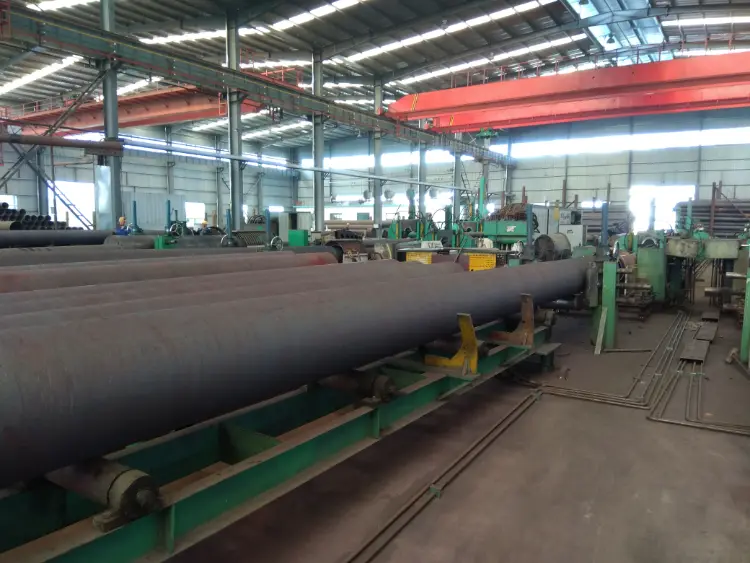
Thermo-mechanical controlled processing (TMCP) or normalising rolling for base plate; pipe manufactured by spiral forming and submerged arc welding (SAW)
- Phone : +8618037372205
- Email : [email protected]
- WhatsApp: Contact via Whtsapp
- WeChat: +8618037372205
GB/T 9711-2011 PSL2 L555 SSAW Pipe Steel Introduction
L555 is a high-strength low-alloy (HSLA) pipeline steel grade specified in GB/T 9711-2011 for petroleum and natural gas pipeline systems. It is primarily used in the form of spiral submerged arc welded (SSAW) pipes, offering a minimum yield strength of 555 MPa. This steel is equivalent to API 5L X80 (PSL2) and is designed for high-pressure, large-diameter transmission lines. The PSL2 designation imposes stricter limits on chemical composition, mechanical properties, and non-destructive inspection to ensure superior performance in demanding environments. L555 exhibits excellent strength, toughness, weldability, and resistance to ductile fracture, making it a key material in modern long-distance energy infrastructure.
GB/T 9711-2011 PSL2 L555 SSAW Pipe Steel Chemical Composition
Chemical limits for L555 steel according to GB/T 9711-2011 PSL2. Composition is based on product analysis and controls microalloying elements to achieve the required strength–toughness balance. The carbon equivalent (CEpcm) is restricted to improve weldability.
| Chemical Element | Standard Value (max, unless range) | Remarks |
|---|---|---|
| Carbon (C) | 0.12 | Max |
| Silicon (Si) | 0.45 | Max |
| Manganese (Mn) | 1.85 | Max |
| Phosphorus (P) | 0.025 | Max (PSL2) |
| Sulfur (S) | 0.015 | Max (PSL2) |
| Niobium (Nb) | 0.06 | Max |
| Vanadium (V) | 0.06 | Max |
| Titanium (Ti) | 0.04 | Max |
| Niobium + Vanadium + Titanium | 0.15 | Max, sum of Nb+V+Ti |
| Copper (Cu) | 0.50 | Max if required |
| Nickel (Ni) | 0.50 | Max if required |
| Chromium (Cr) | 0.50 | Max if required |
| Molybdenum (Mo) | 0.50 | Max if required |
| Nitrogen (N) | 0.012 | Max unless Al is present |
| Aluminium (Al) | 0.060 total; 0.020 acid-soluble | When Al is used for grain refinement |
| Boron (B) | 0.0005 | Max if not deliberately added |
| Carbon Equivalent (CEpcm) | 0.25 | Product analysis, max |
GB/T 9711-2011 PSL2 L555 SSAW Pipe Steel Thermal and Electrical Physical Properties
Representative physical properties for L555 (X80) high-strength low-alloy steel. Values are applicable for engineering design and may vary slightly with actual manufacturing route and temperature.
| Property | Typical Value | Unit | Test Condition |
|---|---|---|---|
| Density (ρ) | 7.85 | g/cm³ | At 20°C |
| Modulus of Elasticity (E) | 207 | GPa | At 20°C |
| Shear Modulus (G) | 80 | GPa | At 20°C (calculated from E and ν) |
| Poisson's Ratio (ν) | 0.3 | – | At 20°C |
| Thermal Expansion Coefficient (α) | 11.7 | 10⁻⁶ 1/K | 20–100°C |
| Thermal Expansion Coefficient (α) | 12.5 | 10⁻⁶ 1/K | 20–200°C |
| Thermal Expansion Coefficient (α) | 13.6 | 10⁻⁶ 1/K | 20–300°C |
| Thermal Conductivity (λ) | 45 | W/(m·K) | At 20°C |
| Thermal Conductivity (λ) | 42 | W/(m·K) | At 200°C |
| Specific Heat Capacity | 470 | J/(kg·K) | 20–100°C |
| Electrical Resistivity (ρ_e) | 0.22 (22 μΩ·cm) | Ω·m | At 20°C |
GB/T 9711-2011 PSL2 L555 SSAW Pipe Steel Mechanical Properties
Minimum and range requirements for L555 PSL2 base metal per GB/T 9711-2011. Tests are performed on transverse strip specimens. Notch toughness is verified by Charpy V-notch impact tests, and ductile fracture resistance by Drop Weight Tear Test (DWTT).
| Property | Standard Requirement | Unit | Test Condition |
|---|---|---|---|
| Yield Strength (ReH) | 555 – 780 (min 555) | MPa | Transverse, 0.5% elongation under load |
| Tensile Strength (Rm) | 625 – 825 | MPa | Transverse, at room temperature |
| Elongation after fracture (A) | ≥ 22 | % | Gauge length 50 mm, thickness ≤ 25.4 mm |
| Elongation after fracture (A) | ≥ 20 | % | Gauge length 50 mm, thickness > 25.4 mm |
| Yield to Tensile Ratio (ReH/Rm) | ≤ 0.93 | – | PSL2 requirement |
| Bend Test (180°) | No cracks or fissures after bending | – | Mandrel diameter = 3 × specimen thickness (for t ≤ 12.7 mm) |
| Charpy V-notch Impact Energy (KV) | ≥ 40 (single) / ≥ 60 (average) | J | Transverse, test temperature 0°C (other temperatures by agreement) |
| Drop Weight Tear Test (DWTT), Shear Area | ≥ 85 | % | At 0°C or as agreed, wall thickness ≥ 6.35 mm |
| Hardness | ≤ 270 HV10 | HV | Base metal and weld metal, transverse section |
GB/T 9711-2011 PSL2 L555 SSAW Pipe Steel Fully Equivalent Material Standards and Substitutable Grades
| Country/Region | Standard | Grade | Remarks |
|---|---|---|---|
| International | API Spec 5L 46th Edition | X80 (PSL2) | Direct equivalent for line pipe; covers SSAW, LSAW, seamless pipes. |
| International | ISO 3183:2019 | L555M (PSL2) | Identical technical content with GB/T 9711; globally recognized. |
| European | EN 10208-2 | L555MB | European standard for steel pipes in combustible fluid pipelines; fully comparable. |
| Russian / CIS | GOST R 52079 | K65 (Strength Class K65) | National standard; K65 corresponds to L555/X80 strength level. |
GB/T 9711-2011 PSL2 L555 SSAW Pipe Steel Application Introduction
L555 (X80) SSAW pipes are extensively used in large-diameter, high-pressure transmission systems for natural gas, crude oil, and refined products. The material is designed for excellent low-temperature toughness and fracture arrest capability, enabling safe operation in challenging environments including arctic regions and seismically active zones. PSL2 certification ensures full traceability and consistent quality.
Product Applications: SSAW pipes with outside diameters typically from 406 mm (16 inch) to 2540 mm (100 inch), Pipe fittings (induction bends, tees, reducers) fabricated from matching L555 material, Sour-service line pipe with additional HIC/SSC testing when ordered to NACE MR0175/ISO 15156 requirements
Processed into products: Line pipe main body (spirally welded joints), Long-radius induction bends for directional changes, Valve bodies and connecting flanges (when dual certified to pressure vessel standards), Anchor flanges and pup pieces for pipeline tie-ins, Structural elements in offshore jacket platforms (as rolled beams or tubulars)
Application industries: Oil & Gas (Onshore long-distance transmission lines, gas trunk pipelines), Offshore pipeline systems (risers and flowlines for shallow water), Refining and petrochemical (high-pressure process piping), Power generation (cooling water lines, heavy-wall structural piping)
GB/T 9711-2011 PSL2 L555 SSAW Pipe Steel Similar / Alternative Material Recommendations
| Country/Region | Standard | Grade | Remarks |
|---|---|---|---|
| China | GB/T 9711-2011 | L485 (X70) | Lower strength grade (min YS 485 MPa); often used when lower pressure or thinner wall is acceptable. |
| China | GB/T 9711-2011 | L625 (X90) | Higher strength grade for ultra-high pressure applications; less common and requires special welding procedures. |
| International | API Spec 5L | X70 (PSL2) | Widely used globally; slightly lower strength but excellent field weldability and proven history. |
| European | EN 10208-2 | L485MB (X70) | Similar application profile; preferred when available wall thickness is adequate. |
| North America | ASTM A691 | Grade 1 Cr (or 1-1/4 Cr) | Alloy steel pipe for elevated-temperature service; not directly comparable but an option for high-strength piping in specific conditions. |
Notes:
For SSAW pipe, the weld metal and heat-affected zone (HAZ) must meet the same hardness and toughness requirements as the base material. Supplementary testing (e.g., HIC per NACE TM0284, SSC per NACE TM0177) can be performed upon customer request for sour service applications. The material is typically produced by TMCP to achieve the required properties without excessive alloy addition. Pre-welding qualification according to API 1104 or equivalent is mandatory for field girth welding. Delivery may include third-party inspection and positive material identification (PMI).
- Share



