
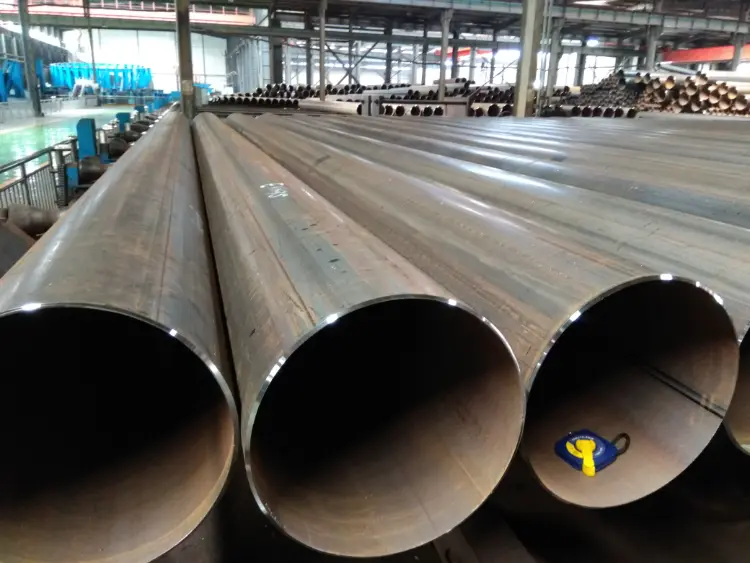
GB/T 9711-2011 PSL2 L390 SSAW Pipe Steel
GB/T 9711-2011 PSL2 L390 SSAW Pipe Steel - Properties, Composition & Equivalents
Comprehensive material data for L390 (X56) PSL2 steel used in spiral submerged arc welded (SSAW) pipes per GB/T 9711-2011, covering chemical composition, mechanical properties, physical performance, international equivalents and application guidance.
Spiral submerged arc welding (SSAW), thermo‑mechanically controlled rolling (TMCP), normalising, cold expansion (if applicable)
- Phone : +8618037372205
- Email : [email protected]
- WhatsApp: Contact via Whtsapp
- WeChat: +8618037372205
GB/T 9711-2011 PSL2 L390 SSAW Pipe Steel Introduction
L390 (PSL2) is a medium–strength steel grade specified in GB/T 9711-2011 (Petroleum and natural gas industries – Steel pipe for pipeline transportation systems) for the manufacture of spiral submerged arc welded (SSAW) pipes. It corresponds to API 5L X56 and ISO 3183 L390. The PSL2 classification imposes stricter requirements on chemical composition, notch toughness and non‑destructive inspection compared to PSL1, making it suitable for high‑pressure, long‑distance oil and gas transmission in demanding service conditions. Typical delivery condition is thermo‑mechanically controlled processed (TMCP) or normalised, ensuring a fine grain structure with excellent weldability, low‑temperature toughness and good resistance to brittle fracture.
- Nominal yield strength: 390 MPa (56 ksi) minimum
- Good weldability with low carbon equivalent (CEV ≤ 0.43)
- Available in large‑diameter spiral welded pipes for pipeline construction
- Fully killed, fine‑grain practice with aluminium treatment
GB/T 9711-2011 PSL2 L390 SSAW Pipe Steel Chemical Composition – PSL2 L390 / X56 as per GB/T 9711-2011
The chemical requirements for L390 PSL2 are strictly controlled to ensure weldability and mechanical performance. Limits are given for heat analysis; product analysis tolerances are defined in the standard. The steel is fully killed and fine‑grain treated with aluminium. Maximum carbon equivalent (CEV) is calculated using the formula: CEV = C + Mn/6 + (Cr+Mo+V)/5 + (Ni+Cu)/15, and shall not exceed 0.43. The sum of V, Nb and Ti shall not exceed 0.15%.
| Element | Standard Value (max unless range) | Remarks |
|---|---|---|
| C | ≤ 0.22 | Pipe body; weld metal may have different limits |
| Si | ≤ 0.45 | Killed steel with sufficient deoxidation |
| Mn | ≤ 1.40 | Contributes to strength and toughness |
| P | ≤ 0.020 | Strict PSL2 limit for improved toughness |
| S | ≤ 0.010 | Ultra‑low sulphur for reduced inclusion content |
| V | ≤ 0.05 | V+Nb+Ti ≤ 0.15 % |
| Nb | ≤ 0.05 | For grain refinement and precipitation strengthening |
| Ti | ≤ 0.04 | Nitrogen binding and grain refinement |
| Al (total) | 0.015 – 0.060 | Fully killed, fine‑grain practice; acid soluble Al also used |
| N | ≤ 0.012 | Maximum nitrogen content (PSL2 requirement) |
| CEV | ≤ 0.43 | Based on heat analysis; for wall thickness ≤ 25 mm typical |
| Others (Cu, Ni, Cr, Mo) | ≤ 0.50; ≤ 0.30; ≤ 0.30; ≤ 0.15 | Residual elements, limited to avoid excessive hardenability |
GB/T 9711-2011 PSL2 L390 SSAW Pipe Steel Thermal and Electrical Physical Properties
The following physical properties are indicative for low‑carbon, micro‑alloyed line pipe steel of the L390 grade. Actual values may vary slightly depending on the exact chemical composition and processing route (TMCP vs normalised). These data are useful for design calculations involving thermal expansion, heat transfer, stress analysis, and cathodic protection.
| Property | Typical Value | Unit | Test Condition / Remarks |
|---|---|---|---|
| Density (ρ) | 7.85 | g/cm³ | Room temperature |
| Modulus of elasticity (E) | 200 – 210 | GPa | Room temperature, static test |
| Shear modulus (G) | 80 – 82 | GPa | Estimated from E and Poisson's ratio |
| Poisson's ratio (ν) | 0.29 – 0.30 | — | Room temperature, elastic range |
| Thermal expansion coefficient (α) | 11.7 – 13.5 | 10⁻⁶ /K | 20–200 °C range (typical values for Mn‑Nb steel) |
| Thermal conductivity (λ) | 42 – 52 | W/(m·K) | At 25 °C; decreases with rising temperature |
| Specific heat capacity (cₚ) | 460 – 500 | J/(kg·K) | At 20–100 °C |
| Electrical resistivity (ρₑ) | 0.20 – 0.28 | μΩ·m | At 20 °C, typical for carbon‑manganese steel |
GB/T 9711-2011 PSL2 L390 SSAW Pipe Steel Mechanical Properties – PSL2 L390 / X56 as per GB/T 9711-2011
Mechanical testing is performed on pipe body samples taken in the transverse direction (perpendicular to the pipe axis). All values refer to room temperature unless otherwise noted. Tensile tests are carried out in accordance with ISO 6892‑1 or ASTM A370. The yield strength is the stress at 0.5% total extension (ReH). Elongation values are based on a gauge length of 50 mm (A₅₀). Charpy V‑notch impact tests are conducted on full‑size (10×10×55 mm) specimens at 0 °C; minimum average absorbed energy is 27 J with individual minimum 20 J. Guided‑bend tests must show no cracks or other defects after 180° bending.
| Property | Required Value | Unit | Test Condition / Remarks |
|---|---|---|---|
| Yield strength (ReH) | 390 – 545 | MPa | Transverse, 0.5% total extension, room temperature |
| Tensile strength (Rm) | 490 – 760 | MPa | Transverse, room temperature |
| Yield to tensile ratio (ReH / Rm) | ≤ 0.93 (typical agreement) | — | Not mandated in GB/T 9711, but often specified for strain‑based design |
| Elongation after fracture (A₅₀) | ≥ 22 | % | 50 mm gauge length, transverse; exact value calculated by formula for t ≤ 25.4 mm |
| Charpy impact energy (KV₂, 0 °C) | ≥ 27 (average) | J | Full‑size specimen; individual min 20 J; test temperature 0 °C (unless lower temperature agreed) |
| Guided‑bend test | No cracks or defects > 3 mm | — | 180° bending; mandrel diameter 4t for wall thickness t |
| Hardness (HV10 or HRC) | ≤ 255 HV10 / 25 HRC | — | Maximum value for weld and HAZ; reference requirement in supplementary specification |
GB/T 9711-2011 PSL2 L390 SSAW Pipe Steel Exact Equivalent Material Standards and Substitute Grades
| Country / Region | Standard | Grade | Remarks |
|---|---|---|---|
| International | ISO 3183 | L390 (PSL 2) | Same strength level, wall thicknesses and test requirements align with GB/T 9711-2011 |
| USA | API 5L (46th Ed.) | X56 (PSL 2) | Direct equivalent; widely used in oil & gas pipelines |
| Europe | EN 10208-2 | L390MB (comparable) | Minor differences in CEV limits; PSL2 requirements essentially similar |
| China | GB/T 9711-2011 | L390 (PSL2) | The reference standard for this material |
GB/T 9711-2011 PSL2 L390 SSAW Pipe Steel Application Introduction
L390 PSL2 SSAW pipe is primarily designed for high‑pressure transportation of sweet and sour hydrocarbons. Its balanced chemistry and controlled rolling provide:
- High resistance to hydrogen‑induced cracking (HIC) in sour service (when specially tested).
- Excellent field weldability, reducing pre‑heat and post‑weld heat treatment needs.
- Good low‑temperature toughness for Arctic or subsea applications.
Typical use includes long‑distance on‑shore and off‑shore pipelines, city gas networks, and structural applications in pipe piling.
Product Applications: Spiral welded steel pipes (SSAW, SAWH) in diameters up to 3048 mm, High‑pressure pipeline segments (coated and lined), Pipe fittings (elbows, tees) fabricated from L390 plate, Casing pipes for underground storage
Processed into products: Mainline pipe for crude oil and natural gas pipelines, Riser pipes and flowlines for offshore platforms, Valve bodies and flanges (when manufactured from corresponding forging grade), Piling pipes and structural tubular columns, Penstock pipes for hydroelectric power stations
Application industries: Oil & gas exploration and production (upstream, midstream), Pipeline transportation (cross‑country, subsea), Gas distribution utilities, Petrochemical plants (pipe rack, transfer lines), Marine and offshore engineering
GB/T 9711-2011 PSL2 L390 SSAW Pipe Steel Closely Related / Alternative Materials for Consideration
| Country / Region | Standard | Grade | Remarks |
|---|---|---|---|
| China | GB/T 9711-2011 | L415 (X60) PSL2 | Next higher strength grade (415 MPa yield); slightly higher C and Mn; CEV ≤ 0.43; can be used for higher pressure or thinner wall design |
| USA | API 5L | X52 (L360) PSL2 | Lower strength grade (360 MPa yield); good toughness; often used where lower operating pressures are acceptable |
| International | ISO 3183 | L415 (X60) PSL 2 | Higher strength variant with comparable weldability and toughness |
| Europe | EN 10208-2 | L360MB | Similar low‑temperature toughness, lower yield strength for less demanding applications |
Notes:
Supplementary notes:
- When used in sour service environments, supplementary HIC and SSC tests as per NACE MR0175/ISO 15156 are required. The steel should demonstrate hardness ≤ 248 HV10 and pass HIC tests with crack length ratio (CLR) ≤ 5% (or as agreed).
- For offshore applications, Charpy transition temperature and CTOD (Crack Tip Opening Displacement) values may be specified.
- PSL2 mandates full‑body ultrasonic or electromagnetic inspection as per the standard, ensuring weld integrity and base metal soundness.
- All values represent mandatory requirements unless marked as "typical". For final design, refer to the latest version of GB/T 9711-2011 and project specifications.
- Share



