
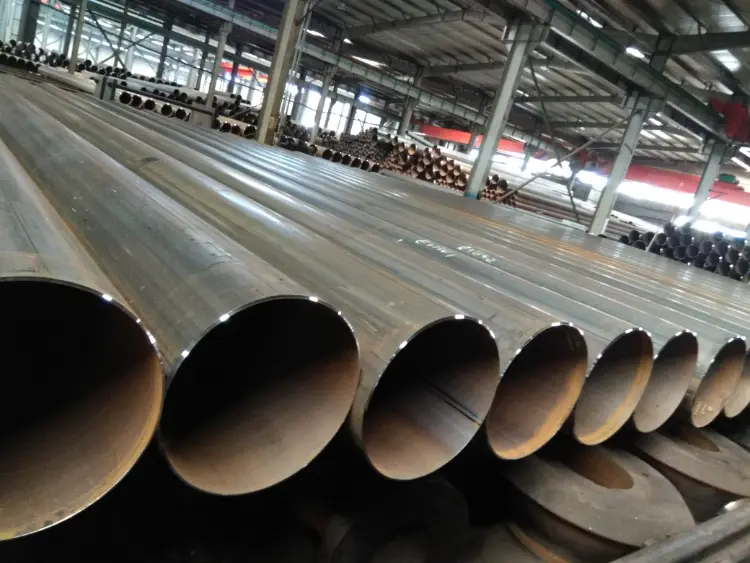
GB/T 9711GB/T 9711-2011 PSL2 L360 SSAW Line Pipe
GB/T 9711-2011 PSL2 L360 SSAW Line Pipe Material Analysis & Equivalent Grades
Comprehensive material properties for L360 steel pipe under GB/T 9711-2011 PSL2, including chemical composition, mechanical properties, physical properties, and international equivalents for oil and gas pipeline applications.
Hot-rolled strip or plate, formed by spiral bending and welded by double-sided submerged arc welding; often supplied in expanded condition.
- Phone : +8618037372205
- Email : [email protected]
- WhatsApp: Contact via Whtsapp
- WeChat: +8618037372205
GB/T 9711GB/T 9711-2011 PSL2 L360 SSAW Line Pipe Introduction
L360 steel is a microalloyed high-strength low-alloy (HSLA) pipe material designed for oil and gas transmission pipelines, classified as PSL2 under GB/T 9711-2011 (equivalent to API 5L X52). It is commonly produced as Spiral Submerged Arc Welded (SSAW) pipe. Key features include:
- Excellent weldability and toughness due to fine-grained microstructure and controlled rolling.
- Stringent restrictions on chemical composition (C≤0.22%, low S, P) and carbon equivalent to ensure field weldability.
- Minimum yield strength of 360 MPa, with a maximum yield-to-tensile ratio of 0.85 to provide sufficient plastic deformation capacity.
- Good low-temperature impact toughness (typically tested at -20°C or lower).
- Compliance with PSL2 ensures additional requirements for fracture toughness, NDT, and traceability.
GB/T 9711GB/T 9711-2011 PSL2 L360 SSAW Line Pipe Chemical Composition
Chemical requirements are based on product analysis according to GB/T 9711-2011 PSL2. For L360 grade, the maximum limits are listed below. The sum of V+Nb+Ti is limited to ensure grain refinement. Specific values may be adjusted for thickness and product type, but must meet the standard's maximum limits and carbon equivalent requirements.
| Element | Standard Value (max, wt%) | Remarks |
|---|---|---|
| Carbon (C) | 0.22 | PSL2 limit for L360 |
| Silicon (Si) | 0.45 | PSL2 limit |
| Manganese (Mn) | 1.40 | PSL2 limit; higher Mn may be agreed for specific thickness |
| Phosphorus (P) | 0.025 | Maximum allowed in PSL2 |
| Sulfur (S) | 0.015 | Maximum allowed in PSL2 |
| Vanadium (V) | 0.05 | Combined V+Nb+Ti ≤ 0.15% |
| Niobium (Nb) | 0.05 | Combined V+Nb+Ti ≤ 0.15% |
| Titanium (Ti) | 0.04 | Combined V+Nb+Ti ≤ 0.15% |
| Copper (Cu) | 0.50 | Residual element; not specified as addition |
| Nickel (Ni) | 0.30 | Residual element |
| Chromium (Cr) | 0.30 | Residual element |
| Molybdenum (Mo) | 0.15 | Residual element |
| Aluminum (Al) | — | Usually present as deoxidizer; total Al 0.015–0.06% |
| Nitrogen (N) | 0.012 | Max allowed unless combined with grain-refining elements |
| Carbon Equivalent (CE Pcm) | 0.25 | For controlled crack susceptibility; typical Pcm limit |
GB/T 9711GB/T 9711-2011 PSL2 L360 SSAW Line Pipe Thermal and Electrical Physical Properties
These typical physical properties apply to L360 HSLA steel at room temperature unless noted otherwise. They are representative for pipeline design and engineering calculations. Actual values may vary slightly depending on exact composition and manufacturing process.
| Property | Typical Value | Unit | Condition |
|---|---|---|---|
| Density (ρ) | 7.85 | g/cm³ | 20°C |
| Elastic Modulus (E) | 210 | GPa | 20°C |
| Shear Modulus (G) | 81 | GPa | 20°C (calculated) |
| Poisson Ratio (ν) | 0.3 | — | 20°C |
| Thermal Expansion Coefficient (α) | 12.0 | 10⁻⁶/K | 20–100°C |
| Thermal Expansion Coefficient (α) | 12.5 | 10⁻⁶/K | 20–200°C |
| Thermal Expansion Coefficient (α) | 13.0 | 10⁻⁶/K | 20–300°C |
| Thermal Conductivity (λ) | 50 | W/(m·K) | 20°C |
| Specific Heat Capacity (c) | 480 | J/(kg·K) | 20°C |
| Electrical Resistivity (ρe) | 0.20 | Ω·mm²/m | 20°C |
GB/T 9711GB/T 9711-2011 PSL2 L360 SSAW Line Pipe Mechanical Properties
The mechanical properties listed below are minimum/maximum required values according to GB/T 9711-2011 PSL2 for L360 steel. Testing is performed on the base metal transverse to the weld, with full-section or machined strip specimens. Impact energy values are based on standard Charpy V-notch tests at a specified temperature.
| Property | Required Value | Unit | Test Condition |
|---|---|---|---|
| Yield Strength (ReH) | 360 – 530 | MPa | Tensile test, transverse direction |
| Tensile Strength (Rm) | 460 – 760 | MPa | Tensile test, transverse direction |
| Yield-to-Tensile Ratio (ReH/Rm) | ≤ 0.85 | — | For PSL2 pipes |
| Elongation (A) | Min. 22 | % | Gauge length 50 mm or as per formula A = 1940 × Ae0.2/Rm0.9 |
| Charpy Impact (KV) | Min. 27 (individual), 40 (average) | J | Transverse specimen, -20°C (or as agreed) |
| Charpy Impact (KV) at lower temp | Min. 27 (individual), 40 (average) | J | As agreed, e.g., -30°C or -45°C |
| Bend Test | No cracks or openings >3 mm | — | 180° bend over mandrel of diameter 4T (T=thickness) |
| Hardness (HV10) | Max. 250 | HV10 | Base metal and heat-affected zone |
GB/T 9711GB/T 9711-2011 PSL2 L360 SSAW Line Pipe Fully Equivalent Material Standards and Replacement Grades
| Country/Region | Standard | Grade/Designation | Remarks |
|---|---|---|---|
| International | ISO 3183:2019 | L360 | PSL2, identical technical delivery conditions |
| USA | API 5L (46th Edition) | X52 PSL2 | L360 is also designated as X52 in API 5L |
| Europe | EN 10208-2 | L360MB | Steel pipes for combustible fluids; type M = hot-rolled |
| Canada | CSA Z245.1 | Grade 359 (Cat II) | Category II corresponding to PSL2 |
| Russia | GOST R 52079 | K52 | Equivalent to L360/X52 |
GB/T 9711GB/T 9711-2011 PSL2 L360 SSAW Line Pipe Application Introduction
L360 (X52) steel pipe, especially in SSAW form, is widely used in oil and gas transmission pipelines where moderate strength, good weldability, and cost-effectiveness are required. It is also utilized in structural applications like offshore platforms and pipe piles. The PSL2 designation guarantees additional toughness and non-destructive testing for critical service.
Product Applications: Crude oil trunk lines, Natural gas long-distance pipelines, Refined product pipelines, Gathering and distribution systems, Offshore pipeline risers and flowlines (sweet service)
Processed into products: Line pipe segments (SSAW pipes, typically 6m to 12m lengths), Induction bends (hot formed), Elbows, reducers, tees (fittings), Flanges (weld neck, slip-on), Structural tubular members in bridges and buildings (when specified as structural pipe)
Application industries: Onshore and offshore oil & gas transportation, Petrochemical and refining, Water transmission and distribution, Structural engineering (piling, bracing), Mining (slurry pipelines)
GB/T 9711GB/T 9711-2011 PSL2 L360 SSAW Line Pipe Similar / Alternate Material Recommendations
| Country/Region | Standard | Grade/Designation | Remarks |
|---|---|---|---|
| China | GBT 9711 | L290/X42 (PSL2) | Slightly lower strength, suitable where load is lower |
| China | GBT 9711 | L415/X60 (PSL2) | Higher strength alternative for increased operating pressure |
| International | ISO 3183 | L360NB | Normalizing-delivered seamless pipe, similar strength |
| Europe | EN 10208-2 | L360GA | Controlled-rolled plate, not normalized |
| USA | API 5L | X52N, X52Q | Normalized (N) or quenched & tempered (Q) delivery conditions |
| Japan | JPI S-1015 | L360 | Japanese pipeline standards, very similar |
Notes:
Additional requirements for PSL2: Carbon equivalent (CEPcm) limit applies to control hydrogen-induced cracking. Non-destructive testing (ultrasonic or eddy current) of the entire pipe body is mandatory. Supplementary testing such as HIC (Hydrogen Induced Cracking) and SSC (Sulfide Stress Cracking) may be specified for sour service. Dimensional tolerances for SSAW pipe are given in the standard. Surface condition and repair welding are strictly controlled. For design, refer to the corresponding pipeline design code (e.g., ASME B31.4, B31.8).
- Share



