
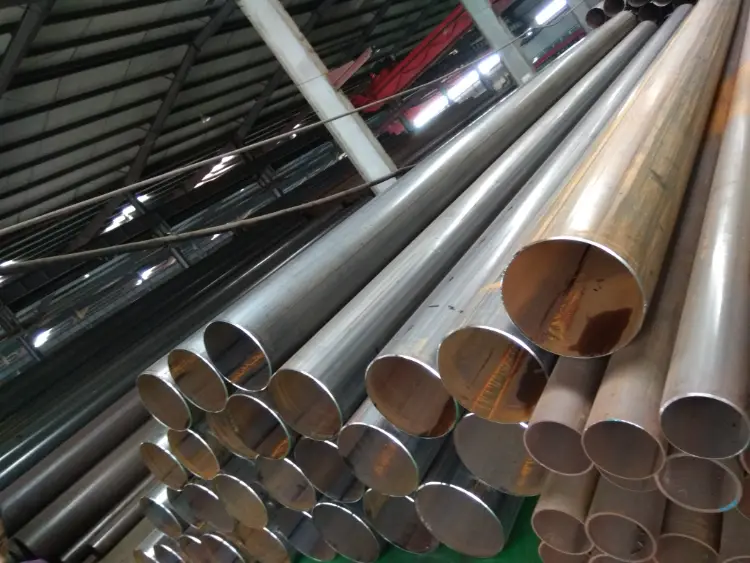
GB/T9711-2011 PSL2 L320 SSAW Pipe
GB/T9711-2011 PSL2 L320 SSAW Pipe: Comprehensive Material Data & Equivalent Grades
In-depth technical data for L320 spiral submerged arc welded pipe under GB/T 9711-2011 PSL2, including chemical composition, mechanical properties, physical properties, international equivalents, and application guidelines.
Welding process: SAW (Submerged Arc Welding); Forming process: Spiral forming; Suitable for further processing: beveling, coating, 3LPE/3LPP/FBE external coating, internal lining.
- Phone : +8618037372205
- Email : [email protected]
- WhatsApp: Contact via Whtsapp
- WeChat: +8618037372205
GB/T9711-2011 PSL2 L320 SSAW Pipe Introduction
GB/T 9711-2011 L320 PSL2 SSAW pipe is a high-quality steel line pipe delivered in spiral submerged arc welded (SSAW) form. It belongs to the L320 grade with product specification level 2 (PSL2), ensuring tighter chemical composition, improved strength and toughness, and mandatory non-destructive testing compared to PSL1. The material exhibits a minimum yield strength of 320 MPa, excellent weldability, and good low-temperature notch toughness. Typical microstructure consists of fine-grained ferrite-pearlite obtained through thermo-mechanical controlled processing (TMCP). L320 is widely used for long-distance oil and gas transmission pipelines, where spiral welded construction provides economic production of large diameters.
GB/T9711-2011 PSL2 L320 SSAW Pipe Chemical Composition
The chemical composition limits for PSL2 L320 are specified in GB/T 9711-2011 Table 8.
- Carbon equivalent (Ceq & Pcm) restrictions ensure good field weldability.
- Microalloying elements Nb, V, and Ti are added individually or in combination for grain refinement and strength, with a sum not exceeding the specified maximum.
- Residual elements like Cu, Ni, Cr, and Mo are also restricted to prevent adverse effects on corrosion resistance and toughness.
| Element | Standard Value (max unless noted) | Remarks |
|---|---|---|
| C | 0.22% | Ladle analysis |
| Si | 0.45% | Ladle analysis |
| Mn | 1.40% | Ladle analysis |
| P | 0.025% | PSL2 requirement |
| S | 0.015% | PSL2 requirement |
| V | Note 1 | See below |
| Nb | Note 1 | See below |
| Ti | Note 1 | See below |
| V+Nb+Ti | ≤ 0.15% | Sum of microalloying, ladle analysis |
| Cu | ≤ 0.50% | If Cu content is specified |
| Ni | ≤ 0.50% | If Ni content is specified |
| Cr | ≤ 0.50% | If Cr content is specified |
| Mo | ≤ 0.50% | If Mo content is specified |
| Ceq (C + Mn/6 + (Cr+Mo+V)/5 + (Ni+Cu)/15) | ≤ 0.43% | Based on ladle analysis, for wall thickness ≤ 25.0 mm |
| Pcm (C + Si/30 + (Mn+Cu+Cr)/20 + Ni/60 + Mo/15 + V/10 + 5B) | ≤ 0.23% | Based on ladle analysis, when specified |
GB/T9711-2011 PSL2 L320 SSAW Pipe Thermal and Electrical Physical Properties
The following data represent typical physical properties for low-carbon microalloyed pipeline steel of this strength grade. These are not specified in GB/T 9711 but are derived from published literature on similar steel grades (such as API X46).
- Density is comparable to that of carbon steel.
- Thermal conductivity and electrical resistivity vary with temperature; values are given at room temperature (20°C).
- Thermal expansion coefficient is averaged for the 20-100°C range.
| Property | Typical Value | Unit | Test Condition |
|---|---|---|---|
| Density (ρ) | 7.85 | g/cm³ | 20°C |
| Elastic Modulus (E) | 210 | GPa | 20°C |
| Shear Modulus (G) | 80 | GPa | 20°C |
| Poisson's Ratio (ν) | 0.30 | — | 20°C |
| Thermal Expansion Coefficient (α) | 12.0 | 10⁻⁶/K | 20-100°C average |
| Thermal Conductivity (λ) | 50 | W/(m·K) | 20°C |
| Specific Heat Capacity (cp) | 480 | J/(kg·K) | 20°C |
| Electrical Resistivity (ρₑ) | 0.16 | μΩ·m | 20°C |
GB/T9711-2011 PSL2 L320 SSAW Pipe Mechanical Properties
Mechanical property requirements according to GB/T 9711-2011 for transverse specimens taken from the pipe body.
- Minimum and maximum limits for yield and tensile strength ensure a balanced strength-ductility ratio.
- Bend test is a guided bend test (180°) with no cracks exceeding 3 mm permitted.
- Charpy V-notch impact tests are mandatory for PSL2, with the minimum average energy of 27 J for full-size specimens at the specified test temperature (0°C if not otherwise agreed).
- For different wall thicknesses, elongation requirements may differ; representative values are shown for common thickness ranges.
| Property | Required Value | Unit | Test Condition / Remarks |
|---|---|---|---|
| Yield Strength (Rt0.5) | 320 - 525 | MPa | Transverse strip specimen, 0.5% total extension |
| Tensile Strength (Rm) | 435 - 655 | MPa | Transverse strip specimen |
| Yield to Tensile Ratio (Rt0.5/Rm) | ≤ 0.93 | — | Maximum allowed for PSL2 |
| Elongation (A) | ≥ 22 | % | Gauge length 50.8 mm, wall thickness ≤ 19.1 mm |
| Elongation (A) | Required value calculated per formula | % | Gauge length 50.8 mm, wall thickness > 19.1 mm (see standard) |
| Bend Test (Guided Bend) | 180° bend; no crack > 3 mm | — | Curved former diameter per standard; transverse weld and HAZ specimens |
| Charpy V-Notch Impact Energy (KV) | ≥ 27 (average of 3), ≥ 20 (single) | J | Full-size 10×10 mm, transverse specimen, test temperature 0°C |
| Charpy V-Notch Impact Energy (KV) | ≥ 27 (average of 3), ≥ 20 (single) | J | Full-size 10×10 mm, transverse specimen, test temperature -20°C (if specified) |
GB/T9711-2011 PSL2 L320 SSAW Pipe Completely Equivalent Material Standards and Replaceable Grades
| Country / Region | Standard | Grade (PSL2 equivalent) | Remarks |
|---|---|---|---|
| International | ISO 3183:2012 | L320 | Identical technical requirements for PSL2 line pipe |
| USA | API Spec 5L (46th Ed.) | X46 (PSL 2) | L320 is the metric designation; full interchangeability with SSAW pipe |
| European Union | EN 10208-2:2009 | L320M | M indicates TMCP delivery condition; equivalent to GB/T 9711 L320 |
| Russia / CIS | GOST R 52079-2003 | 08G2B (or class K46) | Approximate equivalence; chemical comp. may differ slightly; verify with end-user |
GB/T9711-2011 PSL2 L320 SSAW Pipe Application Introduction
L320 PSL2 SSAW pipes are designed for high-integrity fluid transportation, primarily in the oil and gas sector. Their spiral welded construction offers cost-effective production of large diameters, making them ideal for long-distance pipelines. Typical related products and components are listed below.
Product Applications: Spiral submerged arc welded steel pipe (SSAW) in diameters from 219 mm to 3048 mm, Pipe with external anti-corrosion coating (3LPE, 3LPP, FBE), Internally lined pipe for corrosive service, Induction bends and fittings (fabricated from same material or compatible grade)
Processed into products: Line pipe segments for field girth welding, Backing rings and pup pieces, Hot induction bends (with suitable heat treatment to restore properties), Structural components such as riser pipes, conductor casings
Application industries: Oil and gas onshore and offshore trunk lines, Gas gathering and distribution networks, Water transportation (potable water, industrial water), Mineral slurry pipelines (with internal coating), Structural applications (piling, jacket legs in offshore platforms) when certified
GB/T9711-2011 PSL2 L320 SSAW Pipe Similar / Alternative Material Recommendations
| Country / Region | Standard | Grade | Remarks / Comparison |
|---|---|---|---|
| China / International | GB/T 9711 / API 5L / ISO 3183 | L290 (X42) | Lower minimum yield strength (290 MPa). Can be considered when design stress is lower and toughness requirements are similar. |
| China / International | GB/T 9711 / API 5L / ISO 3183 | L360 (X52) | Higher minimum yield strength (360 MPa). May be used as an upgrade but requires re-evaluation of weldability and field bending. |
| European Union | EN 10208-2 | L290M | Strength level below L320; suitable for lower pressure applications. |
| European Union | EN 10208-2 | L360M | Higher strength grade; may require adjustment of welding procedures and cold bend radii. |
Notes:
Purchaser information: Any specific requirements for impact test temperature, sour service (HIC/SSC), or higher inspection levels (DWT, ultrasonic) must be agreed upon at the time of inquiry and order.
Manufacturing: Welds are made by submerged arc welding (inside and outside). Weld metal shall meet overmatching toughness requirements.
Documentation: Certificates compliant to EN 10204 3.1 or 3.2 are usually provided.
- Share



