
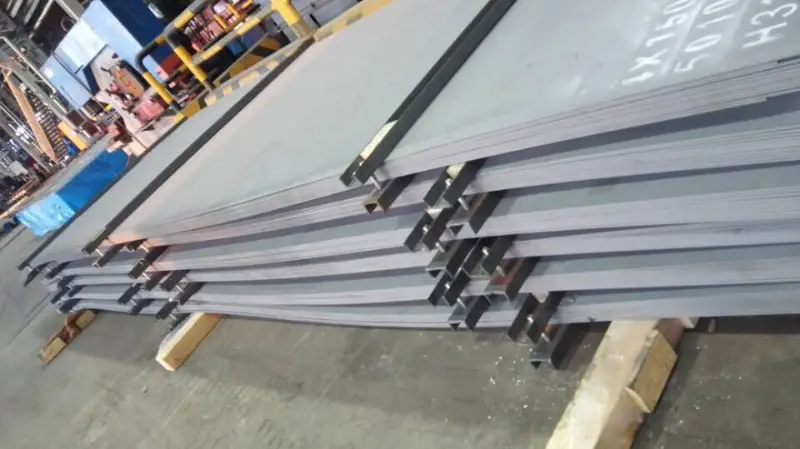
EN 10155 S355J2G2W Weather Resistant Steel Plate
EN 10155 S355J2G2W Weather Resistant Steel Plate - Superior Atmospheric Corrosion Resistance
Comprehensive technical data for EN 10155 S355J2G2W weathering steel plate, including chemical composition, mechanical properties, physical properties, equivalent grades, and application guidance.
Hot rolling, normalizing, cold forming, welding (with suitable consumables), cutting, shot blasting, painting (optional after patina formation)
- Phone : +8618037372205
- Email : [email protected]
- WhatsApp: Contact via Whtsapp
- WeChat: +8618037372205
EN 10155 S355J2G2W Weather Resistant Steel Plate Introduction
EN 10155 S355J2G2W is a structural steel grade with improved atmospheric corrosion resistance (weathering steel), originally specified in the European standard EN 10155:1993 (now superseded by EN 10025-5). It belongs to the S355 strength class, offering minimum yield strength of 355 MPa for thicknesses up to 16 mm. The addition of alloying elements such as chromium, copper and nickel promotes the formation of a dense, adherent protective patina when exposed to the atmosphere, significantly reducing the corrosion rate compared to conventional carbon steel.
The designation J2 indicates a guaranteed impact energy of at least 27 J at -20 °C (longitudinal), while G2 denotes a fully killed fine-grain steel with a specified minimum aluminium content. This makes the material suitable for demanding structural applications even at low temperatures.
Typical delivery conditions are normalised (+N) or as-rolled (+AR), in the form of plates, sheets, strips and wide flats. The steel is widely used in bridges, buildings, containers, railway vehicles and transmission towers, where long-term durability and reduced maintenance costs are essential.
EN 10155 S355J2G2W Weather Resistant Steel Plate Chemical Composition
The chemical composition of S355J2G2W according to EN 10155:1993 is tailored to provide enhanced atmospheric corrosion resistance while maintaining good weldability and toughness. The intentional addition of Cu, Cr and Ni promotes the protective patina. The steel is fully killed and contains a minimum aluminium content to ensure fine grain structure and notch toughness at low temperature.
| Element | Specified Value | Remarks |
|---|---|---|
| Carbon (C) | ≤ 0.16 | Max |
| Silicon (Si) | ≤ 0.50 | Max |
| Manganese (Mn) | 0.50 - 1.50 | |
| Phosphorus (P) | ≤ 0.030 | Max |
| Sulfur (S) | ≤ 0.030 | Max |
| Chromium (Cr) | 0.40 - 0.80 | Weathering element |
| Nickel (Ni) | ≤ 0.65 | Weathering element, max |
| Molybdenum (Mo) | ≤ 0.30 | Max |
| Copper (Cu) | 0.25 - 0.55 | Weathering element |
| Aluminium (Al total) | ≥ 0.020 | Fine grain practice |
EN 10155 S355J2G2W Weather Resistant Steel Plate Thermal and Electrical Physical Properties
The physical properties listed below are typical values for S355J2G2W weathering steel at room temperature (approximately 20 °C) unless a temperature range is specified. These values are suitable for design calculations involving thermal expansion, heat transfer, and electrical conductivity. As with all steels, properties may vary slightly with actual composition and heat treatment. Density is used for weight estimation, while thermal conductivity and specific heat capacity are important for welding and fire design.
| Property | Typical Value | Unit | Test Condition / Remarks |
|---|---|---|---|
| Density (ρ) | 7.85 | g/cm³ | at 20 °C |
| Modulus of elasticity (E) | 210 | GPa | at 20 °C |
| Shear modulus (G) | approx. 81 | GPa | at 20 °C |
| Poisson's ratio (ν) | 0.3 | — | at 20 °C |
| Thermal expansion coefficient (α) | 11.1 × 10⁻⁶ | K⁻¹ | for temperature range 20 – 100 °C |
| Thermal expansion coefficient (α) | 11.9 × 10⁻⁶ | K⁻¹ | for temperature range 20 – 200 °C |
| Thermal expansion coefficient (α) | 12.5 × 10⁻⁶ | K⁻¹ | for temperature range 20 – 300 °C |
| Thermal conductivity (λ) | approx. 42 | W/(m·K) | at 20 °C (mildly dependent on composition) |
| Specific heat capacity (c) | approx. 460 | J/(kg·K) | at 20 °C |
| Electrical resistivity (ρₑ) | approx. 0.25 | μΩ·m | at 20 °C |
EN 10155 S355J2G2W Weather Resistant Steel Plate Mechanical Properties
The mechanical properties of EN 10155 S355J2G2W are guaranteed for the as-delivered condition (normalized or as-rolled). Yield strength and tensile strength depend on product thickness. Elongation and impact energy ensure ductility and toughness. The values below represent the minimum requirements unless otherwise noted. The bend test is used to verify formability. All tests are performed on transverse specimens except where indicated.
| Property | Required Value | Unit | Test Condition |
|---|---|---|---|
| Yield Strength (ReH) | ≥ 355 | MPa | Thickness ≤ 16 mm (transverse) |
| Yield Strength (ReH) | ≥ 345 | MPa | Thickness 16 < t ≤ 40 mm (transverse) |
| Yield Strength (ReH) | ≥ 335 | MPa | Thickness 40 < t ≤ 63 mm (transverse) |
| Yield Strength (ReH) | ≥ 325 | MPa | Thickness 63 < t ≤ 80 mm (transverse) |
| Yield Strength (ReH) | ≥ 315 | MPa | Thickness 80 < t ≤ 100 mm (transverse) |
| Yield Strength (ReH) | ≥ 295 | MPa | Thickness 100 < t ≤ 150 mm (transverse) |
| Tensile Strength (Rm) | 470 - 630 | MPa | Thickness ≤ 100 mm (transverse) |
| Tensile Strength (Rm) | 450 - 600 | MPa | Thickness > 100 ≤ 150 mm (transverse) |
| Elongation after fracture (A5) | ≥ 22 | % | Thickness ≤ 40 mm (transverse) |
| Elongation after fracture (A5) | ≥ 21 | % | Thickness 40 < t ≤ 63 mm (transverse) |
| Elongation after fracture (A5) | ≥ 20 | % | Thickness 63 < t ≤ 100 mm (transverse) |
| Elongation after fracture (A5) | ≥ 19 | % | Thickness > 100 mm (transverse) |
| Impact energy (KV) | ≥ 27 | J | -20 °C, longitudinal, V-notch |
| Bend test (180°) | No cracks (D = 1t) | — | Thickness ≤ 16 mm, D = mandrel diameter, t = specimen thickness |
| Bend test (180°) | No cracks (D = 2t) | — | Thickness > 16 mm |
EN 10155 S355J2G2W Weather Resistant Steel Plate Exact Equivalent Grades and Replacements by Standard
| Country / Region | Standard | Designation / Grade | Remarks |
|---|---|---|---|
| Europe | EN 10025-5:2004 | S355J2W (+N/+AR), 1.8965 | Direct successor to EN 10155 S355J2G2W; identical chemistry and properties. |
| Germany | DIN EN 10025-5 | S355J2W, 1.8965 | National adoption of EN 10025-5. |
| United Kingdom | BS EN 10025-5 | S355J2W | Former BS 4360 WR 50 C is comparable but not identical. |
EN 10155 S355J2G2W Weather Resistant Steel Plate Application Introduction
S355J2G2W is ideally suited for load-bearing structures exposed to the atmosphere, where the natural rust-like patina eliminates the need for painting and reduces lifecycle costs. The steel can be used in the bare condition in most non-marine environments, provided design details avoid water traps. Key industries and applications include:
Product Applications: Weathering steel bridge girders and box sections, Prefabricated building cladding and roofing, Shipping containers and swap bodies, Transmission towers and telecommunication poles, Guardrails and safety barriers, Sculptural and artistic structures
Processed into products: Welded plate girders and stiffeners, Flanges and webs for built-up sections, Rail car side frames and underframes, Lattice tower angles and channels, Bent and folded plate architectural elements
Application industries: Civil engineering and infrastructure (bridges, highway structures), Architectural metalwork and facades, Railway rolling stock and container manufacturing, Electrical power transmission (towers, masts), Industrial plant and equipment (chimney stacks, silos), Shipbuilding and offshore (limited to non-immersed components)
EN 10155 S355J2G2W Weather Resistant Steel Plate Similar / Equivalent Substitute Materials
| Country / Region | Standard | Designation / Grade | Remarks |
|---|---|---|---|
| USA | ASTM A588 / A588M | Grade B (as-rolled) | Similar weathering steel; yield 345 MPa, tensile ≥ 485 MPa; slightly different alloy balance (e.g., higher Cr). |
| Japan | JIS G3114 | SMA490BW | Weathering steel for welded structures; ReH ≥ 365 MPa (t≤16mm), Rm 490-610 MPa; -20 °C impact 27J. |
| China | GB/T 4171-2008 | Q355NH (formerly Q355GNH) | 355 MPa yield class weathering steel; comparable mechanical properties and patina formation. |
| International | ISO 4952:2006 | E355DD (formerly FeE355) | Structural steel with improved atmospheric corrosion resistance; similar strength but may need verification of low-temperature toughness. |
Notes:
Welding: S355J2G2W can be welded by all common methods (SMAW, GMAW, SAW). Preheat and interpass temperatures should be controlled based on thickness and carbon equivalent (CEV typically 0.38–0.44). Use matching weathering steel filler metals (e.g., AWS E80W, EN ISO 2560-A E 42 2 W) to ensure similar corrosion resistance of the weld.
Corrosion: The protective patina forms after cyclic wet/dry exposure over 6–18 months. In continuously wet or highly polluted (chloride-rich) environments, painting or alternative protection may be necessary. Contact with dissimilar metals should be avoided to prevent galvanic corrosion.
Forming: Cold bending requires a minimum radius as per the standard (typically 2-3t). Hot forming above 650 °C may alter the steel's mechanical properties and should be followed by normalizing if required by the specification.
Inspection: Typical delivery is with EN 10204 3.1 certificate. Ultrasonic testing according to EN 10160 is optional.
- Share



