
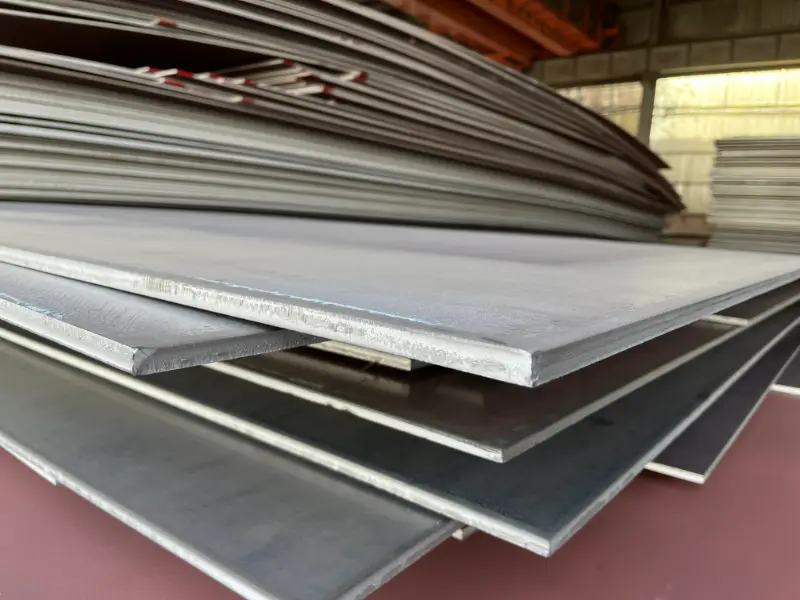
DNV Grade D500 Shipbuilding Steel Plate
DNV Grade D500 Shipbuilding Steel Plate: High Strength, Excellent Toughness, Weldable
Comprehensive technical data and application guide for DNV Grade D500 marine structural steel plate, including chemical composition, mechanical properties, and physical properties.
Cutting, cold forming, hot forming, welding (SMAW, SAW, GMAW, FCAW), machining
- Phone : +8618037372205
- Email : [email protected]
- WhatsApp: Contact via Whtsapp
- WeChat: +8618037372205
DNV Grade D500 Shipbuilding Steel Plate Introduction
DNV Grade D500 is a high-strength shipbuilding steel plate specified under Det Norske Veritas (DNV) rules for the classification of ships and offshore structures. It belongs to the series of high tensile steels with a minimum yield strength of 500 MPa, designated with improved toughness at low temperatures (Grade D: impact tested at -20 °C). The steel exhibits a well-balanced combination of high strength, excellent weldability, and good ductility, making it suitable for critical structural applications in ship hulls, offshore platforms, and marine engineering.
- High strength reduces structural weight while maintaining load-bearing capacity.
- Good low-temperature toughness ensures safe performance in cold waters and Arctic environments.
- Excellent weldability with standard shipyard procedures, provided proper preheat and consumables are used.
- Produced via thermo-mechanical controlled processing (TMCP) or normalized rolling, offering a fine-grained microstructure.
DNV Grade D500 Shipbuilding Steel Plate Chemical Composition
The chemical composition of DNV Grade D500 steel is designed to provide high strength through a combination of microalloying and controlled rolling. Restricted carbon equivalent (CEV) ensures good weldability. Typical elements include niobium, vanadium, and titanium for grain refinement and precipitation strengthening. Aluminum is added for deoxidation and grain size control. Residual elements such as phosphorus and sulfur are kept low to maintain ductility and toughness. The values below are based on DNV-OS-B101 / Ship Rules Pt.2 Ch.2, typical for plates up to 50 mm thickness.
| Element | Standard Value (max %) | Remarks |
|---|---|---|
| Carbon (C) | 0.20 | Ladle analysis; CEV typically ≤ 0.43–0.47 depending on thickness |
| Silicon (Si) | 0.10 – 0.55 | Deoxidation element |
| Manganese (Mn) | 0.90 – 1.70 | Strength and toughness; upper limit may be higher for thicker products |
| Phosphorus (P) | 0.025 | Max; lower values improve toughness |
| Sulfur (S) | 0.025 | Max; low sulfur for formability and lamellar tearing resistance |
| Aluminum (Al total) | ≥ 0.015 | Min (acid-soluble or total); fine grain practice |
| Niobium (Nb) | ≤ 0.05 | Microalloying; grain refinement and precipitation hardening |
| Vanadium (V) | ≤ 0.12 | Microalloying; may be used in combination with Nb |
| Titanium (Ti) | ≤ 0.05 | Grain refinement; may be added for enhanced toughness |
| Nitrogen (N) | ≤ 0.012 | Max; usually bound by aluminium and titanium |
| Carbon Equivalent (CEV) | Typically ≤ 0.43 – 0.47 | Based on IIW formula: CEV = C + Mn/6 + (Cr+Mo+V)/5 + (Ni+Cu)/15; actual limit per thickness and product specification |
DNV Grade D500 Shipbuilding Steel Plate Physical Properties
Physical properties are typical for high-strength low-alloy structural steels. These values are not mandatory in the material specification but serve as guidance for design and engineering calculations. Slight variations may occur depending on the exact chemical composition and processing route.
| Property | Typical Value | Unit | Remarks / Test Condition |
|---|---|---|---|
| Density (ρ) | 7850 | kg/m³ | Mass density at 20 °C |
| Elastic Modulus (E) | 205 – 210 | GPa | Young's modulus; slightly temperature dependent |
| Shear Modulus (G) | ≈ 80 | GPa | Calculated; G = E / [2(1+ν)] |
| Poisson's Ratio (ν) | 0.3 | – | Elastic range |
| Thermal Expansion Coefficient (α) | 11.5 – 12.5 | ×10⁻⁶/K | Linear expansion, 20–100 °C; value increases with temperature (e.g., 13.5–14.5 ×10⁻⁶/K at 20–300 °C) |
| Thermal Conductivity (λ) | 45 – 50 | W/(m·K) | At 20 °C; typical for low-alloy steel |
| Specific Heat Capacity (cp) | 450 – 480 | J/(kg·K) | At 20 °C; varies with temperature |
| Electrical Resistivity (ρe) | 0.15 – 0.25 | μΩ·m | At 20 °C; typical for ferritic steels |
DNV Grade D500 Shipbuilding Steel Plate Mechanical Properties
Mechanical properties are determined on standard test pieces taken in accordance with DNV rules. Values are guaranteed for plates in delivery condition (TMCP or normalized). Minimum yield strength applies for thicknesses up to 50 mm; for thicker sections, a slight reduction may be accepted. Elongation is measured on a gauge length of 5.65√S₀ (L0 = 50 mm for standard flat specimens). Impact toughness test temperature is -20 °C for D-grade, with minimum absorbed energy of 27 J for longitudinal specimens and 20 J for transverse (subject to specific rule versions). Bending test to 180° over a former diameter related to plate thickness, without cracking.
| Property | Standard Required Value | Unit | Test Condition / Specimen Orientation |
|---|---|---|---|
| Yield Strength (ReH) | ≥ 500 | MPa | Thickness ≤ 50 mm; transverse specimen, t/2 location |
| Yield Strength (ReH) | ≥ 490 (if t > 50 mm) | MPa | Thickness 50–100 mm; transverse (check specific rule) |
| Tensile Strength (Rm) | 610 – 770 | MPa | Transverse specimen; for thickness ≤ 100 mm |
| Elongation (A5) | ≥ 16 | % | Gauge length = 5.65√S₀; longitudinal standard specimen; transverse may be ≥ 14% |
| Yield-to-Tensile Ratio (ReH/Rm) | ≤ 0.90 (for typical applications) | – | May be specified for certain offshore projects to ensure ductility; not a mandatory DNV rule for all D500 |
| Charpy-V Impact Energy (KV) | ≥ 27 (longitudinal) | J | At -20 °C; specimen 10×10 mm; transverse may be ≥ 20 J |
| Bend Test (D=3a) | No cracks or ruptures | – | 180° bend over former diameter 3× thickness; for ductility assessment |
| Hardness | Not specified (typically < 200 HBW) | HBW | Informative; for processing considerations |
DNV Grade D500 Shipbuilding Steel Plate Fully Equivalent Standards & Alternative Designations
| Country / Region | Standard / Classification Society | Grade | Remarks |
|---|---|---|---|
| International | DNV (Det Norske Veritas) | D500 | Original designation; now under DNV GL unified rules |
| International | ABS (American Bureau of Shipping) | ABS Grade D500 | Equivalent high-strength shipbuilding steel with similar chemical & mechanical requirements; toughness test at -20 °C |
| International | LR (Lloyd's Register) | LR Grade D500 | Comparable grade under LR Rules; requires verification per specific rule revision |
| International | BV (Bureau Veritas) | BV Grade D500 | Equivalent; may be denoted as E500 for higher toughness, D500 for -20 °C |
| International | CCS (China Classification Society) | CCS D500 | Direct equivalent under CCS Material and Welding Rules |
| International | NK (Nippon Kaiji Kyokai) | NK KE500 (D) | Closest equivalent; NK uses KE500 notation, with D indicating -20 °C impact test |
| International | RINA (Registro Italiano Navale) | RINA Grade D500 | Available as equivalent high-strength structural steel |
| European / Germany | DIN EN 10025-6 | S500Q / S500QL / S500QL1 | Not a direct ship classification, but comparable quenched and tempered structural steel; substitution requires class society approval |
DNV Grade D500 Shipbuilding Steel Plate Application Introduction
DNV Grade D500 steel is engineered for demanding marine and offshore applications where high strength, reliability, and weight reduction are critical. Thanks to its minimum yield strength of 500 MPa, it allows thinner sections compared to conventional 235 or 355 MPa steels, leading to lighter structures without compromising safety. The combination of excellent weldability (low carbon equivalent) and good low-temperature toughness makes it suitable for harsh environments. It is widely utilized in ship hulls, offshore platforms, and specialized engineering projects. Below is a summary of typical industries, end products, and specific components manufactured from this steel.
Product Applications: Hull envelopes and deck plating of large container ships, bulk carriers, and tankers, Jack-up rig legs and spudcans, Offshore platform superstructures (module support frames, helidecks, crane pedestals), Monopile and jacket foundations for offshore wind turbines, Specialized pressure vessels and storage tanks (where class rules permit), Heavy-lift ship crane pedestals and booms
Processed into products: Longitudinal stiffeners and web frames in ship double bottom and side shells, Transverse bulkheads and strength decks, Brackets, gussets, and reinforcement plates in highly stressed joints, Chocks, bollards, fairleads, and other mooring equipment bases, Crane kingposts and slewing rings for offshore cranes, Transition pieces and flanges in jacket connections, Foundation plates for winches, generators, and heavy machinery onboard ships and platforms
Application industries: Shipbuilding (naval and merchant vessels, passenger ships, high-speed ferries), Offshore oil & gas (jack-up rigs, semi-submersibles, FPSO topsides), Marine renewable energy (offshore wind turbine foundations, transition pieces, substations), Heavy-lift and transportation (crane booms, heavy load-bearing structures for ports), Bridge and infrastructure (movable bridges, coastal structures subject to harsh environments), Pressure vessels for marine service (LNG/CNG tanks when supplemented with low-temperature certification)
DNV Grade D500 Shipbuilding Steel Plate Similar or Proximate Substitute Materials
| Country / Region | Standard | Grade | Comments / Analysis |
|---|---|---|---|
| Europe | EN 10025-6 | S500Q / S500QL / S500QL1 | Quenched and tempered high-strength structural steel. Minimum yield strength 500 MPa, similar tensile range. Lacks specific shipbuilding toughness certification; may not meet CET or CEV limits for marine welding. Substitution possible only with classification society acceptance and additional testing. |
| Europe | EN 10025-4 | S500M / S500ML | Thermo-mechanically rolled fine-grain structural steel. Very similar in strength and processing route; however, impact test temperature (e.g., M for -20 °C, ML for -50 °C) and alloy design may differ. Often used as a base for shipbuilding grades, but formal class approval is needed. |
| International / ISO | ISO 4995 / ISO 4996 | HR500 / HS500 | Hot-rolled structural steel sheets with minimum yield 500 MPa. Primarily for non-marine applications; not guaranteed for notch toughness at -20 °C. Not a direct replacement without supplementary testing. |
| USA | ASTM A514 / A517 | Grade Q or S | Quenched & tempered alloy steel plate with high strength (≥690 MPa for some grades). Over-strength and different metallurgy; welding procedures differ. Not generally a substitute for D500 as it refers to higher strength levels; could be considered where higher strength is needed, but toughness and weldability must be re-assessed. |
| Japan | JIS G 3106 | SM570 (SMA570W/P) | Rolled steel for welded structures with min. TS 570 MPa and YS ~460 MPa. Slightly lower yield strength; toughness may not match D500 (depends on quality). Can be considered as an alternative with reduced design strength, provided impact test temperature is adjusted. |
Notes:
Certification: All DNV D500 plates must be delivered with DNV material certificates (e.g., EN 10204 3.1 or 3.2).
Traceability: Full heat and plate number traceability is mandatory.
Lamellar Tearing Resistance: When through-thickness properties are required (e.g., Z-quality), specify supplementary testing in accordance with EN 10164 or DNV rules (Z25 or Z35).
Welding: Low-hydrogen welding procedures are strongly recommended; typical preheat may be required for thicknesses above 30 mm to avoid cold cracking. The CEV should be used to determine preheat and heat input limits.
Corrosion Protection: As with all carbon-manganese steels, proper coating and cathodic protection should be applied in seawater service.
Alternative grades: For improved toughness at lower temperatures, consider Grade E500 (impact tested at -40 °C) or F500 (-60 °C) according to DNV rules.
- Share



