
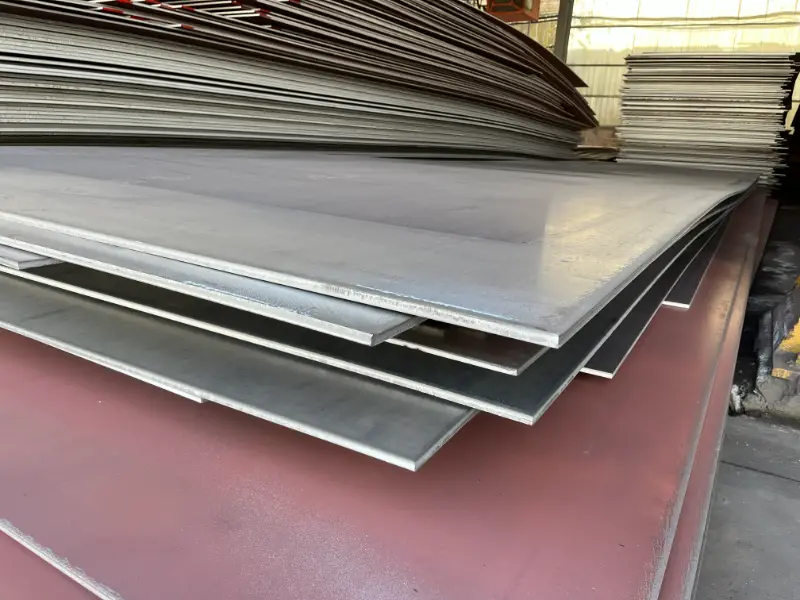
DIN 17102 WStE460 Automobile Structure Steel Plate
DIN 17102 WStE460 Automobile Structure Steel Plate - High-Strength Weldable Fine-Grain Steel
WStE460 is a weldable fine-grain structural steel designed for automobile and engineering structures, offering minimum yield strength of 460 MPa with good toughness and weldability.
Welding, bending, cold forming, machining, hot forming (with controlled conditions)
- Phone : +8618037372205
- Email : [email protected]
- WhatsApp: Contact via Whtsapp
- WeChat: +8618037372205
DIN 17102 WStE460 Automobile Structure Steel Plate Introduction
WStE460 under DIN 17102 is a normalized, weldable fine-grain structural steel primarily used in automobile and mobile crane structures. It provides a minimum yield strength of 460 MPa for thicknesses up to 16 mm, excellent cold forming properties, and good weldability with suitable preheating. The steel offers guaranteed impact toughness at -20°C and is delivered in the normalized condition. It is suitable for highly stressed components requiring a combination of high strength, formability, and reliability under dynamic loading. Typical applications include chassis frames, axle components, and heavy-duty structural parts.
DIN 17102 WStE460 Automobile Structure Steel Plate Chemical Composition
The chemical composition is according to DIN 17102 for WStE460. Key elements ensure fine-grain strengthening and weldability. The steel is fully killed and contains aluminum as a grain refiner. Residual elements are strictly controlled to avoid embrittlement and to maintain toughness.
| Chemical Element | Standard Value | Remarks |
|---|---|---|
| C | ≤0.20 | Maximum for ≤16mm thickness; slightly lower for thicker products |
| Si | ≤0.60 | Silicon content for deoxidation |
| Mn | 1.00 – 1.70 | Increases strength and toughness |
| P | ≤0.035 | Max. phosphorus, controls embrittlement |
| S | ≤0.030 | Max. sulfur, improves machinability and avoids hot cracking |
| Al total | ≥0.02 | Grain refinement |
| Nb | ≤0.07 | Optional microalloying for grain refinement |
| V | ≤0.15 | Optional for precipitation strengthening |
| Ti | ≤0.05 | Optional microalloying |
| N | ≤0.015 | Max. nitrogen for ageing resistance |
| Cr | ≤0.30 | Residual element, not required |
| Ni | ≤0.30 | Residual |
| Mo | ≤0.10 | Residual |
| Cu | ≤0.20 | Residual |
DIN 17102 WStE460 Automobile Structure Steel Plate Physical and Thermal Properties
Physical properties are approximate and representative of low-alloy structural steels. Specific heat, thermal conductivity, and electrical resistivity may vary with temperature. The values are valid for room temperature unless noted otherwise.
| Property | Typical Value | Unit | Test Condition / Remarks |
|---|---|---|---|
| Density (ρ) | 7.85 | kg/dm³ (g/cm³) | Room temperature |
| Elastic modulus (E) | 210 | GPa | 20 °C |
| Shear modulus (G) | 81 | GPa | Estimated (G = E / [2(1+ν)]) |
| Poisson's ratio (ν) | 0.3 | — | At ambient temperature |
| Thermal expansion coefficient (α) | 11.1 × 10⁻⁶ | /K (1/°C) | 20 – 100 °C (also valid for 20–200 °C, typical 12.0) |
| Thermal conductivity (λ) | 45 – 52 | W/(m·K) | 20 °C, typical structural steel |
| Specific heat capacity (cp) | 460 – 510 | J/(kg·K) | 20 °C |
| Electrical resistivity (ρ_e) | 0.18 – 0.25 | Ω·mm²/m | 20 °C |
DIN 17102 WStE460 Automobile Structure Steel Plate Mechanical Properties
Mechanical properties according to DIN 17102 for normalized condition. Values vary with product thickness. Impact energy is measured on Charpy-V specimens, usually at -20°C. Bending test up to a 180° angle around a mandrel of specified diameter without cracks.
| Property | Standard Requirement | Unit | Test Condition / Thickness |
|---|---|---|---|
| Yield strength (ReH) | ≥460 | MPa | t ≤ 16 mm |
| Yield strength (ReH) | ≥440 | MPa | 16 < t ≤ 35 mm |
| Yield strength (ReH) | ≥420 | MPa | 35 < t ≤ 50 mm |
| Yield strength (ReH) | ≥400 | MPa | 50 < t ≤ 70 mm |
| Tensile strength (Rm) | 560 – 760 | MPa | t ≤ 16 mm |
| Tensile strength (Rm) | 550 – 750 | MPa | 16 < t ≤ 35 mm |
| Tensile strength (Rm) | 530 – 730 | MPa | 35 < t ≤ 50 mm |
| Tensile strength (Rm) | 510 – 710 | MPa | 50 < t ≤ 70 mm |
| Elongation after fracture (A), L0 = 5.65√S0 | ≥17 | % | t ≤ 16 mm, transverse specimen |
| Elongation after fracture (A) | ≥16 | % | 16 < t ≤ 35 mm |
| Elongation after fracture (A) | ≥15 | % | 35 < t ≤ 50 mm |
| Elongation after fracture (A) | ≥14 | % | 50 < t ≤ 70 mm |
| Charpy-V impact energy (KV) | ≥27 | J | -20 °C, longitudinal |
| Charpy-V impact energy (KV) | ≥27 | J | -20 °C, transverse (optional) |
| Bend test – mandrel diameter (180°) | 3 × t | mm | t ≤ 16 mm, bending axis transverse |
| Bend test – mandrel diameter (180°) | 4 × t | mm | t > 16 mm |
DIN 17102 WStE460 Automobile Structure Steel Plate Fully Equivalent Material Standards and Substitute Grades
| Country/Region | Standard | Grade | Remarks |
|---|---|---|---|
| Europe | EN 10113-2:1993 (withdrawn, replaced by EN 10025-3) | S460N / S460NL | Direct equivalent normalized fine-grain steel, min. 460 MPa yield |
| USA | ASTM A572/A572M | Grade 65 [450 MPa] | Strength close; 450 MPa yield, slightly lower; check thickness adjustments |
| Japan | JIS G3106 | SM570 | 570 MPa tensile class, similar weldability; yield 460 MPa for thin plates |
| China | GB/T 1591-2018 | Q460D | Same yield class with improved toughness, delivery condition normalized or TMCP |
| International | ISO 4950-2 | S460NL | High strength structural steel with improved notch toughness |
DIN 17102 WStE460 Automobile Structure Steel Plate Application Introduction
WStE460 steel plates are used where high static and dynamic loads require a fine-grain steel with excellent weldability and sufficient cold formability. Main applications include:
- Automobile chassis and frame components
- Mobile crane booms and outriggers
- Heavy transport vehicles
- Structural parts in engineering machinery
- Bridges and welded structures under fatigue loads
The steel can be delivered with additional through-thickness properties (Z-grade) if specified. Suitable welding processes: manual arc, MAG, submerged arc, with low-hydrogen practices and appropriate preheat/interpass temperatures to avoid cold cracking.
Product Applications: Truck chassis frames and longitudinal members, Crane telescopic booms and lattice structures, Dumper bodies and earthmoving equipment, Welded beams, columns, and heavy brackets, Agricultural and forestry machinery parts, Bridge girders and orthotropic decks
Processed into products: Chassis rails, cross members, and suspension brackets, Boom sections, outrigger boxes, and turntables, Axle housings and wheel hubs, Welded T-joints and stiffened panels, Gearbox housings and frame nodes in heavy vehicles, Crane hook blocks and sheave supports
Application industries: Automotive and transportation, Mobile crane and lifting equipment, Heavy machinery and mining, Shipbuilding and offshore (with supplementary approval), Civil engineering and bridge construction, Pressure vessels (when certified)
DIN 17102 WStE460 Automobile Structure Steel Plate Similar/Comparable Materials
| Country/Region | Standard | Grade | Remarks |
|---|---|---|---|
| Europe | EN 10025-3 | S460NL | Currently valid standard; normalized, low-temperature toughness |
| Europe | EN 10025-4 | S460ML | Thermomechanical rolled, similar strength, may need welding qualification |
| Sweden | SS-EN 10113-2 (old) | Domex 460 or equivalent | Commercial high-strength steel with min. 460 MPa yield |
| USA | ASTM A588 | Grade C | Weathering steel with similar strength, 485 MPa tensile class |
| Germany (obsolete) | DIN 17102 | WStE500 | Higher strength grade (500 MPa yield) in same family |
| China | GB/T 1591 | Q460E | Improved low-temperature impact, equivalent to S460NL |
Notes:
DIN 17102 has been withdrawn and replaced by EN 10113-2 (later EN 10025-3 and EN 10025-4). When ordering to the old standard, supplementary requirements may be needed to match modern practices. Normalized delivery condition (+N) is mandatory unless TMCP is agreed. Flame cutting and welding parameters should follow manufacturer's recommendations to preserve fine-grain structure. The steel is not intended for elevated temperature pressure applications unless specifically assessed.
- Share



