
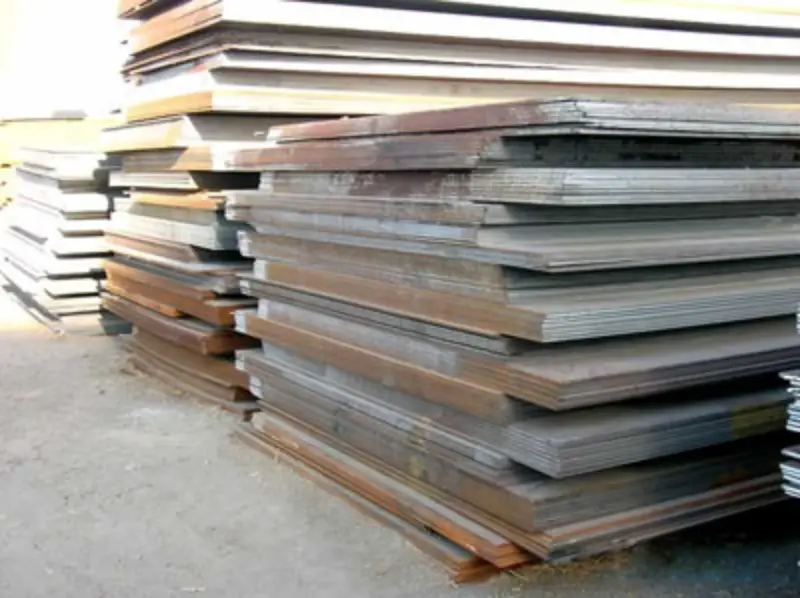
DIN 17102 TStE460 High-Strength Automobile Structural Steel Plate
DIN 17102 TStE460 High-Strength Automobile Structural Steel Plate & Properties
Comprehensive technical data for DIN 17102 TStE460 fine-grain structural steel including chemical composition, mechanical and physical properties, international equivalents and application guidelines.
Thermomechanical rolling, cold forming, welding, bending, punching
- Phone : +8618037372205
- Email : [email protected]
- WhatsApp: Contact via Whtsapp
- WeChat: +8618037372205
DIN 17102 TStE460 High-Strength Automobile Structural Steel Plate Introduction
DIN 17102 TStE460 is a weldable fine-grain structural steel with a minimum yield strength of 460 MPa, produced by thermomechanical rolling. It belongs to the high-strength low-alloy (HSLA) category and is specifically designed for automobile and general structural applications where weight reduction and high load capacity are required. The steel offers excellent cold formability, good weldability, and high impact toughness even at low temperatures. Typical delivery condition is as-rolled or normalized rolled. The standard has been largely superseded by EN 10149-2 (S460MC), but the TStE460 designation remains in use for many legacy projects.
DIN 17102 TStE460 High-Strength Automobile Structural Steel Plate Chemical Composition
The typical chemical composition is based on ladle analysis according to DIN 17102 for TStE460. All elements are given as maximum values unless otherwise stated. The steel is microalloyed with niobium, vanadium and/or titanium to achieve grain refinement and precipitation strengthening.
| Element | Value (max unless noted) | Remarks |
|---|---|---|
| C | ≤0.12 | Carbon |
| Si | ≤0.50 | Silicon |
| Mn | ≤1.60 | Manganese |
| P | ≤0.030 | Phosphorus |
| S | ≤0.025 | Sulfur |
| Al (total) | ≥0.015 | Aluminium, total |
| Nb | ≤0.09 | Niobium |
| V | ≤0.20 | Vanadium |
| Ti | ≤0.22 | Titanium |
| N | ≤0.020 | Nitrogen |
DIN 17102 TStE460 High-Strength Automobile Structural Steel Plate Physical and Thermal Properties
Physical constants are representative for fine-grain HSLA steel and may vary slightly depending on composition and heat treatment. These values serve as design guidelines for engineering calculations. Thermal conductivity, specific heat and coefficient of thermal expansion influence heat treatment and welding behaviour.
| Property | Typical Value | Unit | Conditions / Remarks |
|---|---|---|---|
| Density (ρ) | 7.85 | g/cm³ | 20°C |
| Modulus of elasticity (E) | 210 | GPa | 20°C |
| Shear modulus (G) | ~81 | GPa | 20°C |
| Poisson's ratio (ν) | 0.3 | — | 20°C |
| Coefficient of thermal expansion (α) | 12.0 | 10⁻⁶/K | 20 – 100°C |
| Coefficient of thermal expansion (α) | 12.5 | 10⁻⁶/K | 20 – 200°C |
| Coefficient of thermal expansion (α) | 13.0 | 10⁻⁶/K | 20 – 300°C |
| Thermal conductivity (λ) | 52 | W/(m·K) | 20°C |
| Specific heat capacity (cp) | 460 | J/(kg·K) | 20°C |
| Electrical resistivity (ρe) | 0.16 | Ω·mm²/m | 20°C |
DIN 17102 TStE460 High-Strength Automobile Structural Steel Plate Mechanical Properties
Tests are performed at room temperature on as-delivered material. The properties depend on product thickness. The listed values are guaranteed minimums unless a range is indicated. DIN 17102 requires a minimum impact energy of 27 J at -20°C for longitudinal specimens (Charpy-V). Bending test is carried out with a mandrel diameter of 1t (t = plate thickness) through 180°.
| Property | Value | Unit | Test Conditions / Thickness Range |
|---|---|---|---|
| Yield strength (ReH) | ≥460 | MPa | t ≤ 16 mm |
| Yield strength (ReH) | ≥440 | MPa | 16 < t ≤ 35 mm |
| Yield strength (ReH) | ≥420 | MPa | 35 < t ≤ 50 mm |
| Tensile strength (Rm) | 550 – 720 | MPa | t ≤ 16 mm |
| Tensile strength (Rm) | 530 – 700 | MPa | 16 < t ≤ 35 mm |
| Tensile strength (Rm) | 510 – 680 | MPa | 35 < t ≤ 50 mm |
| Elongation (A), L0 = 80 mm | ≥17 | % | t ≤ 16 mm |
| Elongation (A), L0 = 80 mm | ≥16 | % | 16 < t ≤ 35 mm |
| Elongation (A), L0 = 80 mm | ≥15 | % | 35 < t ≤ 50 mm |
| Bend test (180°) | Mandrel dia. = 1t | — | No cracks, t = plate thickness |
| Impact energy (KV2) | ≥27 | J | Longitudinal, -20°C |
DIN 17102 TStE460 High-Strength Automobile Structural Steel Plate Direct Equivalent Grades
| Country/Region | Standard | Grade | Remarks |
|---|---|---|---|
| Europe | EN 10149-2 | S460MC | Thermomechanically rolled, direct successor to TStE460 |
| International | ISO 6930-2 | S460MC | Identical technical delivery conditions |
| Germany | DIN 17102 | TStE460 | Original designation, still used in some sectors |
| France | NF A36-231 | E460TR | Old French equivalent, withdrawn |
| Italy | UNI 7945 | FeE460KG | Old Italian designation for fine-grain steel |
DIN 17102 TStE460 High-Strength Automobile Structural Steel Plate Application Introduction
TStE460 is utilised wherever high strength, good formability and reliable low-temperature toughness are required. Its fine-grained microstructure guarantees excellent weldability without preheating under moderate conditions. Typical industries and applications:
Product Applications: Heavy-duty truck longitudinal beams and cross members, Mobile crane telescopic booms and outriggers, Excavator buckets and arms, Passenger car B-pillar reinforcements and subframes, Mining dump body liners (abrasion partner, not sole use), High-stress welded tubular structures
Processed into products: Chassis side rails, cross members, engine mounts, Laser-cut and bent brackets, gusset plates, Welded box sections for structural frames, Roll-formed profiles for long-body vehicles, Punched and pressed flanges for machinery
Application industries: Automotive manufacturing (truck frames, chassis members), Construction and earthmoving machinery (booms, arms, frames), Railway wagons and coaches (underframes, side stakes), Agricultural equipment (plough frames, tool carriers), Pressure vessel technology (limited weldable shells), Mechanical engineering (crane structures, platforms)
DIN 17102 TStE460 High-Strength Automobile Structural Steel Plate Similar Alternative Materials
| Country/Region | Standard | Grade | Remarks |
|---|---|---|---|
| China | GB/T 1591 | Q460C / Q460D | Yield 460 MPa, impact properties may differ; check toughness |
| USA | ASTM A1011/A1011M | HSLAS Grade 70 [480] | Slightly lower yield (~480 MPa) but similar ductility; verify weldability |
| Japan | JIS G 3135 | SPFC 590Y | High-strength cold rolled; yield ≥460 N/mm²; used for automotive |
| India | IS 2062 | E460 BR / E460 C | Structural steel with 460 MPa yield; compare toughness class |
| Russia | GOST 19281 | 16G2AF | Microalloyed 460 grade; check delivery condition |
Notes:
- Welding: General welding processes (MAG, MMA, submerged arc) are suitable. Preheating is not required for thicknesses up to 30 mm under normal conditions. Follow guidelines for HSLA steels to avoid cold cracking.
- Forming: Excellent cold formability for bending, roll forming and drawing. Hot forming should be limited to avoid grain coarsening.
- Corrosion resistance: Not inherently corrosion resistant; requires surface protection (painting, galvanising) for outdoor applications.
- Availability: Plates and coils are usually stocked in the thermomechanically rolled condition. The steel can be ordered with normalized rolling upon request.
- Testing: Ultrasonic testing (UT) according to EN 10160 Class S2/E2 is commonly applied for quality verification.
- Share



