
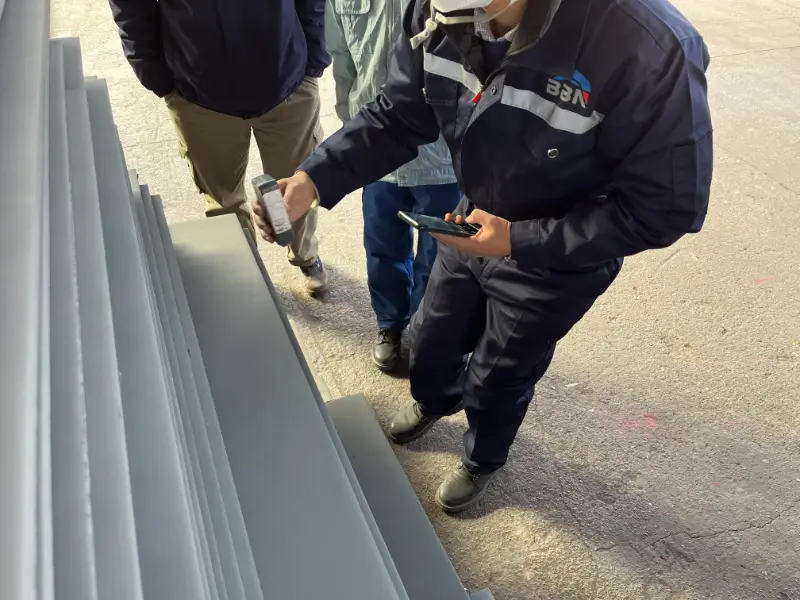
DIN 17102 StE460
DIN 17102 StE460 Steel Plate – Properties, Equivalents & Applications
Complete technical data for DIN 17102 StE460 weldable normalized fine grain structural steel: chemical composition, mechanical properties, thermal/physical data, international equivalents and application guidance.
Welding, machining, thermal cutting, cold and hot forming, bending
- Phone : +8618037372205
- Email : [email protected]
- WhatsApp: Contact via Whtsapp
- WeChat: +8618037372205
DIN 17102 StE460 Introduction
DIN 17102 StE460 is a weldable normalized fine grain structural steel originally specified in the German standard DIN 17102 (withdrawn). It is characterized by a minimum yield strength of 460 MPa in thicknesses up to 16 mm, excellent weldability due to fine grain treatment (typically with aluminium and optionally microalloying elements such as niobium, vanadium or titanium), and good toughness at low temperatures. The steel is supplied in the normalized condition (+N) and is used for welded, highly stressed structures where weight savings, high load capacity and reliable toughness are required. The grade is the direct predecessor of modern EN 10025-3 S460N and comparable to other international structural steels with similar strength and toughness levels.
DIN 17102 StE460 Chemical Composition
The chemical composition of StE460 is designed to ensure fine grain structure and good weldability.
Total aluminium content is specified as a fine grain element, with optional addition of niobium, vanadium and titanium.
When these elements are added singly or in combination, the sum Nb+V+Ti shall not exceed 0.22 %.
P and S are restricted to cleanliness and toughness.
| Chemical element | Standard value (wt%) | Remarks |
|---|---|---|
| Carbon (C) | ≤ 0.20 | |
| Silicon (Si) | ≤ 0.50 | |
| Manganese (Mn) | 1.00 – 1.70 | |
| Phosphorus (P) | ≤ 0.035 | |
| Sulfur (S) | ≤ 0.030 | |
| Aluminium (Al, total) | ≥ 0.020 | Grain refining element |
| Niobium (Nb)* | ≤ 0.05 | Optional; used for grain refinement |
| Vanadium (V)* | ≤ 0.10 | Optional; used for grain refinement |
| Titanium (Ti)* | ≤ 0.05 | Optional; used for grain refinement |
| * Nb+V+Ti | ≤ 0.22 | Applies if added in combination |
DIN 17102 StE460 Thermal & Electrical Physical Properties
The following data are typical for normalized fine grain structural steel with similar composition; they are not mandatory in DIN 17102 but can be used for design calculations.
Values apply at room temperature unless stated otherwise.
| Property | Typical value | Unit | Test conditions |
|---|---|---|---|
| Density (ρ) | 7.85 | g/cm³ | 20 °C |
| Modulus of elasticity (E) | 210 000 | MPa | 20 °C |
| Shear modulus (G) | 81 000 | MPa | 20 °C |
| Poisson's ratio (ν) | 0.30 | — | 20 °C |
| Thermal expansion coefficient (α) | 12.0 × 10⁻⁶ | K⁻¹ | 20 – 100 °C |
| Thermal expansion coefficient (α) | 12.5 × 10⁻⁶ | K⁻¹ | 20 – 200 °C |
| Thermal expansion coefficient (α) | 13.0 × 10⁻⁶ | K⁻¹ | 20 – 300 °C |
| Thermal conductivity (λ) | 50 | W/(m·K) | 20 °C |
| Specific heat capacity (c) | 460 | J/(kg·K) | 20 °C |
| Electrical resistivity (ρₑ) | 0.23 | Ω·mm²/m | 20 °C |
DIN 17102 StE460 Mechanical Properties
Mechanical properties are valid for longitudinal specimens taken from plates and wide flats in the normalized (+N) delivery condition.
The yield strength decreases with increasing product thickness.
Minimum impact energy is guaranteed at 0 °C or, if agreed, at -20 °C; for structural applications, 0 °C is the standard option.
Bend test is performed with 180° bending and a mandrel diameter depending on thickness.
| Property | Standard requirement | Unit | Test conditions |
|---|---|---|---|
| Yield strength (ReH) – t ≤ 16 mm | ≥ 460 | MPa | Ambient temperature |
| Yield strength (ReH) – 16 < t ≤ 35 mm | ≥ 440 | MPa | Ambient temperature |
| Yield strength (ReH) – 35 < t ≤ 50 mm | ≥ 420 | MPa | Ambient temperature |
| Yield strength (ReH) – 50 < t ≤ 70 mm | ≥ 400 | MPa | Ambient temperature |
| Tensile strength (Rm) – all thicknesses up to 70 mm | 550 – 720 | MPa | Ambient temperature |
| Elongation (A) – t ≤ 16 mm | ≥ 17 | % | L₀ = 5.65√S₀ (A5) |
| Elongation (A) – 16 < t ≤ 40 mm | ≥ 17 | % | L₀ = 5.65√S₀ |
| Elongation (A) – 40 < t ≤ 63 mm | ≥ 17 | % | L₀ = 5.65√S₀ |
| Elongation (A) – 63 < t ≤ 100 mm | ≥ 16 | % | L₀ = 5.65√S₀ |
| Impact energy (KV, longitudinal) – at 0 °C | ≥ 27 | J | V-notch, ISO-V specimen |
| Impact energy (KV, longitudinal) – at -20 °C (option) | ≥ 27 | J | If agreed (grade StE460 with KD verification) |
| Bend test – all thicknesses | d = 2a, 180° | — | No cracks |
DIN 17102 StE460 Direct Equivalents & Recommended Replacement Grades
| Country/Region | Standard | Grade | Remarks |
|---|---|---|---|
| Europe | EN 10025-3 | S460N (1.8901) | Direct successor of DIN 17102 StE460; normalized fine grain steel with min. yield 460 MPa and improved toughness levels (0°C or -20°C) |
| International | ISO 630-2:2011 | S460N | Equivalent fine grain structural steel for normalized delivery |
| China | GB/T 1591-2018 | Q460D | Normalized or thermo-mechanically rolled high-strength steel; comparable yield and toughness; -20°C impact specification available |
DIN 17102 StE460 Application Introduction
StE460 steel is designed for welded, highly stressed structures that require high strength, good toughness and excellent weldability. Owing to its fine grain structure and normalized delivery, it is particularly suitable for dynamic and repeated loading conditions, as well as for service at low ambient temperatures. Typical applications include structural frameworks, heavy machinery, transportation equipment and pressure-containing components. The steel can be processed by all conventional methods: thermal cutting, welding (with appropriate preheat if needed), machining and cold or hot forming. When substituting with modern grades such as S460N, a compatible welding filler and procedure should be selected.
Product Applications: Steel bridges and elevated roadways, Multi-storey building frames and columns, Mobile crane booms and undercarriages, Heavy vehicle chassis (trucks, trailers, semi-trailers), Earthmoving and agricultural machinery, Welded storage tanks and silos, Offshore platform support structures
Processed into products: Welded H-beams and box girders, Flanges and stiffeners for bridge sections, Heavy-duty chassis frames and subframes, Boom sections and outriggers for mobile cranes, Pressure vessel shells and heads, Structural nodes and connections for offshore modules, Support beams for heavy machinery
Application industries: Civil engineering and building construction, Bridge engineering, Heavy machinery and mining equipment, Shipbuilding and offshore structures, Transportation and automotive (chassis, frames), Pressure vessel and storage tank fabrication
DIN 17102 StE460 Similar / Alternative Grades with Comparable Properties
| Country/Region | Standard | Grade | Remarks |
|---|---|---|---|
| Europe | EN 10025-4 | S460M (1.8827) | Thermo-mechanically rolled fine grain steel; slightly different production route but similar strength and weldability |
| USA | ASTM A572 / A572M | Grade 65 | High-strength low-alloy structural steel; yield 450 MPa (close to StE460); not necessarily fine grain treated and may have different toughness |
| Japan | JIS G 3106 | SM570 | Weldable structural steel, min. yield 450/430 MPa; often used in heavy structures; similar application range |
| Russia | GOST 19281 | 17G1S (17Г1С) | Structural manganese-silicon steel with yield ~345–390 MPa; lower strength but widely used; for higher strength grades see GOST 10G2FB etc. |
Notes:
DIN 17102 is withdrawn and has been fully replaced by the European standard EN 10025-3. For new designs, S460N (1.8901) should be specified. When ordering according to the old designation StE460, it is common practice to supply material certified to S460N with corresponding inspection documents. The chemical composition and mechanical requirements of S460N overlap with StE460 but may have tighter limits for phosphorus, sulfur and impact test conditions. Always refer to the latest edition of the applicable standard and project specifications.
- Share



