
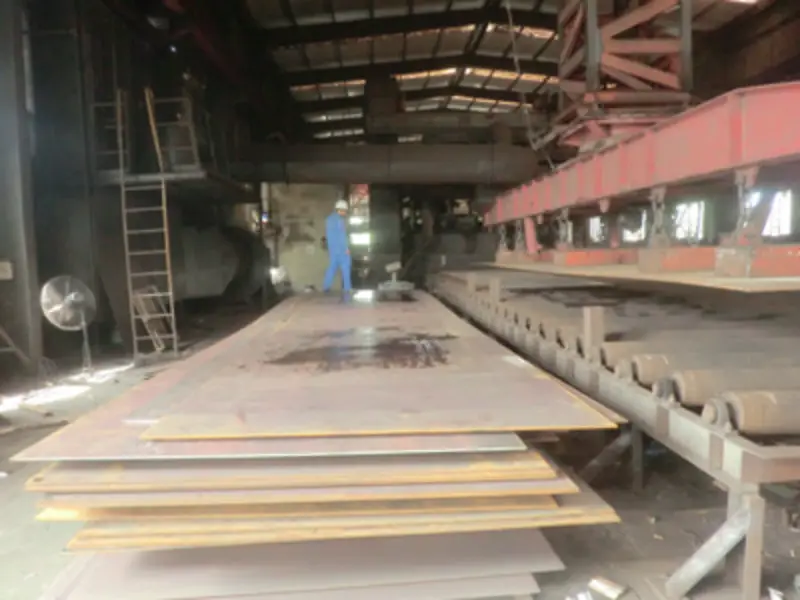
DIN 17102 EStE420 Automobile Structure Steel Plate
DIN 17102 EStE420 Automobile Structure Steel Plate - High-Strength Fine-Grain Steel for Automotive Applications
Comprehensive material data sheet for EStE420 steel according to DIN 17102, including chemical composition, mechanical and physical properties, equivalent grades, and application guide.
Hot rolling, normalizing, thermomechanical rolling; suitable for cold forming, welding, shearing, bending, and machining.
- Phone : +8618037372205
- Email : [email protected]
- WhatsApp: Contact via Whtsapp
- WeChat: +8618037372205
DIN 17102 EStE420 Automobile Structure Steel Plate Introduction
DIN 17102 EStE420 is a weldable fine-grain structural steel designed for automobile structural components. It offers minimum yield strength of 420 MPa and is produced by normalizing or thermomechanical rolling. The fine-grain microstructure, achieved through microalloying elements such as niobium, vanadium, and titanium, ensures excellent toughness and weldability. This grade is typically supplied in the normalized or normalized-rolled condition and is suitable for cold forming and welding without preheating. Its primary use is in heavy-duty automotive frames, chassis parts, and other structural members where high strength-to-weight ratio and good fatigue resistance are required.
DIN 17102 EStE420 Automobile Structure Steel Plate Chemical Composition according to DIN 17102
The chemical composition is designed to ensure fine-grain structure and good weldability. Microalloying elements like Nb, V, and Ti are added singly or in combination to achieve grain refinement and precipitation strengthening. Maximum carbon equivalent (CEV) is controlled to guarantee weldability. Values are given for ladle analysis.
| Element | Standard Value (%) | Remarks |
|---|---|---|
| Carbon (C) | ≤0.20 | Max |
| Silicon (Si) | ≤0.50 | Max |
| Manganese (Mn) | 1.00–1.70 | Range |
| Phosphorus (P) | ≤0.035 | Max |
| Sulfur (S) | ≤0.030 | Max |
| Aluminum (Al) total | ≥0.020 | Min, or other grain-refining elements |
| Niobium (Nb) | ≤0.05 | Single or combination |
| Vanadium (V) | ≤0.12 | Single or combination |
| Titanium (Ti) | ≤0.05 | Single or combination |
| Nitrogen (N) | ≤0.020 | Max if not combined with nitride formers |
| Chromium (Cr) | ≤0.30 | Residual, max |
| Copper (Cu) | ≤0.35 | Residual, max |
| Molybdenum (Mo) | ≤0.10 | Residual, max |
| Nickel (Ni) | ≤0.30 | Residual, max |
DIN 17102 EStE420 Automobile Structure Steel Plate Physical and Thermal Properties
The following physical properties are typical for fine-grain structural steels of this strength level and may vary slightly depending on exact composition and processing. They are provided as guidance for design calculations.
| Property | Typical Value | Unit | Test Condition |
|---|---|---|---|
| Density (ρ) | 7.85 | g/cm³ | At 20°C |
| Elastic Modulus (E) | 210 | GPa | At 20°C |
| Shear Modulus (G) | 81 | GPa | At 20°C |
| Poisson's Ratio (ν) | 0.3 | – | At 20°C |
| Thermal Expansion Coefficient (α) | 12.0 × 10⁻⁶ | 1/K | 20°C to 100°C |
| Thermal Expansion Coefficient (α) | 12.5 × 10⁻⁶ | 1/K | 20°C to 200°C |
| Thermal Expansion Coefficient (α) | 13.3 × 10⁻⁶ | 1/K | 20°C to 400°C |
| Thermal Conductivity (λ) | 50 | W/(m·K) | At 20°C |
| Thermal Conductivity (λ) | 48 | W/(m·K) | At 100°C |
| Specific Heat Capacity (cp) | 460 | J/(kg·K) | At 20°C |
| Electrical Resistivity (ρₑ) | 0.20–0.25 | µΩ·m | At 20°C |
DIN 17102 EStE420 Automobile Structure Steel Plate Mechanical Properties
Mechanical properties are guaranteed in the delivery condition (normalized or normalized-rolled). Values apply to transverse test pieces unless otherwise stated. Impact energy depends on the quality suffix: N (impact at -20°C) or NL (impact at -50°C). For thicker sections, a reduction in strength values may be permitted as per the standard.
| Property | Standard Value | Unit | Test Condition |
|---|---|---|---|
| Yield Strength (ReH) | ≥420 | MPa | Nominal thickness ≤16 mm |
| Yield Strength (ReH) | ≥400 | MPa | 16 mm < t ≤ 40 mm |
| Yield Strength (ReH) | ≥380 | MPa | 40 mm < t ≤ 63 mm |
| Tensile Strength (Rm) | 520–670 | MPa | t ≤ 40 mm |
| Tensile Strength (Rm) | 500–650 | MPa | 40 mm < t ≤ 63 mm |
| Elongation (A) | ≥19 | % | Longitudinal, gauge length 5.65√So, t ≤ 40 mm |
| Elongation (A) | ≥18 | % | Longitudinal, t > 40 mm |
| Impact Energy (KV) | ≥27 | J | Quality N, at -20°C, longitudinal |
| Impact Energy (KV) | ≥27 | J | Quality NL, at -50°C, longitudinal |
| Bend Test (D = mandrel diameter, a = specimen thickness) | D ≤ 3a | – | 180° bend, t ≤ 63 mm |
DIN 17102 EStE420 Automobile Structure Steel Plate Exact Equivalent Standards and Substitute Grades
| Country/Region | Standard | Grade | Remarks |
|---|---|---|---|
| Europe | EN 10025-3 | S420N | Normalized fine-grain steel, identical strength and toughness class, comparable chemical composition. |
| Europe | EN 10025-3 | S420NL | Low-temperature variant (-50°C impact), fully matches EStE420 NL. |
| Europe | EN 10025-4 | S420M | Thermomechanical rolled, same strength, may replace EStE420 with process adjustment. |
| Europe | EN 10025-4 | S420ML | TMCP + low temperature, equivalent for impact-tested conditions. |
| International | ISO 4950-2 | E420 | High yield strength flat products, quenched and tempered or TMCP, strength matches but may differ in production route. |
| Germany | DIN 17102 (obsolete) | EStE420 | Original designation, now replaced by EN grades. |
DIN 17102 EStE420 Automobile Structure Steel Plate Application Introduction
EStE420 is purpose-designed for heavy-duty automotive structural components where high strength, good formability, and reliable weldability are essential. Typical applications include:
- Vehicle chassis and frame longitudinal members
- Cross members and subframes
- Suspension system support brackets
- Stiffeners and reinforcement plates
- Commercial vehicle body components
Product Applications: Chassis frames, Truck bodies and trailers, Dump bodies, Bus frames, Container structural members, Harvester and tractor frames
Processed into products: Side rails and cross members, Suspension mounting brackets and spring hangers, Axle housings and axle beams, Fifth wheel mounting plates, Tow-bar components, Cab tilt cylinders supports, Engine and transmission mounts, Reinforcement gussets and stiffeners
Application industries: Automotive manufacturing, Heavy truck and trailer production, Agricultural machinery, Construction equipment, Railway vehicle structures
DIN 17102 EStE420 Automobile Structure Steel Plate Similar/Alternative Materials with Comparable Performance
| Country/Region | Standard | Grade | Remarks |
|---|---|---|---|
| USA | ASTM A572/A572M | Grade 60 [415] | Nb-V microalloyed, yield strength 415 MPa (≥60 ksi). Slightly lower strength than EStE420 but similar usage. |
| Japan | JIS G 3106 | SM490A/B/C | Yield 325–365 MPa, lower strength; SM490YA (JIS G 3114) with 365 MPa min, closer match if higher strength variant is selected. |
| China | GB/T 1591 | Q420 | High-strength low-alloy structural steel, similar strength level, may require impact testing adjustment. |
| Russia | GOST 19281 | 09G2S (grade 420) | Low-alloy structural steel, yield ~400–420 MPa depending on thickness, chemical composition differs. |
Notes:
Welding recommendations: Preheating is generally not required for thicknesses up to 30 mm. Use low-hydrogen welding consumables to match the base material strength. Post-weld heat treatment may be applied if stress relief is required, but careful control of time and temperature is needed to avoid strength loss. For forming operations, minimum bending radius of 2t is recommended to avoid cracking. Always refer to the latest edition of the relevant standard for precise delivery conditions and testing requirements.
- Share



