
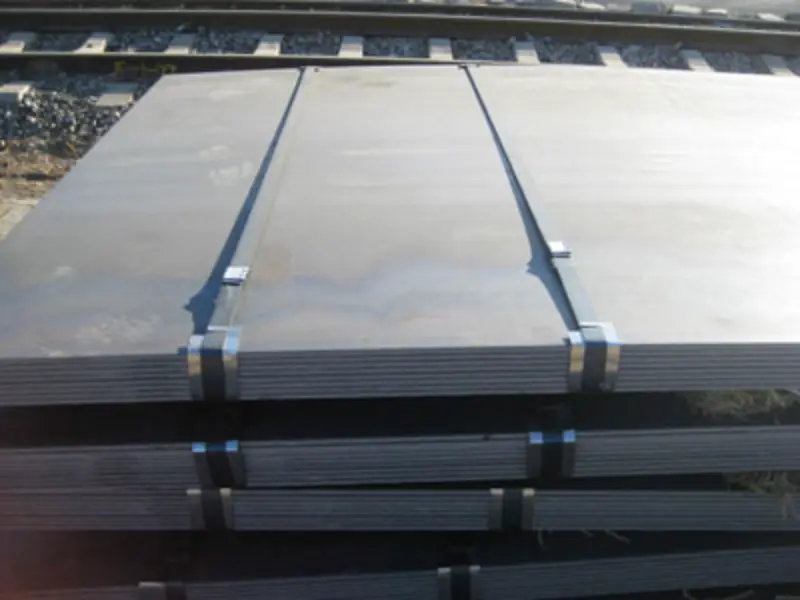
DIN 17102 TStE420
DIN 17102 TStE420: Weldable Fine-Grain Structural Steel for Automotive
Explore DIN 17102 TStE420, a normalized weldable fine-grain structural steel with guaranteed impact toughness at -20°C, high yield strength, and excellent formability for automotive and heavy-duty applications.
Normalizing, hot rolling, cold forming, welding, oxy-fuel and plasma cutting
- Phone : +8618037372205
- Email : [email protected]
- WhatsApp: Contact via Whtsapp
- WeChat: +8618037372205
DIN 17102 TStE420 Introduction
DIN 17102 TStE420 is a hot-rolled, normalized weldable fine-grain structural steel plate widely employed in the automotive and construction sectors. The designation 'TStE' indicates a thermomechanically treated or normalized steel with enhanced notch toughness, while '420' denotes the minimum yield strength in MPa for thicknesses up to 16 mm.
Key properties include:
- High strength: minimum yield strength 420 MPa (t≤16 mm) and tensile strength 520–680 MPa.
- Excellent weldability: low carbon equivalent and tight chemistry control ensure reliable fabrication.
- Fine-grained microstructure: produced through full killing and normalization, meeting toughness requirements down to -20°C (27 J min on V-notch).
- Good cold formability: suitable for press-braking, flanging, and moderate bending operations.
The steel is commonly supplied in normalized condition and intended for welded structures subjected to dynamic loads, such as chassis frames, crane booms, and earthmoving equipment.
DIN 17102 TStE420 Chemical Composition
Ladle analysis in accordance with DIN 17102. The steel is fully killed with aluminium and may contain microalloying elements (Nb, V, Ti) for grain refinement. The carbon equivalent (CEV) is typically ≤0.45 to ensure good weldability.
Values are maximum unless a range is given.
| Chemical Element | Standard Value (wt%) | Remarks |
|---|---|---|
| Carbon (C) | ≤ 0.22 | For thickness ≤ 50 mm; lower C improves toughness and weldability |
| Silicon (Si) | ≤ 0.55 | Deoxidation agent; higher for thicker plates |
| Manganese (Mn) | 1.00 – 1.70 | Strength and toughness enhancer; range may be adjusted per thickness |
| Phosphorus (P) | ≤ 0.035 | Controlled for toughness |
| Sulfur (S) | ≤ 0.035 | Controlled for internal soundness |
| Aluminium (Al) total | ≥ 0.020 | Fine-grain practice ensured by sufficient free nitrogen fixing |
| Niobium (Nb) | ≤ 0.05 | Microalloying for grain refinement; optional |
| Vanadium (V) | ≤ 0.10 | Optional microalloying for precipitation strengthening |
| Titanium (Ti) | ≤ 0.03 | Optional for toughness improvement |
| Nitrogen (N) | ≤ 0.012 | Residual; binding with Al and microalloys |
| Carbon Equivalent (CEV) | ≤ 0.45 (typical) | CEV = C + Mn/6 + (Cr+Mo+V)/5 + (Ni+Cu)/15; for weldability assessment |
DIN 17102 TStE420 Thermal and Electrical Physical Properties
Physical properties are representative of carbon‑manganese structural steels and valid at room temperature unless otherwise stated. Values serve for design calculations and may vary slightly with actual composition and processing.
Data sourced from typical steel references.
| Property | Standard Value | Unit | Test Condition / Remarks |
|---|---|---|---|
| Density (ρ) | 7.85 | g/cm³ | At 20°C |
| Modulus of elasticity (E) | 210 | GPa | Tensile, at 20°C |
| Shear modulus (G) | 81 | GPa | Calculated; G = E / [2(1+ν)] |
| Poisson's ratio (ν) | 0.30 | — | At 20°C, elastic range |
| Linear thermal expansion coefficient (α) | 12.0 | 10⁻⁶/K | Between 20°C and 100°C |
| Linear thermal expansion coefficient (α) | 13.0 | 10⁻⁶/K | Between 20°C and 200°C |
| Linear thermal expansion coefficient (α) | 13.8 | 10⁻⁶/K | Between 20°C and 300°C |
| Thermal conductivity (λ) | 45 | W/(m·K) | At 20°C |
| Thermal conductivity (λ) | 42 | W/(m·K) | At 100°C |
| Specific heat capacity (cₚ) | 460 | J/(kg·K) | Between 20°C and 100°C |
| Specific heat capacity (cₚ) | 480 | J/(kg·K) | Between 20°C and 200°C |
| Electrical resistivity (ρₑ) | 0.22 | µΩ·m | At 20°C |
DIN 17102 TStE420 Mechanical Properties
Minimum values for normalized (+N) material in longitudinal direction, unless otherwise noted. Tensile tests per DIN EN 10002-1. Impact tests per ISO 148-1 (V-notch) at -20°C. Bending test up to 180° with mandrel diameter dependent on thickness.
Values apply to flat products; thickness ranges reflect standard designations.
| Property | Standard Required Value | Unit | Test Condition / Thickness Range |
|---|---|---|---|
| Upper yield strength (ReH) | ≥ 420 | MPa | t ≤ 16 mm |
| Upper yield strength (ReH) | ≥ 400 | MPa | 16 mm < t ≤ 35 mm |
| Upper yield strength (ReH) | ≥ 380 | MPa | 35 mm < t ≤ 50 mm |
| Tensile strength (Rm) | 520 – 680 | MPa | t ≤ 50 mm |
| Tensile strength (Rm) | 510 – 660 | MPa | 50 mm < t ≤ 100 mm (by agreement) |
| Elongation after fracture (A) | ≥ 19 | % | Gauge length 5.65√S0, longitudinal; t ≤ 16 mm |
| Elongation after fracture (A) | ≥ 18 | % | Gauge length 5.65√S0, longitudinal; 16 < t ≤ 35 mm |
| Elongation after fracture (A) | ≥ 17 | % | Gauge length 5.65√S0, longitudinal; 35 < t ≤ 50 mm |
| Impact energy (KV₂) | ≥ 27 | J | -20°C, V-notch, longitudinal, average of 3 tests |
| Bend test | No cracks | - | 180° bending; mandrel diameter 2t for t ≤ 10 mm, 3t for 10 < t ≤ 16 mm (typical) |
DIN 17102 TStE420 Full Equivalent Material Standards and Replaceable Grades
| Country / Region | Standard | Grade | Remarks |
|---|---|---|---|
| European Union | EN 10025-3:2004 | S420N | Direct equivalent; normalized/normalized rolled weldable fine‑grain steel; identical strength and toughness class. |
| European Union (former) | EN 10113-2:1993 | S420N | Superseded standard, same grade; often encountered in older documentation. |
| International (ISO) | ISO 4950-2:1995 | FeE420K | High yield strength flat steel products; normalized condition; K quality with -20°C impact requirement. |
| China | GB/T 1591-2018 | Q420D | Normalized fine‑grain steel; minimum yield 420 MPa and impact energy ≥27 J at -20°C (longitudinal); dimension-dependent properties align well. |
| Germany (DIN) | DIN 17102 | TStE420 | Original specification; often dual‑certified with EN 10025‑3 S420N. |
DIN 17102 TStE420 Application Introduction
DIN 17102 TStE420 is engineered for weight‑critical, dynamically loaded welded structures where good formability, high strength, and reliable low‑temperature toughness are paramount. The normalized fine‑grain microstructure guarantees uniform mechanical properties across the plate thickness, making it a preferred choice in the automotive, mobile crane, and heavy‑machinery sectors.
Typical application stages:
- Cutting: plasma, oxy‑fuel, or laser cutting without preheating for common thicknesses.
- Forming: cold bending, press‑braking, and flanging with mandrel radii ≥2t.
- Welding: all conventional arc processes (SMAW, GMAW, FCAW, SAW) with low‑hydrogen consumables; preheating may be recommended for thick sections or high restraint joints.
- Surface treatment: hot‑dip galvanizing, painting, or powder coating after suitable surface preparation.
Product Applications: Automotive chassis frames, cross members, and longitudinal beams, Trailer gooseneck hitches and fifth‑wheel plates, Crane booms, telescopic arms, and outrigger bases, Excavator and bulldozer arms and buckets, Welded structural columns and trusses in industrial buildings, Support frames for wind turbine towers, Undercarriages for railway coaches
Processed into products: Laser‑ or plasma‑cut brackets and gussets, Rolled or press‑braked U‑channels and box sections, Machined pivot bosses and welded sub‑frames, Bolted and welded node connections in space frames, Curved or dished plates for pressure vessels (after forming), Stiffeners and doubler plates in bridge girders
Application industries: Automotive and heavy‑vehicle manufacturing, Railway rolling stock and infrastructure, Mobile crane and lifting equipment, Earthmoving and mining machinery, Shipbuilding (secondary structures), Construction and bridge building, Pressure vessel and tank fabrication
DIN 17102 TStE420 Similar / Closely Matching Alternative Materials
| Country / Region | Standard | Grade | Remarks |
|---|---|---|---|
| European Union | EN 10025-3 | S420M | Thermomechanically rolled (TMCP) variant; same strength level but with lower carbon equivalent and better weldability; may have slightly different toughness guarantees. |
| Japan | JIS G3135 | SPFC590Y | High strength cold‑rolled steel sheet; yield strength ≈ 420 MPa; for automotive structural parts; not fully equivalent in thickness range or hot‑rolled condition. |
| United States | ASTM A572/A572M | Grade 60 | High‑strength low‑alloy structural steel; yield strength 415 MPa (60 ksi) minimum; lacks full normalization requirement, but commonly used in similar bridge and building applications. |
| United States | ASTM A633/A633M | Grade E | Normalized high‑strength low‑alloy steel; high toughness at -50°C; tensile strength 560‑700 MPa; suitable for heavy‑duty welded structures. |
| International (ISO) | ISO 4951-2 | S420MC | Hot‑rolled high yield steel for cold forming; microalloyed; uses TMCP; can serve as alternative when forming is critical but normalization is not mandatory. |
Notes:
- TStE420 can be supplied with inspection certificates according to EN 10204 type 2.2, 3.1, or 3.2 upon request.
- For improved atmospheric corrosion resistance, consult the supplier about optional copper additions (CORTEN‑type weathering steel not covered by DIN 17102).
- Post‑weld heat treatment (stress relieving) may be applied at 530‑580°C; however, prolonged holding can reduce strength mildly.
- The steel is CE marked under the Construction Products Regulation (CPR) when supplied as EN 10025‑3 S420N.
- Thickness tolerance and flatness comply with EN 10029 or equivalent standards; check for specific requirements on automotive blanks.
- Share



