
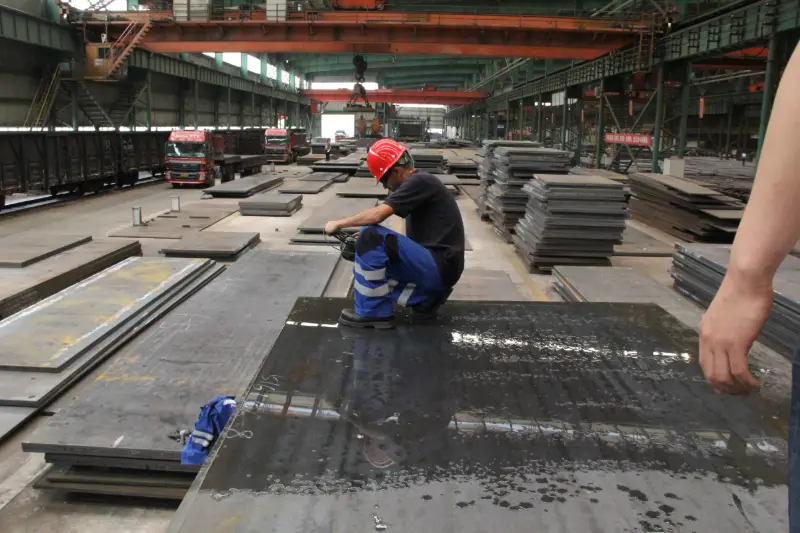
DIN 17102 TStE315 Automobile Structure Steel Plate
DIN 17102 TStE315 Automobile Structure Steel Plate – Fine Grain Weldable Grade
Detailed material data for TStE315 steel plate according to DIN 17102, including chemical composition, mechanical and physical properties, international equivalents and application guidance.
Welding, cutting, cold forming, bending, machining, hot-dip galvanizing
- Phone : +8618037372205
- Email : [email protected]
- WhatsApp: Contact via Whtsapp
- WeChat: +8618037372205
DIN 17102 TStE315 Automobile Structure Steel Plate Introduction
DIN 17102 TStE315 is a normalized fine grain structural steel supplied as plates and coils for welded structures in automobile and general engineering. The designation 'T' guarantees impact toughness at low temperature. The grade combines a minimum yield strength of 315 MPa with good weldability and formability, achieved through a fine grain microstructure stabilized by aluminum or microalloying elements.
Key features:
- Excellent toughness at temperatures down to −20°C (KV≈27 J)
- Uniform mechanical properties due to normalized delivery condition
- High reliability in welded constructions without post-weld heat treatment
- Good suitability for cold forming and hot-dip galvanizing
Typical applications include automobile chassis components, crane booms, bridges, and general structural members.
DIN 17102 TStE315 Automobile Structure Steel Plate Chemical Composition
The chemical composition of TStE315 is designed to provide a fine grain structure and improved toughness. Carbon equivalent is controlled for excellent weldability. Key elements like aluminum, niobium, vanadium, or titanium are added singly or in combination for grain refinement. Maximum limits for phosphorus and sulfur ensure cleanliness and resistance to brittle fracture.
| Element | Standard Value | Remarks |
|---|---|---|
| Carbon (C) | ≤0.18% | Typical range 0.12–0.16% for optimized weldability |
| Silicon (Si) | ≤0.50% | Deoxidizer, aids strength |
| Manganese (Mn) | 0.90–1.65% | Strengthens and refines grain |
| Phosphorus (P) | ≤0.030% | Max for toughness |
| Sulfur (S) | ≤0.025% | Max for ductility |
| Aluminum (Al total) | ≥0.020% | Minimum for fine grain practice; acid-soluble Al may be specified |
| Nitrogen (N) | ≤0.015% | When Al is used, N is bound as AlN for grain refinement |
| Niobium (Nb) | ≤0.05% | Optional grain refiner, singly or in combination |
| Vanadium (V) | ≤0.12% | Optional grain refiner |
| Titanium (Ti) | ≤0.05% | Optional grain refiner |
| Nb+V+Ti | ≤0.22% | Sum of microalloying elements if added |
DIN 17102 TStE315 Automobile Structure Steel Plate Thermal and Electrical Physical Properties
Physical properties are typical for low-carbon structural steels and are suitable for design calculations. Values may vary slightly with temperature and specific heat treatment condition. These are provided as engineering reference data at room temperature unless otherwise noted.
| Property | Typical Value | Unit | Test Condition / Remarks |
|---|---|---|---|
| Density (ρ) | 7.85 | g/cm³ | At 20°C |
| Elastic modulus (E) | 210 | GPa | At 20°C |
| Shear modulus (G) | 81 | GPa | At 20°C |
| Poisson's ratio (ν) | 0.3 | – | Elastic range |
| Thermal expansion (α) | 12.0 | 10⁻⁶/K | 20–100°C |
| Thermal expansion (α) | 12.8 | 10⁻⁶/K | 20–200°C |
| Thermal expansion (α) | 13.5 | 10⁻⁶/K | 20–400°C |
| Thermal conductivity (λ) | 53 | W/(m·K) | At 20°C |
| Thermal conductivity (λ) | 47 | W/(m·K) | At 300°C |
| Specific heat (cp) | 0.47 | J/(g·K) | At 20°C |
| Electrical resistivity (ρe) | ~0.15 | Ω·mm²/m | At 20°C |
DIN 17102 TStE315 Automobile Structure Steel Plate Mechanical Properties
Mechanical properties are guaranteed in the normalized condition. The yield and tensile strength values vary with product thickness. Impact toughness is verified longitudinally at −20°C for TStE315 (T = low temperature). Elongation decreases slightly with increasing thickness. All tests are performed in accordance with EN 10002-1 and EN 10045-1.
| Property | Standard Required Value | Unit | Test Condition / Remarks |
|---|---|---|---|
| Yield strength (ReH) | min 315 | MPa | Thickness ≤ 16 mm |
| Yield strength (ReH) | min 295 | MPa | Thickness > 16 mm ≤ 35 mm |
| Yield strength (ReH) | min 275 | MPa | Thickness > 35 mm ≤ 50 mm |
| Yield strength (ReH) | min 255 | MPa | Thickness > 50 mm ≤ 70 mm |
| Tensile strength (Rm) | 490–630 | MPa | Thickness ≤ 16 mm (all ranges approx.) |
| Tensile strength (Rm) | 490–630 | MPa | Thickness > 16 mm ≤ 40 mm |
| Tensile strength (Rm) | 470–610 | MPa | Thickness > 40 mm ≤ 63 mm |
| Elongation (A, longitudinal) | min 22 | % | L0 = 5.65√S0, thickness ≤ 16 mm |
| Elongation (A, longitudinal) | min 22 | % | Thickness > 16 mm ≤ 40 mm |
| Elongation (A, longitudinal) | min 21 | % | Thickness > 40 mm ≤ 63 mm |
| Impact energy (KV, longitudinal) | ≥ 27 | J | At −20°C, Charpy V-notch |
| Bend test (transverse) | No cracks | – | Mandrel diameter ~2×t (t = thickness), 180° bend |
DIN 17102 TStE315 Automobile Structure Steel Plate Exactly Equivalent Material Standards and Substitutable Grades
| Country / Region | Standard | Grade | Remarks |
|---|---|---|---|
| Europe | EN 10025-3:2004 | S315N | Normalized fine grain structural steel, matches TStE315 chemistry and mechanical properties |
| International | ISO 630-2:2011 | S315N | Corresponding normalized grade with same yield and toughness class |
| Germany (obsolete) | DIN 17102 | TStE315 | Original designation, still used for reference and replacement orders |
DIN 17102 TStE315 Automobile Structure Steel Plate Application Introduction
TStE315 is used where a good balance of strength, toughness and weldability is required. Its fine grain structure ensures consistent properties after welding and allows the fabrication of robust structures without post-weld heat treatment. Typical areas of application span the automotive, crane, and general engineering industries.
Product Applications: Automobile chassis frames and sub-frames, Welded structural beams and columns, Crane booms and lattice structures, Bridge girders and deck plates, Pressure vessel shells not requiring high-temperature design, Fatigue-loaded welded assemblies
Processed into products: Chassis side rails and cross members, Suspension mounting brackets, Welded stiffeners and gussets, Lifting lugs and clevises, Base plates and sole plates for machinery, Hydraulic cylinder bodies and mounting flanges, Construction machinery booms and arms
Application industries: Automotive manufacturing (commercial vehicles, trailers), Crane and lifting equipment, Bridge and structural engineering, Heavy machinery and earthmoving equipment, Pressure vessels and storage tanks (non-aggressive environments), Shipbuilding (secondary structures)
DIN 17102 TStE315 Automobile Structure Steel Plate Similar / Alternative Materials with Approximate Properties
| Country / Region | Standard | Grade | Remarks |
|---|---|---|---|
| Europe | EN 10025-3 | S355N | Higher strength normalized fine grain steel (min 355 MPa yield), similar weldability and toughness |
| Germany | DIN 17102 | TStE355 | Higher yield version in the same standard; suitable for heavier loads |
| USA | ASTM A572/A572M | Grade 42 / Grade 50 | High-strength low-alloy structural steel; not fine grain, but after normalizing can achieve comparable toughness |
| Japan | JIS G 3106 | SM490A/B/C | Welded structural steel; SM490B/C with impact test may substitute for moderate thickness |
| China | GB/T 1591 | Q345D | Low-alloy high-strength structural steel; Q345D has good low-temperature toughness (~ –20°C), but not fine grain by design |
Notes:
This steel is typically ordered with inspection certificate 3.1 according to EN 10204. For service temperatures below –20°C, a grade with higher toughness (e.g., TStE355 with –40°C option) should be considered. Normalizing after forming is not mandatory for thicknesses ≤ 30 mm when using finely grained killed steel with thermo-mechanical processing. Care must be taken during hot-dip galvanizing to avoid liquid metal embrittlement in heavily cold-formed areas; proper pre-heating may be required.
- Share



