
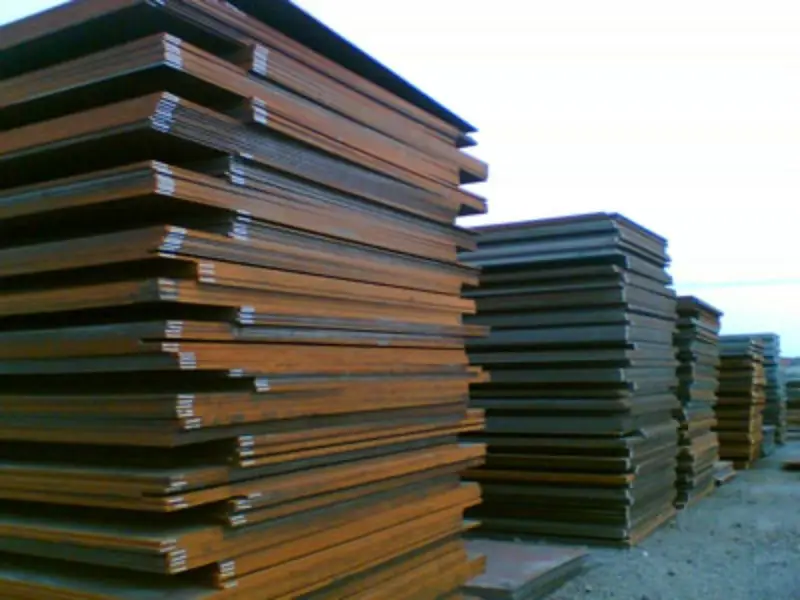
DIN 17102 WStE315 Automobile Structure Steel Plate
DIN 17102 WStE315 Automobile Structure Steel Plate - Fine-Grain Structural Steel
Comprehensive material properties and data for WStE315 steel plate according to DIN 17102, including chemical composition, mechanical and physical properties, equivalents, and application guidance for automotive structural components.
Hot rolling, cold forming, bending, welding, cutting, machining
- Phone : +8618037372205
- Email : [email protected]
- WhatsApp: Contact via Whtsapp
- WeChat: +8618037372205
DIN 17102 WStE315 Automobile Structure Steel Plate Introduction
WStE315 is a normalized fine-grain structural steel specified in DIN 17102, primarily used for load-bearing components in vehicle structures. It offers a minimum yield strength of 315 MPa, good cold formability, and excellent weldability, making it ideal for chassis and frame parts. The fine-grain microstructure achieved through controlled normalizing delivers consistent toughness and ductility at low temperatures. This grade is often supplied in the normalized condition (N) and provides reliable performance under dynamic loads.
DIN 17102 WStE315 Automobile Structure Steel Plate Chemical Composition
Typical ladle analysis according to DIN 17102 for thickness ≤ 16 mm. Microalloying elements like Nb, V, and Ti refine grain structure and improve strength. The carbon equivalent (CEV) is controlled to ensure good weldability. Elements Al, Nb, V, and Ti are added for grain refinement and precipitation strengthening.
| Chemical Element | Standard Value (wt%) | Remarks |
|---|---|---|
| Carbon (C) | ≤ 0.18 | Maximum |
| Silicon (Si) | ≤ 0.50 | Maximum |
| Manganese (Mn) | 1.00 – 1.60 | Range |
| Phosphorus (P) | ≤ 0.030 | Maximum |
| Sulfur (S) | ≤ 0.025 | Maximum |
| Aluminium (Al) | ≥ 0.02 | Minimum total aluminium |
| Niobium (Nb) | ≤ 0.05 | Maximum |
| Vanadium (V) | ≤ 0.12 | Maximum |
| Titanium (Ti) | ≤ 0.03 | Maximum |
| Nitrogen (N) | ≤ 0.020 | Maximum |
DIN 17102 WStE315 Automobile Structure Steel Plate Thermal and Electrical Physical Properties
Physical properties at room temperature unless otherwise stated. These values are typical for low-alloy fine-grain structural steels and are suitable for general engineering calculations. Actual values may vary slightly with composition and heat treatment.
| Property | Standard Reference Value | Unit | Test Condition |
|---|---|---|---|
| Density (ρ) | 7.85 | g/cm³ | At 20 °C |
| Elastic modulus (E) | 210 | GPa | At 20 °C |
| Shear modulus (G) | 81 | GPa | Calculated from E and ν |
| Poisson's ratio (ν) | 0.3 | - | At 20 °C |
| Thermal expansion coefficient (α) | 12.0 × 10⁻⁶ | K⁻¹ | 20 – 100 °C |
| Thermal conductivity (λ) | 50 | W/(m·K) | At 20 °C |
| Specific heat capacity | 460 | J/(kg·K) | At 20 °C |
| Electrical resistivity (ρ_e) | 0.23 × 10⁻⁶ | Ω·m | At 20 °C |
DIN 17102 WStE315 Automobile Structure Steel Plate Mechanical Properties
Minimum requirements in the normalized condition (N) at ambient temperature, transverse test pieces unless otherwise stated. Yield strength and elongation depend on product thickness. Charpy impact energy is guaranteed for quality J at -20 °C. Data based on DIN 17102 and comparable EN 10025-3 S315N.
| Property | Standard Requirement Value | Unit | Test Condition |
|---|---|---|---|
| Yield strength (ReH) | ≥ 315 | MPa | Thickness ≤ 16 mm, transverse |
| Yield strength (ReH) | ≥ 295 | MPa | 16 < t ≤ 40 mm, transverse |
| Yield strength (ReH) | ≥ 285 | MPa | 40 < t ≤ 63 mm, transverse |
| Yield strength (ReH) | ≥ 275 | MPa | 63 < t ≤ 80 mm, transverse |
| Tensile strength (Rm) | 490 – 630 | MPa | Thickness ≤ 80 mm, transverse |
| Elongation (A) | ≥ 22 | % | L₀ = 5.65√S₀, t ≤ 16 mm, transverse |
| Elongation (A) | ≥ 21 | % | L₀ = 5.65√S₀, 16 < t ≤ 40 mm, transverse |
| Elongation (A) | ≥ 20 | % | L₀ = 5.65√S₀, 40 < t ≤ 63 mm, transverse |
| Elongation (A) | ≥ 19 | % | L₀ = 5.65√S₀, 63 < t ≤ 80 mm, transverse |
| Charpy impact energy (KV) | ≥ 27 | J | Longitudinal, -20 °C (quality J) |
| Bend test | D = 3 t | - | 180°, with the bend axis perpendicular to the rolling direction |
DIN 17102 WStE315 Automobile Structure Steel Plate Fully Equivalent Material Standards and Replaceable Grade Recommendations
| Country / Region | Standard | Grade | Remarks |
|---|---|---|---|
| Germany | DIN 17102 | WStE315 | Original specification, normalized fine-grain steel |
| European Union | EN 10025-3 | S315N | Direct replacement after harmonization, same yield class and delivery condition N |
| International | ISO 4950-1 | E315 | Property equivalent, normalized delivery condition |
| UK (superseded) | BS 4360 | Grade 43EE | Historically comparable, though yield class differs slightly |
DIN 17102 WStE315 Automobile Structure Steel Plate Application Introduction
WStE315 steel plate is engineered for demanding structural applications where weight, strength, and safety are critical. Its fine-grain structure guarantees high toughness even at low temperatures, making it a preferred choice for chassis members, suspension components, and reinforcements in commercial and passenger vehicles. The material can be formed, welded, and machined with standard workshop practices. Typical processing includes plasma or laser cutting, bending, and MIG/MAG welding with matching filler metals. Surface protection (painting, galvanizing) is recommended for corrosion-prone environments.
Product Applications: Truck chassis frames, Longitudinal rails and cross members, Suspension and axle brackets, Reinforcement plates for vehicle bodies, Container underframes
Processed into products: Main longitudinal beams of truck chassis, Cross beams and engine cradle supports, Spring hanger brackets, Tow bars and coupling plates, Welded box sections for bus frames, Bumper back plates and crash boxes
Application industries: Automotive manufacturing (trucks, buses, trailers), Heavy machinery and earth-moving equipment, Railway rolling stock structures, Agricultural machinery
DIN 17102 WStE315 Automobile Structure Steel Plate Similar / Comparable Substitute Materials
| Country / Region | Standard | Grade | Remarks |
|---|---|---|---|
| European Union | EN 10025-2 | S355J0 | Higher yield strength (355 MPa), but similar ductility and weldability; thicker sections may require preheat |
| USA | ASTM A572/A572M | Grade 50 [345] | Yield strength 345 MPa, similar structural applications, note chemical composition differences |
| China | GB/T 1591 | Q345B | Comparable strength level, widely used for vehicle structures; CEV may be slightly higher |
| Japan | JIS G 3106 | SM490A | Tensile class 490 MPa, yield ~325 MPa for t≤16 mm, suitable for welded structures |
| International | EN 10149-3 | S315NC | Cold-rolled, normalized or normalizing rolled; higher formability but limited thickness range |
Notes:
Additional information: WStE315 is suitable for hot-dip galvanizing (HDG) provided the silicon content is controlled to avoid excessive coating thickness. Welding procedures should follow EN 1011-2; preheating may be required for thick plates (>40 mm) to avoid hydrogen cracking. The carbon equivalent (CEV) is typically ≤0.43% for t ≤16 mm, ensuring excellent field weldability. Notch toughness at temperatures down to -50 °C can be agreed upon when ordering with quality K option (not shown here). For fatigue-loaded components, post-weld treatment such as shot peening may be beneficial.
- Share



