
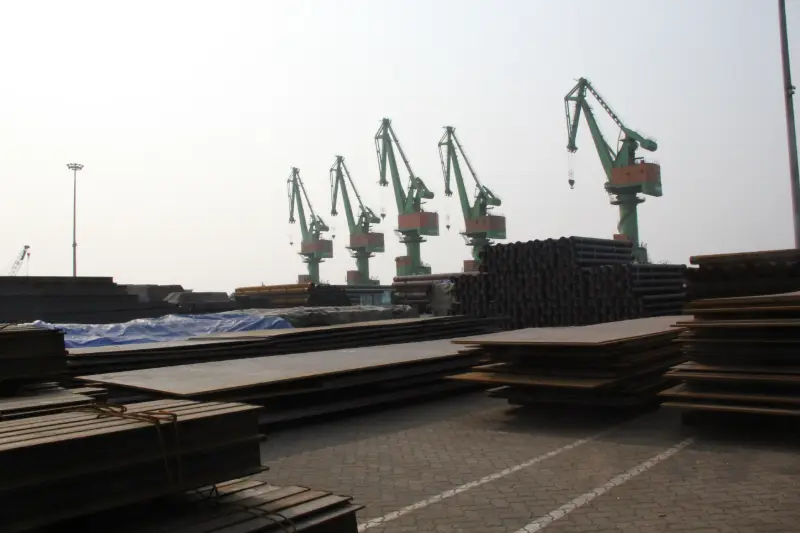
StE315 Automobile Structure Steel Plate
StE315 Automobile Structure Steel Plate | DIN 17102 Fine-Grain Steel
Comprehensive material data for StE315 automobile structure steel plate per DIN 17102, including chemical composition, mechanical and physical properties, and international equivalents.
Welding, gas cutting, cold forming, bending, machining
- Phone : +8618037372205
- Email : [email protected]
- WhatsApp: Contact via Whtsapp
- WeChat: +8618037372205
StE315 Automobile Structure Steel Plate Introduction
The StE315 steel grade, specified in the German standard DIN 17102, is a weldable fine-grain structural steel primarily intended for applications in automobile construction and general structural engineering. Delivered in the normalized or normalized rolled condition (N), this steel exhibits a minimum yield strength of 315 MPa and excellent weldability combined with good low-temperature toughness.
Key features include:
- Controlled chemical composition with microalloying elements like Nb, V and Ti to refine grain size and improve mechanical properties.
- High resistance to brittle fracture, ensured by guaranteed impact energy values down to -20 °C (for StE315-3).
- Good formability, making it suitable for cold and hot forming operations up to certain thicknesses.
- Versatile applications in vehicle chassis, crane booms, and structural components requiring high strength and reliability.
StE315 plates and wide strips are available in thicknesses typically up to 63 mm, and can be processed by cutting, bending, welding and surface treatment.
StE315 Automobile Structure Steel Plate Chemical Composition
The chemical composition of StE315 is designed to provide a fine-grain structure through microalloying additions, enhancing strength and toughness. The table presents the limits as per DIN 17102. Carbon equivalent (CE) is typically low to ensure excellent weldability.
| Element | Content (max % unless range given) | Notes |
|---|---|---|
| Carbon (C) | ≤0.20 | Max. |
| Silicon (Si) | ≤0.50 | Max. |
| Manganese (Mn) | ≤1.50 | Max. |
| Phosphorus (P) | ≤0.040 | Max. |
| Sulfur (S) | ≤0.040 | Max. |
| Aluminum (Altot) | ≥0.020 | Min. for grain refinement |
| Niobium (Nb) | ≤0.05 | Optional microalloy |
| Vanadium (V) | ≤0.10 | Optional microalloy |
| Titanium (Ti) | ≤0.05 | Optional microalloy |
| Nitrogen (N) | ≤0.020 | Typically controlled |
StE315 Automobile Structure Steel Plate Thermal and Electrical Physical Properties
These physical constants are typical for carbon-manganese structural steels at room temperature and can be used for design calculations. Actual values may vary with chemical composition and processing.
| Property | Typical Value | Unit | Test Condition |
|---|---|---|---|
| Density (ρ) | 7.85 | kg/dm³ (g/cm³) | At 20 °C |
| Modulus of elasticity (E) | 210 | GPa | At 20 °C |
| Shear modulus (G) | ~80 | GPa | At 20 °C, derived from E and ν |
| Poisson ratio (ν) | 0.3 | — | At 20 °C |
| Thermal expansion coefficient (α) | 12.0 | 10⁻⁶/K | Between 20 °C and 100 °C |
| Thermal conductivity (λ) | ~50 | W/(m·K) | At 20 °C |
| Specific heat capacity (c) | ~460 | J/(kg·K) | At 20 °C |
| Electrical resistivity (ρe) | ~0.16 | Ω·mm²/m | At 20 °C |
StE315 Automobile Structure Steel Plate Mechanical Properties
The mechanical properties for StE315 are guaranteed for the normalized or normalized rolled condition. Values depend on product thickness. Test specimens are taken in the transverse direction unless otherwise indicated. Impact energy is measured on Charpy V-notch samples.
| Property | Requirement | Unit | Test Condition |
|---|---|---|---|
| Yield strength (ReH) | ≥315 | MPa | Thickness ≤ 16 mm |
| Yield strength (ReH) | ≥295 | MPa | Thickness 16 mm < t ≤ 40 mm |
| Yield strength (ReH) | ≥275 | MPa | Thickness 40 mm < t ≤ 63 mm |
| Tensile strength (Rm) | 450 – 600 | MPa | Thickness ≤ 40 mm |
| Tensile strength (Rm) | 430 – 580 | MPa | Thickness 40 mm < t ≤ 63 mm |
| Elongation (A on L0 = 5.65√S0) | ≥21 | % | Thickness ≤ 40 mm |
| Elongation (A) | ≥20 | % | Thickness 40 mm < t ≤ 63 mm |
| Bend test (180° mandrel diameter) | d = 2t | — | Thickness ≤ 40 mm |
| Bend test (180° mandrel diameter) | d = 3t | — | Thickness 40 mm < t ≤ 63 mm |
| Impact energy (KV, transverse) | ≥27 | J | At 0 °C (StE315-2) |
| Impact energy (KV, transverse) | ≥27 | J | At -20 °C (StE315-3) |
StE315 Automobile Structure Steel Plate International Equivalent Standards and Similar Grades
| Country/Region | Standard | Designation | Remarks |
|---|---|---|---|
| Europe (EN) | EN 10113-2 | S315N (or S315NL) | Normalized fine-grain steel, very close properties, but check thickness range and impact class |
| Europe (EN) | EN 10149-2 | S315MC | Thermo-mechanically rolled fine-grain steel, similar yield but different production route; may have tighter thickness tolerances |
| USA | ASTM A572/A572M | Grade 45 [310] | 310 MPa minimum yield, slightly lower strength; Grade 50 (345 MPa) may be used with design adjustment |
| Japan | JIS G3106 | SM490A | Minimum yield 325 MPa, higher strength with good weldability, widely used for welded structures |
| China | GB/T 1591 | Q355D (or Q345D) | 355 MPa yield at ≤16mm, higher strength level; Q345D provides low-temperature toughness similar to StE315-3 |
StE315 Automobile Structure Steel Plate Application Introduction
StE315 steel plates are specially designed for welded structures requiring a combination of strength, toughness and weldability. Typical applications span the automotive sector, heavy machinery, and structural engineering. Its fine-grain nature provides enhanced resistance against brittle fracture even at low temperatures.
Processing recommendations:
- Preheating is generally not required for thicknesses below 30 mm, but may be considered for thicker sections or when cold temperatures prevail.
- Suitable for all common welding processes (MAG, SMAW, SAW) using low-hydrogen consumables.
- Can be cold formed with a minimum bending radius of about 2t (for t ≤ 16 mm) perpendicular to rolling direction.
- Post-weld heat treatment is not normally required but may be applied for stress relief.
Always consult the steel supplier and applicable design codes for specific usage conditions.
Product Applications: Truck chassis frames and crossmembers, Trailer and semi-trailer beams, Crane booms and jibs, Welded structural sections and box girders, Agricultural machinery frames
Processed into products: Longitudinal chassis rails, Suspension arms and brackets, Crane base frames, Heavy-duty vehicle subframes, Excavator boom and arm components
Application industries: Automotive and commercial vehicle manufacturing, Construction and earth-moving equipment, Lifting and crane engineering, Bridge and steel structure construction, Pressure vessel and storage tank supports
StE315 Automobile Structure Steel Plate Similar Strength Materials for Comparison
| Country/Region | Standard | Designation | Remarks |
|---|---|---|---|
| Germany | DIN 17100 | St52-3 (S355J2) | Yield strength 355 MPa, comparable use, but not fine-grain treated |
| International | ISO 4950-2 | Fe315C | Weathering steel with 315 MPa yield, for atmospheric corrosion resistance |
| Russia | GOST 19281 | 09G2S (09Г2С) | Manganese-silicon structural steel with ~295-345 MPa yield, similar weldability |
| Europe | EN 10025-2 | S355J2+N | Structural steel with higher yield, commonly used in place of StE315 when strength can be increased |
Notes:
This data is based on DIN 17102 (withdrawn) but remains relevant for existing structures and maintenance. For new designs, reference should be made to current EN standards such as EN 10025-3 or EN 10149-2. Typical carbon equivalent (CEV) for StE315 is below 0.40%, which ensures good weldability without excessive preheat. Surface condition: as-rolled or shot blasted.
- Share



