
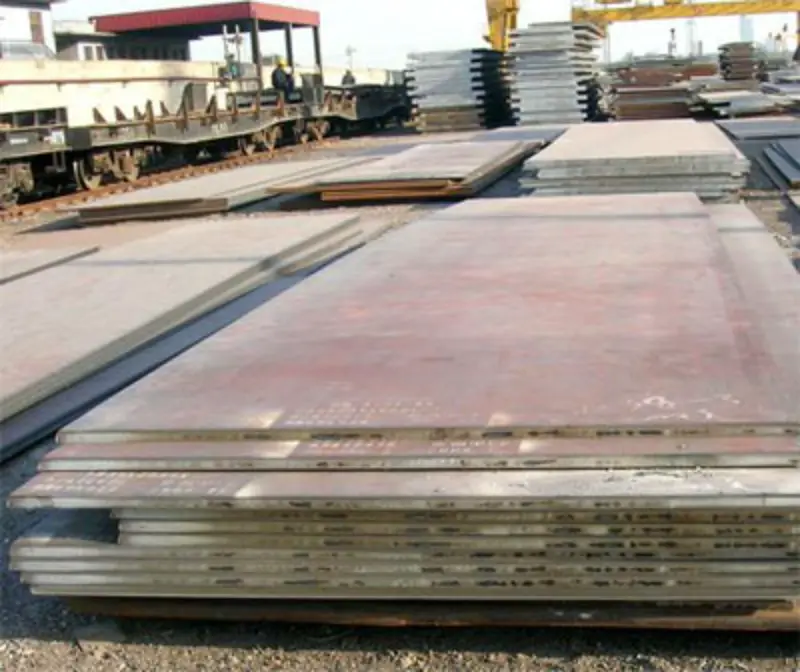
DIN 17102 EStE285 Automotive Structural Steel
DIN 17102 EStE285 Automotive Structural Steel: Composition, Properties & Equivalents
Technical data for DIN 17102 EStE285 automotive structural steel plate: chemical composition, mechanical and thermal properties, equivalent standards, and application guidance.
Cold forming, bending, stamping, welding, cutting, machining
- Phone : +8618037372205
- Email : [email protected]
- WhatsApp: Contact via Whtsapp
- WeChat: +8618037372205
DIN 17102 EStE285 Automotive Structural Steel Introduction
EStE285 is a weldable fine grain structural steel specified in DIN 17102, primarily designed for automobile structural applications. It is supplied in the normalizing (or thermomechanically rolled) condition, ensuring a minimum yield strength of 285 MPa for thicknesses up to 16 mm. The steel offers a good combination of strength, toughness, and formability, making it suitable for chassis components, frames, and other load-bearing parts. Its fine grain structure, achieved through microalloying with elements such as niobium, vanadium, or titanium, guarantees excellent weldability and resistance to brittle fracture even at low temperatures. The material meets the demands of the automotive industry for lightweight yet robust construction.
DIN 17102 EStE285 Automotive Structural Steel Chemical Composition
The chemical composition of DIN 17102 EStE285 is designed to ensure fine grain size, good weldability, and adequate strength. Carbon is kept low to improve toughness and weldability; manganese provides solid solution strengthening. Microalloying elements (Nb, V, Ti) refine the grain and contribute to precipitation hardening. Aluminum is used for deoxidation and grain size control. The limits shown below are typical maximum values unless a range is indicated.
| Element | Standard Value (%) | Remarks |
|---|---|---|
| Carbon (C) | ≤ 0.20 | Max. |
| Silicon (Si) | 0.10 – 0.50 | Range |
| Manganese (Mn) | ≤ 1.60 | Max. |
| Phosphorus (P) | ≤ 0.035 | Max. |
| Sulfur (S) | ≤ 0.030 | Max. |
| Aluminum (Altotal) | ≥ 0.015 | Min., fine grain practice |
| Niobium (Nb) | ≤ 0.09 | Max., single or combined |
| Vanadium (V) | ≤ 0.10 | Max., single or combined |
| Titanium (Ti) | ≤ 0.12 | Max., single or combined |
| Nitrogen (N) | ≤ 0.015 | Max. |
| Chromium (Cr) | ≤ 0.30 | Residual element |
| Nickel (Ni) | ≤ 0.30 | Residual element |
| Molybdenum (Mo) | ≤ 0.10 | Residual element |
| Copper (Cu) | ≤ 0.20 | Residual element |
DIN 17102 EStE285 Automotive Structural Steel Thermal & Electrical Physical Properties
The physical properties of EStE285 are typical of low-carbon, fine grain structural steels. They are provided as reference data for design calculations and are not part of the delivery specification. Values may vary slightly depending on the exact chemical composition and manufacturing route.
| Property | Typical Value | Unit | Test Condition / Remarks |
|---|---|---|---|
| Density (ρ) | 7.85 | kg/dm³ | At 20°C |
| Modulus of elasticity (E) | 210 | GPa | At room temperature |
| Shear modulus (G) | 81 | GPa | At room temperature |
| Poisson's ratio (ν) | 0.3 | — | Elastic range |
| Coefficient of thermal expansion (α) | 11.1 | 10⁻⁶·K⁻¹ | 20°C – 100°C |
| Coefficient of thermal expansion (α) | 12.1 | 10⁻⁶·K⁻¹ | 20°C – 200°C |
| Coefficient of thermal expansion (α) | 12.9 | 10⁻⁶·K⁻¹ | 20°C – 300°C |
| Thermal conductivity (λ) | 50 | W·m⁻¹·K⁻¹ | At 20°C |
| Thermal conductivity (λ) | 45 | W·m⁻¹·K⁻¹ | At 200°C |
| Specific heat capacity (cp) | 460 | J·kg⁻¹·K⁻¹ | At 20°C – 100°C |
| Electrical resistivity (ρe) | 0.15 – 0.25 | 10⁻⁶ Ω·m | At 20°C |
DIN 17102 EStE285 Automotive Structural Steel Mechanical Properties
The following values are measured on test pieces taken in the longitudinal direction from normalized or thermomechanically rolled EStE285 plates. Impact tests are performed on Charpy-V specimens at -20°C. Properties depend on product thickness; the table lists the main thickness ranges. Bending test is carried out with the axis of the bend parallel to the rolling direction.
| Property | Standard Requirement | Unit | Testing Condition / Thickness |
|---|---|---|---|
| Yield strength (ReH) | ≥ 285 | MPa | Thickness ≤ 16 mm |
| Yield strength (ReH) | ≥ 275 | MPa | 16 mm < thickness ≤ 35 mm |
| Yield strength (ReH) | ≥ 265 | MPa | 35 mm < thickness ≤ 50 mm |
| Tensile strength (Rm) | 420 – 560 | MPa | All thicknesses (typical range) |
| Elongation (A5) | ≥ 22 | % | Thickness ≤ 40 mm, longitudinal |
| Elongation (A5) | ≥ 21 | % | 40 mm < thickness ≤ 63 mm, longitudinal |
| Bend test (mandrel diameter) | No crack (d = 2a) | — | Thickness ≤ 16 mm, 180° bend |
| Bend test (mandrel diameter) | No crack (d = 3a) | — | 16 mm < thickness ≤ 40 mm, 180° bend |
| Impact energy (KV, longitudinal) | ≥ 27 | J | -20°C, 10×10 mm Charpy-V |
| Impact energy (KV, transverse) | ≥ 20 | J | -20°C, 10×10 mm Charpy-V |
DIN 17102 EStE285 Automotive Structural Steel Fully Equivalent Material Standards & Replaceable Grade Recommendations
| Country / Region | Standard | Grade | Remarks |
|---|---|---|---|
| Europe | EN 10025-3 | S275N / S275NL | Closest European equivalent; normalizing rolled fine grain steel. Yield strength ≥ 275 MPa, slightly lower than EStE285. Impact quality NL guarantees 27 J at -50°C. |
| International | ISO 630-3 | S275N / S275NL | Same as EN 10025-3, harmonized international standard. |
DIN 17102 EStE285 Automotive Structural Steel Application Introduction
EStE285 is specially designed for the automotive and transport industry, where a consistent combination of moderate strength, good formability, and reliable impact toughness is essential. It is used in welded structural components subjected to dynamic loads. Typical processing includes cold forming, stamping, and MIG/MAG welding. Preheating is generally not required for moderate thicknesses, but post-weld heat treatment is not recommended as it may impair the mechanical properties.
Product Applications: Truck frame rails and cross members, Automobile chassis and subframes, Trailer sidemembers and drawbars, Stamped wheel discs (rim components), Axle beams and suspension brackets, Structural sections for bus and coach body frames
Processed into products: Longitudinal and transverse beams for vehicle frames, Spring hanger brackets, Steering knuckle supports, Shock absorber mounting plates, Cross shaft reinforcements, Welded assembly parts for heavy-duty vehicles
Application industries: Automotive manufacturing (cars, trucks, trailers), Railway vehicle construction, Agricultural and construction equipment, General engineering and steel structures, Container and pressure vessel components (non-pressure boundary)
DIN 17102 EStE285 Automotive Structural Steel Similar / Substitute Material Recommendations
| Country / Region | Standard | Grade | Remarks |
|---|---|---|---|
| Europe | EN 10025-4 | S275M / S275ML | Thermomechanically rolled fine grain steel; similar strength and chemical concept, improved weldability due to lower carbon equivalent. |
| Europe | EN 10149-2 | S315MC | High-strength low-alloy steel for cold forming; minimum yield 315 MPa, thinner gauge typical for automotive use. Not a direct substitute but used in similar applications. |
| Japan | JIS G3106 | SM400A/B/C | Weldable structural steel with minimum yield 245 MPa; lower strength but widely used in automotive and general structures. Good availability. |
| USA | ASTM A572/A572M | Grade 50 (345 MPa) | High-strength low-alloy structural steel; significantly higher yield strength, may require design adjustment. |
| China | GB/T 1591 | Q275C (or Q275D) | Similar yield strength level (275 MPa) with fine grain practice; can be considered for non-European projects. |
Notes:
- The original DIN 17102 standard has been withdrawn and replaced by the EN 10025 series; EStE285 remains available by agreement based on the former standard.
- For welding, low hydrogen processes and filler metals with a strength level matching that of the base metal are recommended (e.g., AWS ER70S-6 or similar).
- Cold forming radii should respect a minimum ratio r/t ≥ 2 for thicknesses up to 16 mm to avoid cracking.
- If improved atmospheric corrosion resistance is required, a weather-resistant grade (e.g., EN 10025-5 S355J0W) may be considered, though this implies higher strength and different welding parameters.
- Share



