
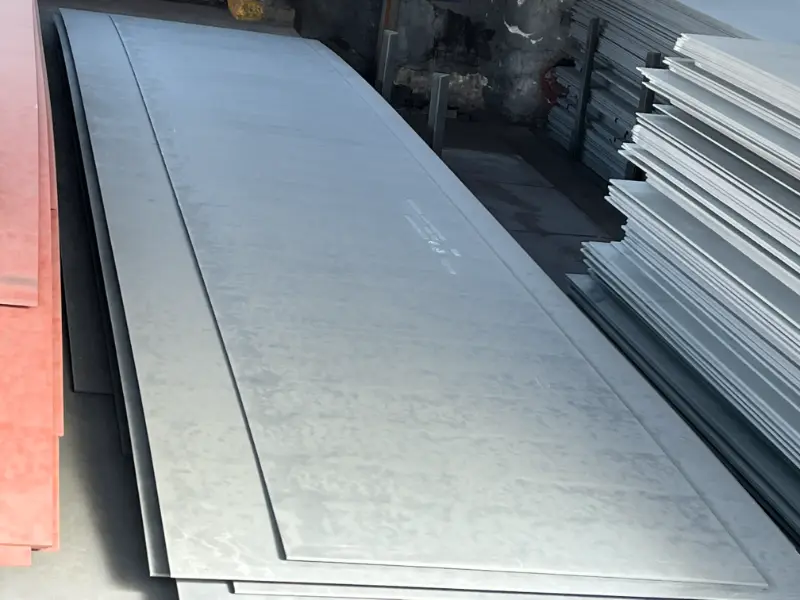
Corten B Weather Resistant Steel Plate
Corten B Weather Resistant Steel Plate: Superior Atmospheric Corrosion Resistance
Corten B is a high-strength, low-alloy weathering steel with enhanced resistance to atmospheric corrosion. It is ideal for structural applications where weight savings and durability are critical, often used without protective painting in suitable environments.
Hot rolling, controlled rolling, normalising, welding, bolting, cutting
- Phone : +8618037372205
- Email : [email protected]
- WhatsApp: Contact via Whtsapp
- WeChat: +8618037372205
Corten B Weather Resistant Steel Plate Introduction
Corten B is a high-strength, low-alloy structural steel that exhibits superior resistance to atmospheric corrosion compared to unalloyed steels. Under alternating wet-dry conditions, it forms a dense, adherent patina that slows further corrosion, often eliminating the need for painting.
- Key Features: Excellent corrosion resistance in most atmospheric environments, good weldability, higher yield strength than plain carbon steels, and cost-effectiveness over the life cycle.
- Standard Compliance: Conforms to ASTM A588 Grade B and is equivalent to EN 10025-5 S355J2W.
- Typical Applications: Bridges, building facades, railway vehicles, containers, and structural components exposed to the weather.
Corten B Weather Resistant Steel Plate Chemical Composition
The controlled alloying elements, particularly copper, chromium, and nickel, enhance atmospheric corrosion resistance. The composition below complies with ASTM A588 Grade B for plates. Minor variations may exist for other product forms; vanadium and columbium are optional grain refining elements.
| Element | Standard Value (%) | Remarks |
|---|---|---|
| Carbon (C) | ≤ 0.20 | Max |
| Manganese (Mn) | 0.75 - 1.35 | Inclusive range |
| Phosphorus (P) | ≤ 0.04 | Max |
| Sulfur (S) | ≤ 0.05 | Max |
| Silicon (Si) | 0.15 - 0.50 | Inclusive range |
| Nickel (Ni) | ≤ 0.50 | Max |
| Chromium (Cr) | 0.40 - 0.70 | Inclusive range |
| Copper (Cu) | 0.20 - 0.40 | Inclusive range |
| Vanadium (V) | 0.01 - 0.10 | Optional; inclusive range |
| Columbium (Nb) | 0.005 - 0.05 | Optional; may be used instead of V |
Corten B Weather Resistant Steel Plate Thermal and Electrical Physical Properties
These representative values are typical for Corten B / ASTM A588 Grade B steel at room temperature unless otherwise noted. The material exhibits good thermal conductivity and a stable coefficient of thermal expansion, suitable for structural design across a wide temperature range. Electrical resistivity is moderate for a low-alloy steel.
| Physical Property | Typical Value | Unit | Test Condition / Remarks |
|---|---|---|---|
| Density (ρ) | 7.85 | g/cm³ | At 20 °C |
| Elastic Modulus (E) | 200 | GPa | Ambient temperature |
| Shear Modulus (G) | 80 | GPa | Calculated from E and Poisson's ratio |
| Poisson's Ratio (ν) | 0.3 | - | Elastic range |
| Thermal Expansion (α) | 10.8 | µm/m·°C | 20 °C to 100 °C |
| Thermal Conductivity (λ) | 42 | W/m·K | At 20 °C |
| Specific Heat Capacity | 460 | J/kg·K | At 20 °C |
| Electrical Resistivity (ρ_e) | 0.23 | µΩ·m | At 20 °C |
Corten B Weather Resistant Steel Plate Mechanical Properties
Tensile requirements as per ASTM A588 Grade B for plates ≤ 100 mm thickness. Elongation depends on gauge length. Bending tests are conducted at 180° for plates. Impact toughness is usually not a mandatory requirement unless specified for low-temperature service.
| Property | Standard Requirement | Unit | Test Condition |
|---|---|---|---|
| Yield Strength (ReH) | ≥ 345 | MPa | Thickness ≤ 100 mm |
| Tensile Strength (Rm) | ≥ 485 | MPa | Thickness ≤ 100 mm |
| Elongation (A200) | ≥ 18 | % | In 200 mm gauge length |
| Elongation (A50) | ≥ 21 | % | In 50 mm gauge length |
| Bend Test (180°) – t ≤ 20 mm | D = 2t | - | Mandrel diameter = 2 × thickness |
| Bend Test (180°) – 20 mm < t ≤ 25.4 mm | D = 2½t | - | Mandrel diameter = 2.5 × thickness |
Corten B Weather Resistant Steel Plate Fully Equivalent Material Standards and Replaceable Grades
| Country/Region | Standard | Grade | Remarks |
|---|---|---|---|
| USA | ASTM A588/A588M | Grade B | Original Corten B designation |
| Europe | EN 10025-5 | S355J2W | 1.8965 steel number; equivalent for plates |
| Japan | JIS G3125 | SPA-H | For hot-rolled atmospheric corrosion resisting steel |
| China | GB/T 4171 | Q355NH | Near equivalent; check individual element tolerances |
| China | GB/T 4171 | Q355GNHL | Higher corrosion resistance variant; similar strength |
Corten B Weather Resistant Steel Plate Application Introduction
Corten B is widely used in structural applications where long-term corrosion resistance and reduced maintenance are critical. It performs well in alternating wet-dry environments that promote the formation of a protective oxide layer. It is not recommended for fully submerged or heavily polluted industrial atmospheres without design considerations.
- Fabrication methods include gas cutting, plasma cutting, and MIG/MAG welding with appropriate consumables.
- For aesthetic architectural use, the patina can be stabilised with pre-weathering treatments.
Product Applications: Weathering steel plates for bridges, Cor-ten B cladding and architectural panels, Container side and roof sheets, Transmission tower angles and channels, Off-highway vehicle frames
Processed into products: Bridge girders, stiffeners, and diaphragms, Architectural cladding and rainscreen panels, Container corner posts and side rails, Pylon members and cross-arms, Wagon side walls and underframes
Application industries: Bridge construction, Building and architecture (facades, sculptures, canopies), Railway rolling stock (wagons, containers), Power transmission (towers, poles), Port and coastal structures, Industrial equipment (hoppers, chutes)
Corten B Weather Resistant Steel Plate Similar / Alternative Material Recommendations
| Country/Region | Standard | Grade | Remarks |
|---|---|---|---|
| USA | ASTM A242/A242M | Type 1 | Similar weathering steel; slightly lower yield strength (min 345 MPa for thin plate); Cu content higher. |
| Europe | EN 10025-5 | S355K2W | Enhanced impact properties at low temperature (K2W); chemistry slightly different, Cu and Cr similar. |
| Germany (DIN) | DIN 1.8962 | WTSt 37-3 | Older standard; comparable to Corten B; check current availability. |
| USA | ASTM A709 Grade 50W | Grade 50W | Bridge steel with weathering properties; overlap with A588 Gr.B but may have extra requirements. |
| Japan | JIS G3114 | SMA490AW | Weathering steel for welded structures; tensile strength ≥ 490 MPa; Cr-Cu-Ni system. |
Notes:
Welding: Use low-hydrogen electrodes matching the strength class (e.g., E7018 or ER70S-6). For architectural applications, a pre-weathering treatment is often recommended to achieve an even patina quickly. Deoxidation: The steel is fully killed and typically made to fine-grain practice. Forming: Minimum bending radius guidelines follow standard structural steel practices; the higher strength may require slightly larger radii than mild steel. Storage: Protect from prolonged contact with moisture before patina formation to avoid uneven staining.
- Share



