
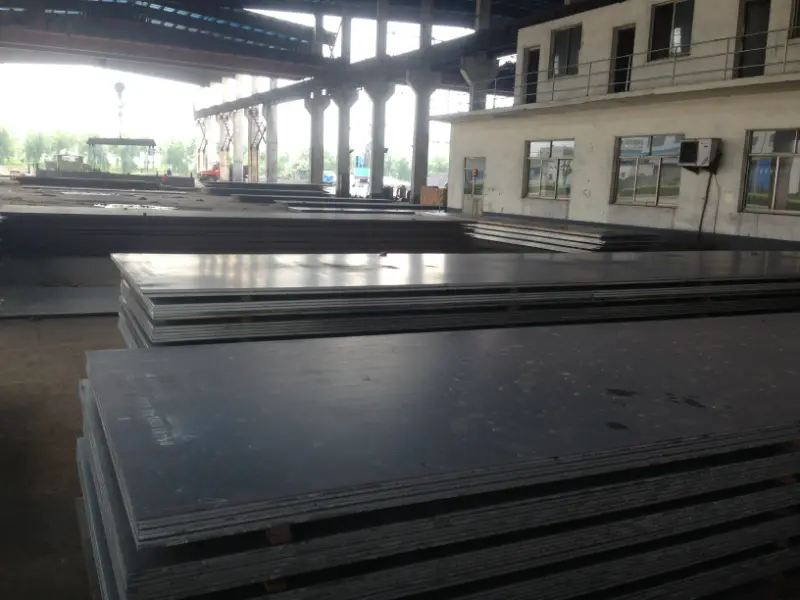
ASTM A302 Gr.B (A302GRB) Pressure Vessel & Boiler Steel Plate
ASTM A302 Gr.B (A302GRB) Pressure Vessel & Boiler Steel Plate
Complete technical data for ASTM A302 Grade B steel: chemical composition, mechanical properties, physical properties, equivalent grades, and application recommendations.
Hot rolling, normalizing, normalizing and tempering, stress relieving, quenching and tempering (optional). Most common delivery condition is normalized.
- Phone : +8618037372205
- Email : [email protected]
- WhatsApp: Contact via Whtsapp
- WeChat: +8618037372205
ASTM A302 Gr.B Pressure Vessel & Boiler Steel Plate Introduction
ASTM A302 Grade B is a manganese-molybdenum alloy steel plate intended primarily for welded boilers and pressure vessels operating at elevated temperatures. The addition of molybdenum improves high-temperature strength and creep resistance compared to ordinary carbon steels. This grade is typically supplied in the normalized or stress-relieved condition to ensure uniform mechanical properties and to refine the grain structure. It offers a good balance of strength, toughness, and weldability, making it a reliable choice for critical components in the power generation, petrochemical, and chemical processing industries. When properly fabricated and heat-treated, A302 Grade B can perform safely at service temperatures up to approximately 450°C (840°F).
ASTM A302 Gr.B Pressure Vessel & Boiler Steel Plate Chemical Composition
The following table shows the specified chemical composition for ASTM A302 Grade B steel plate per ASTM A302/A302M. Values are from heat analysis. Residual elements such as chromium, nickel, and copper are limited to ensure adequate weldability and toughness. Vanadium or other microalloys are not intentionally added.
| Element | Standard Value (max or range) | Remarks |
|---|---|---|
| Carbon (C) | ≤0.25 | |
| Manganese (Mn) | 1.15 – 1.50 | |
| Phosphorus (P) | ≤0.035 | |
| Sulfur (S) | ≤0.035 | |
| Silicon (Si) | 0.15 – 0.40 | Killed fine grain practice |
| Molybdenum (Mo) | 0.45 – 0.60 | |
| Chromium (Cr)* | ≤0.30 | Residual element; not intentionally added |
| Nickel (Ni)* | ≤0.40 | Residual element; not intentionally added |
| Copper (Cu)* | ≤0.40 | Residual element; may be specified lower for certain services |
ASTM A302 Gr.B Pressure Vessel & Boiler Steel Plate Thermal and Electrical Physical Properties
The physical properties listed below are typical for normalized A302 Grade B steel in the as-supplied condition. These values are not mandatory requirements of ASTM A302 but are useful for thermal and structural design. Properties may vary slightly with temperature, heat treatment, and composition within the allowed range.
| Property | Typical Value | Unit | Test Condition / Temperature |
|---|---|---|---|
| Density (ρ) | 7.85 | g/cm³ | At 20 °C |
| Modulus of Elasticity (E) | 207 | GPa | At 20 °C, static measurement |
| Shear Modulus (G) | 80 | GPa | Calculated typical (E/(2(1+ν))) |
| Poisson's Ratio (ν) | 0.30 | — | At 20 °C |
| Thermal Expansion Coefficient (α) | 11.7 | 10-6/K | Between 20 °C and 100 °C |
| Thermal Expansion Coefficient (α) | 12.4 | 10-6/K | Between 20 °C and 200 °C |
| Thermal Expansion Coefficient (α) | 12.9 | 10-6/K | Between 20 °C and 300 °C |
| Thermal Conductivity (λ) | 51 | W/(m·K) | At 100 °C |
| Thermal Conductivity (λ) | 48 | W/(m·K) | At 200 °C |
| Specific Heat Capacity (c) | 486 | J/(kg·K) | At 100 °C (approximate) |
| Electrical Resistivity (ρe) | 0.17 | μΩ·m | At 20 °C |
ASTM A302 Gr.B Pressure Vessel & Boiler Steel Plate Mechanical Properties
Mechanical properties are obtained from transverse test specimens taken from normalized plates. Tensile and yield strength requirements depend on the plate thickness. The elongation values apply to plates ≤50 mm thick. Bend tests are required by the general specification ASTM A20/A20M. Impact properties are not mandatory and must be specified if needed.
| Property | Required Value | Unit | Test Condition / Remarks |
|---|---|---|---|
| Tensile Strength (Rm) | 550 – 690 | MPa | For all thicknesses |
| Yield Strength (ReH) | ≥ 345 | MPa | Plate thickness ≤ 50 mm (2 in.) |
| Yield Strength (ReH) | ≥ 310 | MPa | Plate thickness >50 mm to 100 mm (2–4 in.) |
| Elongation (A) 200 mm gauge | ≥ 18 | % | Thickness ≤ 50 mm, transverse |
| Elongation (A) 50 mm gauge | ≥ 22 | % | Thickness ≤ 50 mm, transverse |
| Bend Test (180°) | No cracks | — | Bend diameter d = 3a (a = specimen thickness); wider specimens may require larger diameter per ASTM A20 |
ASTM A302 Gr.B Pressure Vessel & Boiler Steel Plate Completely Equivalent Standards and Substitute Grades
| Region/Standard | Standard & Grade | Remarks |
|---|---|---|
| USA / ASME | ASME SA302 Grade B | Identical to ASTM A302 Grade B; accepted under ASME Boiler and Pressure Vessel Code Section II, Part A. |
| International | — | No direct ISO equivalent. ISO 9328-2 does not contain a grade with the exact Mn-Mo chemistry and strength range as A302 Gr.B. Use similar materials (see below) with caution. |
ASTM A302 Gr.B Pressure Vessel & Boiler Steel Plate Application Introduction
ASTM A302 Grade B plates are used almost exclusively in welded pressure vessels and boilers that require moderate elevated-temperature performance. The molybdenum content provides improved creep strength and resistance to softening compared to plain carbon steels such as ASTM A516. Good fabrication practices including preheating (typically 100–200 °C) and post-weld heat treatment (PWHT, often at 600–650 °C) are recommended to avoid cold cracking and to achieve the required toughness in the heat-affected zone. The steel is accepted under ASME Boiler and Pressure Vessel Code Section VIII for unfired pressure vessels and Section I for power boilers.
Product Applications: Steam boilers and boiler drums, Heat exchangers (shell-and-tube, plate type), Reactor pressure vessels for moderate temperatures, LPG and ammonia storage spheres, High-pressure separators and accumulators
Processed into products: Vessel shell courses and cylindrical sections, Dished heads, hemispherical and ellipsoidal ends, Tube sheets and tubesheet forgings (when plate is used), Nozzle bodies and reinforcing pads, Flanges (slip-on, weld-neck – plate cut rings), Baffle plates and support rings, Manhole covers and blind flanges
Application industries: Oil & Gas (refinery pressure vessels, separators), Petrochemical (reactors, columns, heat exchangers), Power generation (steam drums, boiler shells, feedwater heaters), Chemical processing (storage tanks, digesters), Industrial boilers and marine boilers
ASTM A302 Gr.B Pressure Vessel & Boiler Steel Plate Similar or Close Alternative Materials
| Region/Standard | Standard & Grade | Remarks |
|---|---|---|
| Europe / EN 10028-2 | 16Mo3 (1.5415) | 0.2%Mo steel with lower Mn (0.40–0.90%) and lower tensile strength (440–590 MPa). Suitable for similar service temperatures, but may have lower creep strength. Commonly used for boilers and pressure vessels. |
| China / GB/T 713 | Q345R (formerly 16MnR) | C-Mn steel without intentional Mo addition. Lower elevated-temperature strength. Widely used for general pressure vessels, but not a direct substitute for high-temperature Mo-bearing grades. |
| Japan / JIS G3119 | SBV2 | Mn-Mo-Ni steel for boilers and pressure vessels. Contains nickel (~0.40–0.70%) and has similar strength levels, but chemistry differs. Acceptable alternative with careful welding procedure qualification. |
| USA / ASTM | A204 Grade B | C-0.5Mo steel with lower Mn (≤0.90%) and lower tensile strength (485–620 MPa). Can be an alternative where slightly lower strength is sufficient, for similar service temperatures. |
Notes:
The data provided are for general information and represent typical values from the applicable ASTM standards and common mill practices. For critical design, always refer to the latest edition of ASTM A302/A302M and ASME SA302/SA302M. Charpy V-notch impact testing is not mandatory unless specified on the purchase order (e.g., per supplementary requirement S5 of ASTM A20). When impact toughness is required, the test temperature and minimum energy values must be agreed upon. PWHT procedures should follow ASME Section VIII or the applicable construction code.
- Share



