
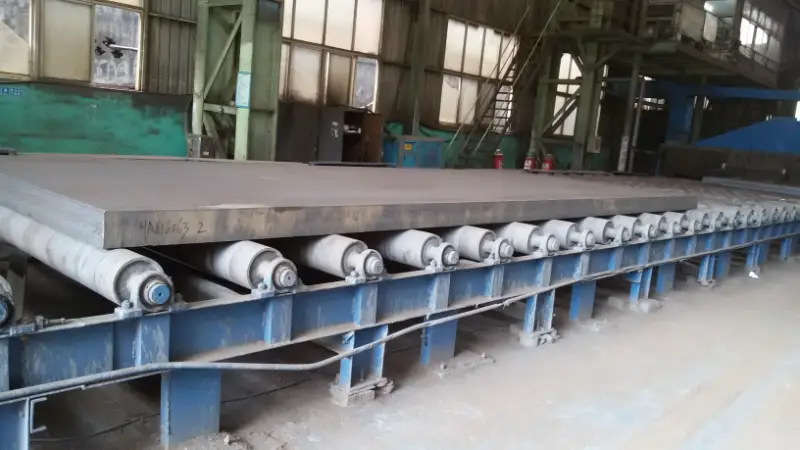
ASTM A302 Grade C (A302GRC) Alloy Steel Plate for Pressure Vessels & Boilers
ASTM A302 Grade C (A302GRC) Alloy Steel Plate for Pressure Vessels & Boilers
Complete material data for ASTM A302 Grade C, a manganese-molybdenum-nickel alloy steel plate used in pressure vessels and boilers, including chemical composition, mechanical properties, thermal and electrical physical properties, equivalent grades, and application guidance.
Normalizing, normalizing and tempering, cutting, welding, forming (cold or hot), machining
- Phone : +8618037372205
- Email : [email protected]
- WhatsApp: Contact via Whtsapp
- WeChat: +8618037372205
ASTM A302 Grade C Alloy Steel Plate for Pressure Vessels & Boilers Introduction
ASTM A302 Grade C is a manganese-molybdenum-nickel alloy steel plate primarily used in the fabrication of pressure vessels and boilers. It is produced to the ASTM A302/A302M standard and is supplied in the normalized or normalized and tempered condition. This grade offers a good combination of moderate elevated-temperature strength, toughness, and weldability. The addition of nickel improves low-temperature notch toughness, while molybdenum enhances high-temperature strength and resistance to softening. Typical delivery thicknesses range up to 100 mm. The material is widely adopted in the power generation, petrochemical, and process industries for vessels operating at moderate temperatures and pressures.
ASTM A302 Grade C Alloy Steel Plate for Pressure Vessels & Boilers Chemical Composition
The chemical composition is specified in ASTM A302/A302M. Carbon content depends on plate thickness. The steel contains intentional additions of manganese, nickel, and molybdenum to achieve the required mechanical properties. Residual elements such as copper, chromium, and vanadium are not specifically limited but are reported if specified.
| Element | Specified Value (wt. %) | Remarks |
|---|---|---|
| C | ≤0.20 (thickness ≤25 mm) | ≤0.23 (thickness >25 to 50 mm) | ≤0.25 (thickness >50 to 100 mm) | Carbon; thickness-dependent maximum |
| Mn | 1.15 - 1.50 | Manganese |
| Si | 0.15 - 0.40 | Silicon |
| P | ≤0.035 | Phosphorus |
| S | ≤0.035 | Sulfur |
| Ni | 0.40 - 0.70 | Nickel |
| Mo | 0.45 - 0.60 | Molybdenum |
| Cu | ≤0.35 (typical limit) | Copper; residual element, not specifically required by standard but commonly reported |
| Cr | ≤0.25 (typical limit) | Chromium; residual element |
| V | ≤0.05 (typical limit) | Vanadium; residual element |
ASTM A302 Grade C Alloy Steel Plate for Pressure Vessels & Boilers Thermal and Electrical Physical Properties
The following physical properties are typical for Mn-Mo-Ni alloy steels in the normalized condition. They are not part of the ASTM A302 specification and are provided for design guidance. Actual values may vary slightly with processing history and temperature.
| Property | Typical Value | Unit | Test Condition |
|---|---|---|---|
| Density (ρ) | 7850 | kg/m³ | Room temperature |
| Modulus of Elasticity (E) | 200 - 210 | GPa | Room temperature |
| Shear Modulus (G) | 79 - 81 | GPa | Room temperature |
| Poisson's Ratio (ν) | 0.3 | - | Room temperature |
| Thermal Expansion Coefficient (α) | 11.5 - 12.5 | 10⁻⁶/K | 20 °C to 100 °C |
| Thermal Expansion Coefficient (α) | 12.5 - 13.5 | 10⁻⁶/K | 20 °C to 300 °C |
| Thermal Conductivity (λ) | 45 - 50 | W/(m·K) | At 100 °C |
| Thermal Conductivity (λ) | 40 - 45 | W/(m·K) | At 300 °C |
| Specific Heat Capacity | 460 - 500 | J/(kg·K) | Room temperature |
| Electrical Resistivity (ρ_e) | 0.2 - 0.25 | 10⁻⁶ Ω·m | Room temperature |
ASTM A302 Grade C Alloy Steel Plate for Pressure Vessels & Boilers Mechanical Properties
Tensile properties are mandated for the normalized or normalized-and-tempered condition. Yield strength, tensile strength, and elongation are verified on transverse test specimens. The standard does not require Charpy impact testing unless specified as supplementary requirement. Values are minimums or ranges as indicated.
| Property | Requirement | Unit | Test Condition / Remarks |
|---|---|---|---|
| Yield Strength (ReH) | ≥ 345 | MPa | Transverse; thickness ≤ 50 mm (approx.) |
| Yield Strength (ReH) | ≥ 345 | MPa | Transverse; thickness > 50 mm (approx.) |
| Tensile Strength (Rm) | 550 - 690 | MPa | Transverse; all thicknesses |
| Elongation (A) in 50 mm (2 in.) | ≥ 21 | % | For plates ≤ 19 mm (0.75 in.) thick |
| Elongation (A) in 50 mm (2 in.) | ≥ 19 | % | For plates > 19 mm (0.75 in.) thick |
| Elongation (A) in 200 mm (8 in.) | ≥ 17 | % | For plates ≤ 19 mm thick (if 8 in. gauge used) |
| Elongation (A) in 200 mm (8 in.) | ≥ 15 | % | For plates > 19 mm thick (if 8 in. gauge used) |
ASTM A302 Grade C Alloy Steel Plate for Pressure Vessels & Boilers Exact Equivalent Standards and Substitutable Grades
| Country/Region | Standard | Grade/Designation | Remarks |
|---|---|---|---|
| USA | ASTM A302/A302M | A302 Grade C | Original specification; normalized or normalized and tempered |
| USA | ASME SA-302/SA-302M | SA-302 Grade C | Identical to ASTM A302 Grade C, accepted by ASME Boiler & Pressure Vessel Code |
ASTM A302 Grade C Alloy Steel Plate for Pressure Vessels & Boilers Application Introduction
ASTM A302 Grade C is widely used in welded pressure vessels and boilers where moderate temperature strength and toughness are required. It is suitable for fabrication by most common workshop practices including hot and cold forming, flame cutting, and all fusion welding processes. Post-weld heat treatment is typically required depending on thickness and design code rules. The steel performs well in environments up to approximately 400 °C (750 °F).
Product Applications: Pressure vessels (separators, accumulators, reactors), Steam boilers and drums, Heat exchangers and condensers, LPG and ammonia storage tanks, Autoclaves and digesters, Columns and towers
Processed into products: Cylindrical shells and shell courses, Dished and hemispherical heads (hot/cold formed), Nozzles, flanges, and reinforcements, Tube sheets, Baffles and support plates, Welded structural components for pressurized enclosures
Application industries: Power generation (fossil fuel and nuclear), Petrochemical and chemical processing, Oil & gas (refineries, storage tanks), Pharmaceutical and food processing equipment, Industrial boiler manufacturing, Heavy machinery and structural fabrication
ASTM A302 Grade C Alloy Steel Plate for Pressure Vessels & Boilers Comparable / Similar Alternative Materials
| Country/Region | Standard | Grade/Designation | Remarks |
|---|---|---|---|
| Japan | JIS G3119 | SBV2 | Mn-Mo-Ni steel for boilers and pressure vessels; similar tensile properties, minor composition differences |
| Germany | DIN 17155 (historical) | 15MoNi55 (1.6310) | Comparable Mn-Ni-Mo steel; now partly superseded by EN grades |
| European Union | EN 10028-2 | 15NiMo5-5 (1.6310) | Closely matching chemistry and mechanical properties; used for similar applications |
| China | GB/T 713 | 13MnNiMoR | Comparable boiler and pressure vessel steel; different designation, similar performance |
Notes:
Special requirements such as impact testing, ultrasonic examination, elevated-temperature tension tests, and restrictions on welding consumables may be specified by supplementary requirements in ASTM A302/A302M (e.g., S1, S2, S3, etc). The steel is not recommended for hydrogen or sour service without specific evaluation. For service below -20 °C, additional notch-toughness testing is advised. Always refer to the latest edition of the ASTM standard and the relevant design code (e.g., ASME BPVC Section II and Section VIII) for complete design and fabrication rules.
- Share



