
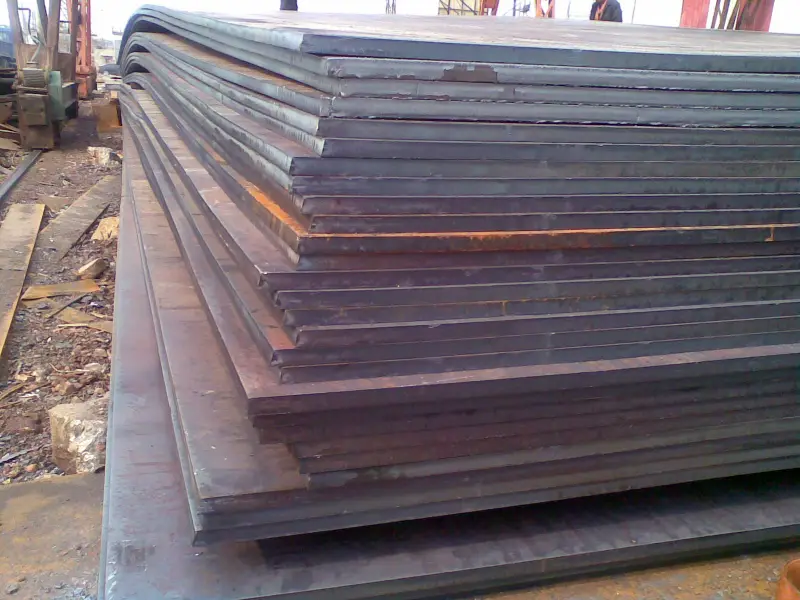
ASTM A302 Grade D (A302GRD) Pressure Vessel Mn
ASTM A302 Grade D (A302GRD) Pressure Vessel Mn-Mo-Ni Alloy Steel Plate
Detailed material properties and technical data for ASTM A302 Grade D manganese-molybdenum-nickel alloy steel plate used in boilers and pressure vessels.
Hot rolling, normalizing, stress relieving, quenching and tempering upon agreement
- Phone : +8618037372205
- Email : [email protected]
- WhatsApp: Contact via Whtsapp
- WeChat: +8618037372205
ASTM A302 Grade D Pressure Vessel Mn Introduction
ASTM A302 Grade D (A302GRD) is a manganese-molybdenum-nickel alloy steel plate designed for use in welded boilers and pressure vessels. This grade exhibits excellent strength and toughness at elevated temperatures, thanks to the combined effect of nickel and molybdenum, which refine the microstructure and enhance hardenability. Typically supplied in the normalized or stress-relieved condition, it offers good weldability and ductility. The material conforms to ASTM A302/A302M standard and is widely used in the fabrication of shells, heads, and other critical components operating under moderate to high temperature and pressure conditions.
ASTM A302 Grade D Pressure Vessel Mn Chemical Composition
The chemical composition of ASTM A302 Grade D is carefully controlled to achieve the required strength, toughness, and weldability. Nickel is added to improve low-temperature notch toughness and hardenability, while molybdenum increases elevated-temperature strength. Note: Values are maxima unless a range is shown. Product analysis tolerances apply as per ASTM A302/A302M.
| Element | Content (%) | Remarks |
|---|---|---|
| Carbon (C) | ≤ 0.25 | Key for strength and weldability |
| Manganese (Mn) | 1.15 - 1.50 | Deoxidizer, influencing strength and toughness |
| Phosphorus (P) | ≤ 0.035 | Residual element, controlled for cleanliness |
| Sulfur (S) | ≤ 0.035 | Residual element, controlled for cleanliness |
| Silicon (Si) | 0.15 - 0.40 | Deoxidizer and strength contributor |
| Nickel (Ni) | 0.70 - 1.00 | Enhances toughness and hardenability |
| Molybdenum (Mo) | 0.45 - 0.60 | Increases high-temperature strength and creep resistance |
ASTM A302 Grade D Pressure Vessel Mn Thermal and Electrical Physical Properties
These properties are typical for low-alloy Mn-Mo-Ni steels in the normalized condition. Actual values may vary slightly depending on heat treatment and processing. Data are provided for general design calculations and are not mandatory per ASTM A302 standard.
| Property | Typical Value | Unit | Test / Reference Condition |
|---|---|---|---|
| Density (ρ) | 7.85 | g/cm³ | Room temperature |
| Elastic (Young's) Modulus (E) | 200 - 210 | GPa | Room temperature |
| Shear Modulus (G) | 80 | GPa | Room temperature |
| Poisson's Ratio (ν) | 0.29 - 0.30 | - | Room temperature |
| Thermal Expansion Coefficient (α) | 13.0 - 14.5 | 10⁻⁶ /°C | 100 - 400 °C |
| Thermal Conductivity (λ) | 38 - 42 | W/(m·K) | 100 - 400 °C |
| Specific Heat Capacity (cp) | 460 - 520 | J/(kg·°C) | 100 - 400 °C |
| Electrical Resistivity (ρe) | 0.25 | µΩ·m | Room temperature |
ASTM A302 Grade D Pressure Vessel Mn Mechanical Properties
Tensile properties are determined in accordance with ASTM A370 on specimens taken in the transverse direction. Impact tests may be specified by the purchaser; typical values at -40 °C are provided for reference. Note: Requirements vary with plate thickness; multiple rows are shown for different thickness ranges.
| Property | Required Value | Unit | Test Condition |
|---|---|---|---|
| Yield Strength (ReH) | ≥ 345 | MPa | Room temperature, all thicknesses |
| Tensile Strength (Rm) | 550 - 690 | MPa | Room temperature, all thicknesses |
| Elongation (A) - 50 mm (2 in.) gauge | ≥ 18 | % | Plate thickness ≤ 50 mm |
| Elongation (A) - 50 mm (2 in.) gauge | ≥ 17 | % | Plate thickness > 50 to 100 mm |
| Elongation (A) - 50 mm (2 in.) gauge | ≥ 16 | % | Plate thickness > 100 to 200 mm |
| Charpy V-notch impact energy (KV) | ≥ 27 (typical) | J | -40 °C, transverse (when required) |
ASTM A302 Grade D Pressure Vessel Mn Direct Equivalent Standards and Substitutable Grades
| Country/Region | Standard | Grade | Remarks |
|---|---|---|---|
| USA | ASME SA-302/SA-302M | SA-302 Grade D | Identical material; ASME Boiler & Pressure Vessel Code adoption |
| Japan | JIS G3119 | SBV2 | Very close chemical match (C ≤0.20, Mn 1.15-1.60, Ni 0.70-1.00, Mo 0.45-0.60); similar strength class |
| China | GB/T 713 | 13MnNiMoR | Comparable in concept but with lower C (≤0.15), lower Mo (0.20-0.40), and Nb addition; check mechanicals |
| Germany/EU | EN 10028-2 | 15NiCuMoNb5 (1.6368) | Contains Cu (0.50-0.80) and Nb (0.015-0.040); higher yield but not identical |
ASTM A302 Grade D Pressure Vessel Mn Application Introduction
ASTM A302 Grade D is engineered for moderate to high-temperature pressure vessel service where good strength, ductility, and notch toughness are required. Its weldability and availability in wide thicknesses make it a versatile choice for fabricating welded pressure-containing equipment.
Product Applications: Cylindrical pressure vessel shells, Hemispherical and elliptical heads, Heat exchanger shells and channels, Steam drums and mud drums, Autoclaves and reactors, High-pressure storage spheres
Processed into products: Welded shell courses and seamless forged rings, Tube sheets and flanges, Nozzle necks and reinforcement pads, Baffle plates and support structures, Manway covers and bolted access doors, Jacketed vessel components (when clad or overlaid)
Application industries: Petrochemical and chemical processing, Power generation (boilers, steam drums), Oil and gas (separators, knock-out drums), Nuclear engineering (secondary containment, not reactor core), Fertilizer and ammonia plants, Pulp and paper digesters
ASTM A302 Grade D Pressure Vessel Mn Similar / Alternative Material Recommendations
| Country/Region | Standard | Grade | Remarks |
|---|---|---|---|
| USA | ASTM A533/A533M | Type B Class 1 | Higher C, Mn, Mo; quenched and tempered for nuclear pressure vessels; superior toughness |
| USA | ASTM A302/A302M | A302 Grade C | Same Mo content but no Ni; lower strength and toughness at low temperatures |
| EU | EN 10028-2 | 13CrMo4-5 (1.7335) | Cr-Mo steel without Ni; used for elevated temperature but lower allowable stress at design temperatures |
| China | GB/T 713 | 18MnMoNbR | Contains Nb, higher Mn; used for thick-wall pressure vessels but with different welding requirements |
Notes:
Welding: Preheating (typically 150–200 °C) and post-weld heat treatment (PWHT) are recommended to relieve residual stresses and reduce hydrogen cracking risk. Forming: Hot forming should be followed by normalizing to restore mechanical properties. Inspection: Ultrasonic testing per ASTM A578/A578M is often specified for plates in critical service. Thickness: For thicknesses above 200 mm, mechanical properties may be agreed upon between purchaser and supplier. The material is generally supplied with a mill test report (EN 10204 3.1 or 3.2).
- Share



