
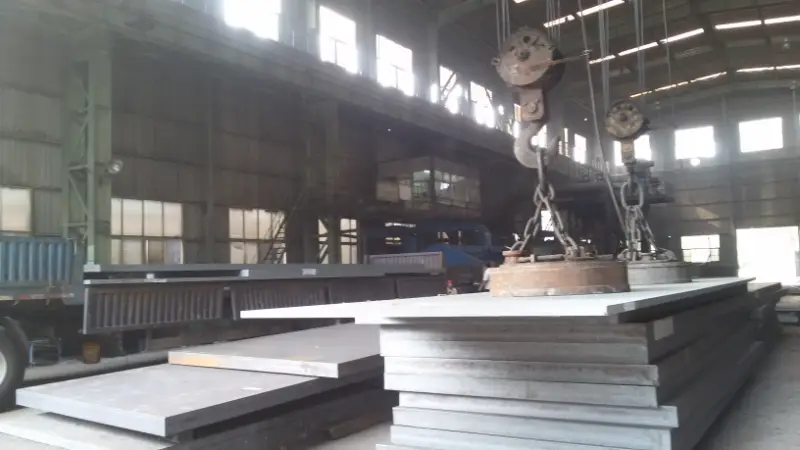
ASTM A203 Grade B (A203GRB) Low-Temperature Pressure Vessel Steel Plate
ASTM A203 Grade B (A203GRB) Low-Temperature Pressure Vessel Steel Plate - Properties and Equivalents
Complete technical data for ASTM A203 Grade B (A203GRB) low-temperature nickel alloy steel plate used in pressure vessels and boilers. Includes chemical composition, mechanical properties, thermal properties, international equivalents, and application guide.
Hot rolling, normalizing, tempering; cutting, forming, welding
- Phone : +8618037372205
- Email : [email protected]
- WhatsApp: Contact via Whtsapp
- WeChat: +8618037372205
ASTM A203 Grade B Low-Temperature Pressure Vessel Steel Plate Introduction
ASTM A203 Grade B is a nickel-alloyed steel plate intended primarily for welded pressure vessels in low-temperature environments down to approximately -68°C (-90°F). The addition of 2.0–2.5% nickel improves notch toughness and strength at sub-zero temperatures while maintaining good weldability. It is supplied in the normalized or normalized and tempered condition and meets stringent toughness requirements, often verified by Charpy V-notch impact tests at low temperatures. Standard: ASTM A203/A203M. Main features:
- Good low-temperature toughness
- Moderate strength level (min YS 275 MPa)
- Excellent weldability with proper procedures
- Suitable for pressure vessel and boiler construction
ASTM A203 Grade B Low-Temperature Pressure Vessel Steel Plate Chemical Composition
The following elements are controlled according to ASTM A203/A203M. Residual elements are limited but not intentionally added. Typical heat analysis limits ensure the desired low-temperature toughness and strength.
- Carbon and manganese are kept low to enhance weldability and toughness.
- Nickel is the principal alloying element for low-temperature properties.
- Phosphorus and sulfur are restricted to avoid embrittlement.
| Element | Standard Value (max, unless range given) | Remarks |
|---|---|---|
| Carbon (C) | 0.21% | Maximum |
| Manganese (Mn) | 0.70% | Maximum; for plates ≤ 12.5 mm, may be 0.75% max if C ≤ 0.21% |
| Phosphorus (P) | 0.035% | Maximum |
| Sulfur (S) | 0.035% | Maximum |
| Silicon (Si) | 0.15–0.40% | Range |
| Nickel (Ni) | 2.03–2.57% | Range |
| Copper (Cu) | 0.35% | Maximum residual |
| Chromium (Cr) | 0.25% | Maximum residual |
| Molybdenum (Mo) | 0.08% | Maximum residual |
ASTM A203 Grade B Low-Temperature Pressure Vessel Steel Plate Thermal and Electrical Physical Properties
Physical properties are typical values for 2.5% Ni steel in the temperature range 20–100°C, based on ASME BPVC Section II Part D data for SA-203 Grade B. Exact values may vary slightly with heat treatment and plate thickness.
- The density is similar to carbon steel.
- Elastic modulus decreases with temperature; the room-temperature value is provided.
- Thermal conductivity and expansion are suitable for cryogenic design.
| Property | Typical Value | Unit | Test Condition / Remarks |
|---|---|---|---|
| Density (ρ) | 7.85 | g/cm³ | Room temperature |
| Elastic Modulus (E) | 200 | GPa | Room temperature (≈ 29.0 ×10⁶ psi) |
| Shear Modulus (G) | 76.9 | GPa | Calculated from E and ν at room temperature |
| Poisson&'s Ratio (ν) | 0.3 | – | Room temperature (typical for steel) |
| Mean Thermal Expansion Coefficient (α) | 11.5 | 10⁻⁶/°C | 20°C to 100°C (ASME TE-1) |
| Thermal Conductivity (λ) | 51.9 | W/(m·K) | At 20°C (ASME TE-2) |
ASTM A203 Grade B Low-Temperature Pressure Vessel Steel Plate Mechanical Properties
Tensile and impact properties as specified in ASTM A203/A203M for Grade B. The values apply to material in the normalized condition. Impact energy requirements are mandatory only when ordered with supplementary impact test requirements (typically at -68°C).
- Yield strength is measured by 0.2% offset or 0.5% extension under load.
- Elongation values depend on gauge length.
- Bend test is performed as per ASTM A20/A20M to verify ductility.
| Property | Required Value | Unit | Test Condition |
|---|---|---|---|
| Yield Strength (ReH) | ≥ 275 | MPa | Transverse or longitudinal, room temperature |
| Tensile Strength (Rm) | 485 – 620 | MPa | Room temperature |
| Elongation (A) | ≥ 17 | % | Gauge length 200 mm (8 in.) |
| Elongation (A) | ≥ 21 | % | Gauge length 50 mm (2 in.) |
| Bend Test (D = mandrel diameter, t = specimen thickness) | No cracks; D = 2.5t (typical) | 180° bend, room temperature, per ASTM A20 | |
| Charpy V-Notch Impact Energy (KV) | ≥ 18 (13 ft·lbf) | J | At -68°C (-90°F), longitudinal, when specified (common supplementary requirement) |
ASTM A203 Grade B Low-Temperature Pressure Vessel Steel Plate Completely Equivalent Material Standards and Replaceable Grades
| Country/Region | Standard | Grade | Remarks |
|---|---|---|---|
| USA | ASME SA-203/SA-203M | SA-203 Grade B | Identical chemical and mechanical requirements; for pressure vessels per ASME BPVC |
| Global | UNS | K21703 | Unified Numbering System designation covering the same material |
ASTM A203 Grade B Low-Temperature Pressure Vessel Steel Plate Application Introduction
ASTM A203 Grade B is engineered for fabricating welded pressure vessels and boilers that operate at low temperatures, typically down to -68°C (-90°F). Its good notch toughness and weldability make it suitable for critical components in the oil & gas, petrochemical, and cryogenic storage industries. Typical applications include:
- Liquefied natural gas (LNG) storage tanks
- Liquefied petroleum gas (LPG) vessels
- Ammonia and ethylene storage spheres
- Low-temperature heat exchangers and evaporators
- Chemical reactor shells operating under low-temperature conditions
Product Applications: LNG and LPG storage tanks, Pressure vessel shells and heads, Low-temperature separators and scrubbers, Heat exchangers (shell-and-tube, plate-fin), Boiler drums and steam drums, Spherical storage spheres for ethylene, propylene
Processed into products: Shell courses and reinforcement plates, Dished heads (hemispherical, ellipsoidal), Nozzles and manway openings, Flanges and backing rings, Support skirts and saddles, Internal trays and baffles (when cold service)
Application industries: Oil & Gas (downstream, LNG, gas processing), Petrochemical and chemical processing, Cryogenic storage and transportation, Power generation (boilers, auxiliaries), Industrial gas (air separation units)
ASTM A203 Grade B Low-Temperature Pressure Vessel Steel Plate Similar / Alternative Material Recommendations
| Country/Region | Standard | Grade | Remarks |
|---|---|---|---|
| Japan | JIS G3127 | SL2N255 | 2.5% Ni low-temperature steel plate; yield strength min. 265 MPa, tensile strength 480–590 MPa; broadly similar but slightly lower strength and tighter Ni range (2.10–2.50%) |
| EU | EN 10028-4 | 12Ni14 | 3.5% Ni steel; higher nickel content gives better toughness at lower temperatures; strength range ~490–640 MPa; may be used as an upgraded alternative |
| China | GB 3531 | 15MnNiDR | 1.5% Ni low-temperature steel; yield ≥ 325 MPa; designed for similar cryogenic applications but lower Ni content; suitable for less demanding low-temperature conditions |
| ISO | ISO 9328-3 | 13MnNi6-3 | Lower nickel (0.6–1.0% Ni) with Mn strengthening; used for moderate low-temperature service; not a direct replacement but can be considered for less severe requirements |
Notes:
Material is generally supplied in normalized condition, with optional impact testing at -68°C (-90°F) per ASTM A20 supplementary requirement S5. Welding must follow procedures qualified for low-temperature service to preserve toughness. Post-weld heat treatment (PWHT) may be required depending on thickness and service conditions. All data are based on ASTM A203/A203M and ASME BPVC Section II. For design calculations, the allowable stress values and temperature-dependent physical properties from ASME Section II Part D should be used.
- Share



