
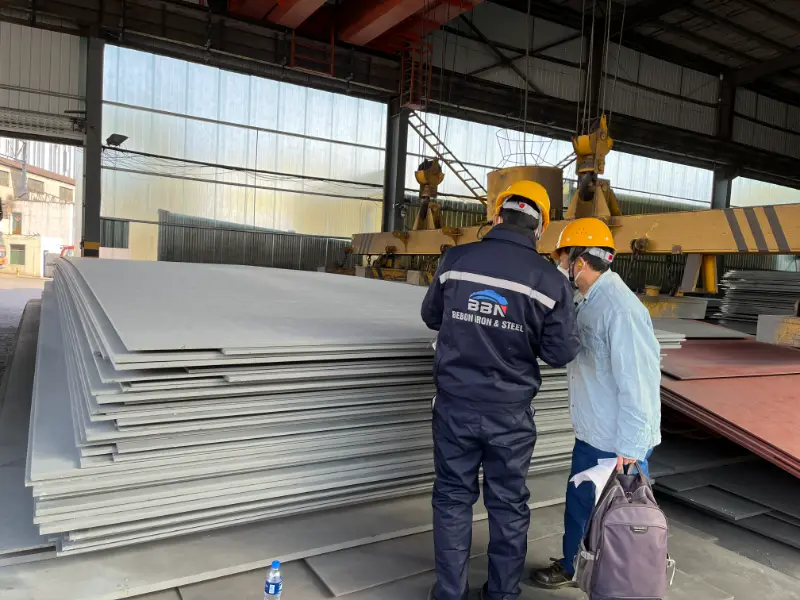
ASTM A203 Grade D Nickel
ASTM A203 Grade D Nickel-Alloy Steel Plate for Low-Temperature Pressure Vessels
ASTM A203 Grade D is a nickel-alloy steel plate intended for low-temperature pressure vessel applications. It provides excellent notch toughness at temperatures down to -101°C (-150°F) and is widely used in the fabrication of welded pressure vessels, storage tanks, and heat exchangers.
Hot rolling, normalizing, normalizing and tempering, quenching and tempering (optional), welding, forming, machining
- Phone : +8618037372205
- Email : [email protected]
- WhatsApp: Contact via Whtsapp
- WeChat: +8618037372205
ASTM A203 Grade D Nickel Introduction
ASTM A203 Grade D (A203GRD) is a low-carbon, 3.5% nickel-alloy steel plate designed for pressure vessels and boilers operating at low temperatures. It offers a combination of moderate strength, excellent weldability, and superior impact toughness at sub-zero service conditions. The material is typically supplied in the normalized or normalized and tempered condition, ensuring uniform grain structure and reliable mechanical properties. Key features include:
- Minimum yield strength of 275 MPa (40 ksi)
- Tensile strength in the range of 485–620 MPa (70–90 ksi)
- Good ductility with elongation ≥23% (2 in. gauge for plates ≤50 mm)
- Excellent low-temperature impact toughness down to -101°C (-150°F)
- Compliance with ASTM A203/A203M and ASME SA-203 specifications
ASTM A203 Grade D Nickel Chemical Composition
The chemical composition of ASTM A203 Grade D is carefully controlled to achieve low-temperature toughness and weldability. Nickel is the primary alloying element, enhancing notch toughness without sacrificing weldability. The maximum carbon content is limited to 0.17% for plates up to 50 mm thickness and 0.20% for plates over 50 mm to 100 mm. Phosphorus and sulfur are kept at low levels to ensure clean steel and high ductility. Residual elements like copper, chromium, and molybdenum are restricted to avoid temper embrittlement and ensure consistent properties.
| Element | Standard Value (max unless range given) | Remarks |
|---|---|---|
| Carbon (C) | ≤0.17 (≤50 mm); ≤0.20 (>50–100 mm) | Heat analysis; thickness dependent |
| Manganese (Mn) | ≤0.70 | Heat analysis; product analysis ≤0.78 |
| Phosphorus (P) | ≤0.025 | |
| Sulfur (S) | ≤0.025 | |
| Silicon (Si) | 0.15–0.40 | Heat analysis; product analysis 0.13–0.45 |
| Nickel (Ni) | 3.25–3.75 | Primary alloying element for low-temperature toughness |
| Copper (Cu) | ≤0.35 | Residual element |
| Chromium (Cr) | ≤0.25 | Residual element |
| Molybdenum (Mo) | ≤0.08 | Residual element |
ASTM A203 Grade D Nickel Thermal and Electrical Physical Properties
Physical properties of ASTM A203 Grade D are typical for medium-carbon, 3.5% nickel low-alloy steel. These values represent room-temperature data unless otherwise specified and are useful for design calculations involving thermal expansion, heat transfer, and electrical resistivity. Actual values may vary slightly with heat treatment and composition within the specified range.
| Property | Typical Value | Unit | Test Condition / Remarks |
|---|---|---|---|
| Density (ρ) | 7.85 | g/cm³ | Room temperature |
| Modulus of Elasticity (E) | 200 | GPa | Room temperature |
| Shear Modulus (G) | 77.5 | GPa | Calculated from E and ν |
| Poisson's Ratio (ν) | 0.29 | — | Room temperature |
| Thermal Expansion Coefficient (α) | 10.5 | ×10⁻⁶/K | Average, -100°C to 20°C |
| Thermal Expansion Coefficient (α) | 11.7 | ×10⁻⁶/K | Average, 20°C to 100°C |
| Thermal Expansion Coefficient (α) | 12.4 | ×10⁻⁶/K | Average, 20°C to 200°C |
| Thermal Expansion Coefficient (α) | 12.9 | ×10⁻⁶/K | Average, 20°C to 300°C |
| Thermal Conductivity (λ) | 42 | W/(m·K) | At 20°C |
| Thermal Conductivity (λ) | 41 | W/(m·K) | At 100°C |
| Thermal Conductivity (λ) | 39 | W/(m·K) | At 200°C |
| Specific Heat Capacity (c) | 460 | J/(kg·K) | Room temperature |
| Electrical Resistivity (ρe) | 0.23 | ×10⁻⁶ Ω·m | At 20°C (equivalent to 23 μΩ·cm) |
ASTM A203 Grade D Nickel Mechanical Properties
Mechanical properties of ASTM A203 Grade D are determined by tensile testing on transverse specimens taken from normalized or normalized and tempered plates. The minimum yield strength is 275 MPa, and tensile strength is controlled between 485 and 620 MPa. Elongation requirements vary with plate thickness and gauge length. Impact toughness (Charpy V-notch) is typically specified by the purchaser using Supplementary Requirement S5; common acceptance criteria at -101°C (-150°F) are an average of ≥20 J (15 ft·lbf) and a minimum single value of ≥16 J (12 ft·lbf) for transverse specimens. Bending tests are not mandatory but may be performed per agreement.
| Property | Standard Required Value | Unit | Test Condition / Remarks |
|---|---|---|---|
| Yield Strength (ReH) | ≥275 | MPa | 0.2% offset; transverse specimen; for all thicknesses |
| Tensile Strength (Rm) | 485–620 | MPa | Transverse specimen; for all thicknesses |
| Elongation (A) | ≥23 | % | Gauge length 50 mm (2 in.); plate thickness ≤50 mm |
| Elongation (A) | ≥19 | % | Gauge length 200 mm (8 in.); plate thickness >50 mm |
| Charpy V-Notch Impact (KV) | ≥20 (average) | J | At -101°C (-150°F); typical S5 requirement, transverse; min single 16 J |
ASTM A203 Grade D Nickel Fully Equivalent International Standards and Grades
| Country/Region | Standard | Grade | Remarks |
|---|---|---|---|
| USA / ASME | ASME SA-203/SA-203M | Grade D | Identical chemical and mechanical requirements; approved for ASME pressure vessel construction |
| European Union | EN 10028-4 | 12Ni14 (1.5637) | 3.5% Ni steel; comparable low-temperature toughness; tensile properties slightly different (Rm 490–640 MPa, ReH ≥ 345 MPa for normalized) |
| Japan | JIS G3127 | SL3N255 | Formerly SL3N28; similar 3.5% Ni composition; yield ≥255 MPa, tensile 490–610 MPa |
| China | GB 3531 | 08Ni3DR | Low-temperature pressure vessel steel; C ≤0.10, Ni 3.25–3.70; mechanicals comparable (ReH ≥300 MPa for thickness ≤50 mm) |
| International | ISO 9328-4 | 12Ni14 | Equivalent to EN 10028-4 grade |
ASTM A203 Grade D Nickel Application Introduction
ASTM A203 Grade D is engineered for low-temperature service where a combination of strength, weldability, and notch toughness is critical. It is suitable for welded pressure vessels and boilers operating down to -101°C (-150°F). Typical applications require compliance with ASME Boiler and Pressure Vessel Code, Section VIII, and often involve impact testing at design metal temperature. The steel is readily formable and weldable using conventional methods, with preheating and post-weld heat treatment (PWHT) recommended based on thickness and service conditions.
Product Applications: Low-temperature pressure vessels (LPG/ethane/propane storage bullets), Liquefied natural gas (LNG) storage tanks, Heat exchanger shells and channels, Boiler steam drums for low-temperature economizers, Separation columns and cold boxes, Cryogenic storage spheres
Processed into products: Shell plates, head plates, and reinforcement pads for pressure vessels, Tube sheets and flanges for heat exchangers, Internal support rings and baffles, Nozzle forgings (when machined from plate), Structural components directly attached to cryogenic equipment
Application industries: Oil & Gas (LNG, LPG storage and transportation), Petrochemical and chemical processing, Cryogenic engineering and gas separation plants, Power generation (boiler drums, heat exchangers), Industrial gas and refrigeration
ASTM A203 Grade D Nickel Similar or Alternative Low-Temperature Steels
| Country/Region | Standard | Grade | Remarks |
|---|---|---|---|
| USA | ASTM A203/A203M | Grade B | 2.25% Ni steel; lower nickel content provides higher minimum design temperature (-60°C typical); lower cost alternative for less severe cryogenic service |
| USA | ASTM A203/A203M | Grade E | 3.5% Ni with slight composition adjustment (C ≤0.20, Ni 3.25–3.75, similar to D but higher strength class?); check exact properties |
| USA | ASTM A353/A353M | Grade – | 9% Ni steel for cryogenic service down to -196°C; much higher nickel content, significantly tougher and more expensive |
| European Union | EN 10028-4 | 13MnNi6-3 | Low-alloy Cr-Mo steel for moderate low temperature; not a direct substitute for 3.5Ni but used in similar pressure vessel applications at higher temperatures |
| China | GB 3531 | 15MnNiNbDR | Niobium-microalloyed Mn-Ni steel; designed for -50°C service; lower nickel content (0.30–0.70%) gives economical option for less demanding cold environments |
Notes:
Welding considerations: Low-hydrogen welding processes (SMAW, SAW, GMAW) with nickel-based or matching filler metals are recommended. Preheat (typically 100–200°C) and post-weld heat treatment (PWHT at 590–650°C) may be required to reduce residual stresses and meet toughness requirements. Impact testing: Supplementary Requirement S5 (Charpy V-Notch Test) is commonly invoked; test temperature and acceptance criteria must be specified by the purchaser. Thickness limitations: For normalized plates, thicknesses up to 50 mm (2 in.) are common; greater thicknesses may require quenched and tempered heat treatment or specific agreement. Forming: Cold forming is possible, but hot forming above 980°C followed by re-normalizing may be necessary for severe deformation.
- Share



