
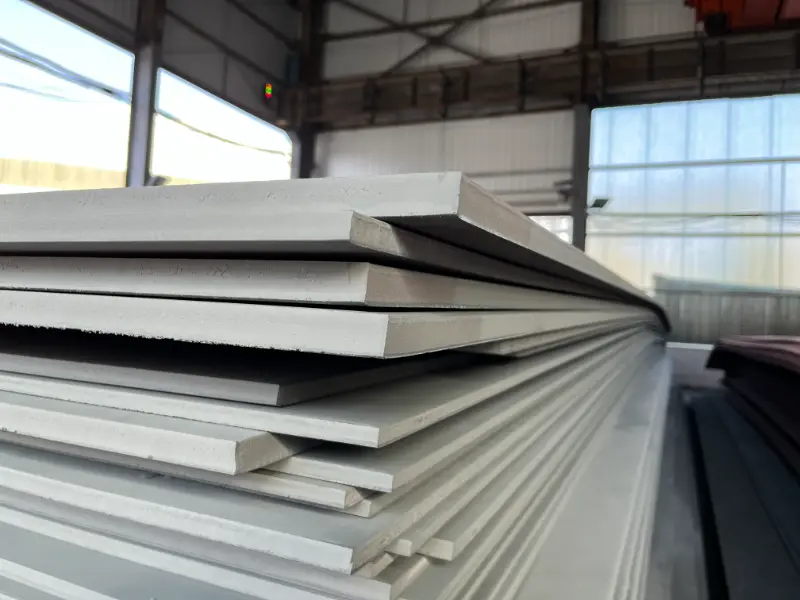
ASME SA283 Grade A (SA283GRA) Carbon Steel Plate
ASME SA283 Grade A (SA283GRA) Carbon Steel Plate - Composition, Properties & Equivalents
Detailed material data for ASME SA283 Grade A carbon structural steel plate: chemical composition, mechanical and physical properties, international equivalents, and application recommendations.
Hot rolling, cold forming, welding, machining, punching, shearing
- Phone : +8618037372205
- Email : [email protected]
- WhatsApp: Contact via Whtsapp
- WeChat: +8618037372205
ASME SA283 Grade A Carbon Steel Plate Introduction
ASME SA283 Grade A (also designated SA283GRA) is a carbon structural steel plate widely used for low-to-intermediate strength welded structures. It belongs to the family of steels covered by the ASME SA283/SA283M specification (identical to ASTM A283/A283M) and is supplied in hot-rolled condition. The steel exhibits good weldability, reasonable ductility, and moderate strength, making it suitable for general fabrication where strict notch toughness is not required.
The typical delivery condition is as-rolled, and the product is available in plates, sheets, and strips. With a maximum carbon content of 0.14% (for thinner sections) and manganese up to 0.90%, the steel can be easily formed and welded using common arc welding processes. A copper-bearing variant (min. 0.20% Cu) is optionally available for slightly improved atmospheric corrosion resistance. The material is not intended for high-pressure applications but serves as an economical choice for tanks, bins, building frames, and non-critical machine parts. Mechanical properties are verified by tensile and bend tests on a per-heat or lot basis, with guaranteed minimum yield strength of 165 MPa (24 ksi) and tensile strength of 310–415 MPa (45–60 ksi).
ASME SA283 Grade A Carbon Steel Plate Chemical Composition
The table below shows the ladle analysis limits according to ASME SA283/SA283M for Grade A. Carbon content is dependent on plate thickness. Copper is optional and only required when a copper-bearing steel is specified. Other elements like silicon are not specified but may be present as residual; the steel is essentially a plain carbon grade.
| Element | Standard Requirement (max unless indicated) | Remarks |
|---|---|---|
| Carbon (C) | ≤0.14 | For plates ≤ 20 mm thickness; ≤0.17 for thickness > 20–40 mm |
| Manganese (Mn) | ≤0.90 | Applicable to all thicknesses |
| Phosphorus (P) | ≤0.035 | Ladle analysis |
| Sulfur (S) | ≤0.035 | Ladle analysis |
| Copper (Cu) | ≥0.20 (min) | Only when copper steel is specified; otherwise unrestricted |
ASME SA283 Grade A Carbon Steel Plate Thermal and Electrical Physical Properties
The following physical characteristics are representative for carbon steel similar to SA283 Grade A in as-rolled condition. These values are not specified in the procurement standard but are widely accepted for design calculations. They can vary slightly with temperature, processing, and exact chemical composition.
| Property | Typical Value | Unit | Test Condition / Remarks |
|---|---|---|---|
| Density (ρ) | 7.85 | g/cm³ | Ambient (20°C) |
| Modulus of Elasticity (E) | 200–210 | GPa | At 20°C; typically 205 GPa used in design |
| Shear Modulus (G) | 80 | GPa | Calculated for E ≈207 GPa, ν =0.29 |
| Poisson's Ratio (ν) | 0.29 | - | Elastic range at room temperature |
| Thermal Expansion Coeff. (α) | 11.7 | 10⁻⁶/K | Between 20°C and 100°C |
| Thermal Expansion Coeff. (α) | 12.5 | 10⁻⁶/K | Between 20°C and 300°C |
| Thermal Conductivity (λ) | 51.9 | W/m·K | At 20°C |
| Specific Heat Capacity (c) | 486 | J/kg·K | At 20°C; increases with temperature |
| Electrical Resistivity (ρ_e) | 0.15–0.20 | μΩ·m | At 20°C; typical for low-carbon steel |
ASME SA283 Grade A Carbon Steel Plate Mechanical Properties
Tensile and bend test requirements are taken from ASME SA283/SA283M for Grade A plates ≤ 100 mm thickness. The values apply to the as-rolled condition and are measured on longitudinal test specimens. Elongation is based on an 8 in. (200 mm) gauge length; the 2 in. (50 mm) elongation is typically about 28% for reference but not mandated. Bend test is conducted at 180° with the reported mandrel diameter ratio.
| Property | Standard Requirement | Unit | Test Condition |
|---|---|---|---|
| Tensile Strength (Rm) | 310–415 | MPa | Ambient temperature, tensile test on strip/rounded specimen |
| Tensile Strength (Rm) | 45–60 | ksi | Ambient temperature, tensile test |
| Yield Strength (ReH) | ≥165 | MPa | 0.2% offset / upper yield, depending on thickness |
| Yield Strength (ReH) | ≥24 | ksi | 0.2% offset / upper yield |
| Elongation (A) | ≥23 | % | Gauge length 8 in. (200 mm); plates ≤ 100 mm |
| Bend Test (Bending Angle) | 180° | degrees | Bend diameter = 1 × specimen thickness; no cracks allowed |
ASME SA283 Grade A Carbon Steel Plate Exact Equivalent Material Standards and Substitutable Grades
| Country/Region | Standard | Grade | Remarks |
|---|---|---|---|
| United States | ASTM A283/A283M | Grade A | Identical chemical and mechanical requirements; directly substitutable. |
| United States | ASME SA283/SA283M (dual certified) | Grade A | Same specification; mandatory for ASME pressure boundary items. |
ASME SA283 Grade A Carbon Steel Plate Application Introduction
ASME SA283 Grade A carbon steel plate is primarily intended for structures and components where moderate strength and good weldability are required, without the need for impact toughness guarantees. Its low carbon content allows for easy cutting, forming, and submerged arc or manual welding without preheating (for moderate thicknesses). Common applications span construction, agricultural, and industrial equipment.
The following lists provide typical industries, end-use products, and fabricated parts manufactured from this steel grade.
Product Applications: Storage tanks and bins, Weldments and structural frames, Floor plates and decking, Base plates and anchor plates, Non-pressure vessel shells (atmospheric), Ductwork and supporting brackets, Farm implements
Processed into products: Tank shell plates and bottoms, Structural columns and beams (built-up sections), Machine frames and bases, Hoppers and chutes, Angle stiffeners and gussets, Brackets, cleats, and mounting plates, Low-duty gear and sprocket blanks
Application industries: Construction and civil engineering, Agricultural machinery, Material handling equipment, Storage tank and silo manufacturing, Shipbuilding (non-critical structural parts), Railcar components, General metal fabrication
ASME SA283 Grade A Carbon Steel Plate Similar / Alternative Materials with Comparable Performance
| Country/Region | Standard | Grade | Remarks |
|---|---|---|---|
| Europe / International | EN 10025-2 | S235JR (1.0038) | Similar minimum yield (235 MPa) and tensile (360–510 MPa); improved weldability. Not direct equivalent – SA283A requires evaluation for substitution. |
| International | ISO 630-2 | Fe 360B | Comparable to S235JR; similar strength level; no automatic equivalence without project agreement. |
| Japan | JIS G3101 | SS400 | Nominal 400 MPa tensile, minimum 245 MPa yield; slightly higher strength; may replace SA283A in less critical applications. |
| China | GB/T 700 | Q235B | Yield ≥235 MPa, tensile 370–500 MPa; widely used structural carbon steel; can be considered an alternative. |
| India | IS 2062 | E250 (Fe 410 WA) | Higher minimum yield (250 MPa) and tensile (410 MPa); often replaces SA283A in general fabrication. |
Notes:
- This steel is not intended for pressure vessel service unless specifically permitted by the relevant construction code.
- Multiple thickness categories influence carbon limits – always verify the applicable limit for the ordered thickness.
- Welding consumables should be matched to the lower tensile strength (e.g., AWS E60XX or E70XX electrodes).
- For cold forming that exceeds 10% strain, stress relieving may be recommended to prevent strain-age embrittlement.
- Availability in copper-bearing variant improves atmospheric corrosion resistance but does not meet the minimum requirements of weathering steel standards.
- Share



