
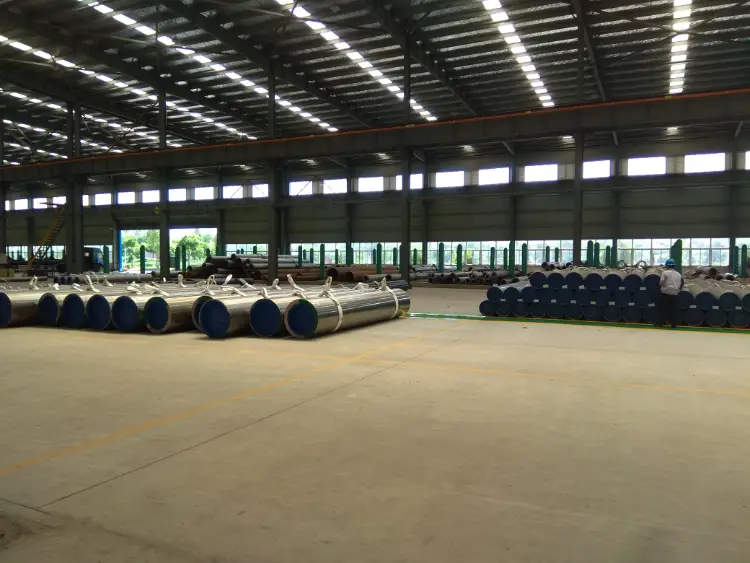
API 5L X65 ERW Pipe
API 5L PSL2 X65 ERW Pipe: High-Strength Line Pipe for Oil & Gas Transmission
Comprehensive technical data for API 5L PSL2 X65 electric resistance welded (ERW) steel pipe, including chemical composition, mechanical properties, and international equivalents.
Electric Resistance Welding (ERW), followed by post-weld heat treatment of the seam, sizing, straightening, and hydrostatic testing.
- Phone : +8618037372205
- Email : [email protected]
- WhatsApp: Contact via Whtsapp
- WeChat: +8618037372205
API 5L X65 ERW Pipe Introduction
API 5L X65 ERW pipe under PSL2 is a high-strength carbon steel line pipe widely used in the oil and gas industry for onshore and offshore transmission systems. It is manufactured by electric resistance welding of hot-rolled coils, meeting stringent requirements for chemical composition, toughness, and weld integrity. PSL2 denotes Product Specification Level 2, which mandates stricter controls on carbon equivalent, notch toughness, and non-destructive testing compared to PSL1. The pipe offers excellent balance of yield strength (minimum 450 MPa) and ductility, suitable for sour service with appropriate supplementary requirements. Typical delivery condition is as-welded or with light cold expansion.
API 5L X65 ERW Pipe Chemical Composition as per API 5L PSL2 X65
The chemical composition for X65 PSL2 ERW pipe is based on heat analysis. Values are maximum unless a range is specified. Carbon equivalent (CEpcm or CEIIW) is restricted depending on thickness. Additional limits apply for sour service (NACE MR0175/ISO 15156). Trace elements like titanium (Ti) or niobium (Nb) may be added for grain refinement.
| Element | Required Value (max %) | Remarks |
|---|---|---|
| Carbon (C) | 0.22 | For ERW pipe; lower limit can be 0.16 for reduction of area requirements |
| Manganese (Mn) | 1.65 | Max; minimum typically 1.00 for strength |
| Phosphorus (P) | 0.025 | PSL2 requirement |
| Sulfur (S) | 0.015 | PSL2 requirement |
| Silicon (Si) | 0.45 | Max; may be up to 0.50 in some agreements |
| Niobium (Nb) | 0.05 | Max; when added alone or in combination with other micro-alloying elements |
| Vanadium (V) | 0.05 | Max; same as Nb |
| Titanium (Ti) | 0.04 | Max; sum of Nb+V+Ti ≤ 0.15% typically |
| Copper (Cu) | 0.50 | Max; if specified |
| Nickel (Ni) | 0.50 | Max; if specified |
| Chromium (Cr) | 0.50 | Max; if specified |
| Molybdenum (Mo) | 0.50 | Max; if specified |
| Nitrogen (N) | 0.012 | Max; if Al is added, N ≤ 0.015 |
| Aluminum (Al) | 0.060 | Total Al, usually between 0.015–0.060 for grain refinement |
| Carbon equivalent (CEpcm) | 0.25 max | For pipe with T ≤ 25 mm, see standard formula |
API 5L X65 ERW Pipe Thermal and Electrical Physical Properties
These properties are not mandated by API 5L but represent typical values for X65 grade carbon steel. Actual values may vary depending on exact chemistry and processing. Density and elastic moduli are commonly used in pipeline design calculations.
| Property | Typical Value | Unit | Condition/Remarks |
|---|---|---|---|
| Density (ρ) | 7.85 | g/cm³ | Room temperature |
| Elastic modulus (E) | 205–210 | GPa | Room temperature, in tension |
| Shear modulus (G) | 80–81 | GPa | Calculated from E and Poisson's ratio |
| Poisson's ratio (ν) | 0.29–0.30 | – | Elastic range |
| Thermal expansion coefficient (α) | 11.7–12.5 × 10⁻⁶ | K⁻¹ | 20–100 °C average |
| Thermal conductivity (λ) | 45–50 | W/(m·K) | At 20 °C |
| Specific heat capacity | 460–480 | J/(kg·K) | At 20 °C |
| Electrical resistivity (ρe) | 0.18–0.22 × 10⁻⁶ | Ω·m | At 20 °C, typical for carbon steel |
API 5L X65 ERW Pipe Mechanical Properties as per API 5L PSL2 X65
Mechanical properties are determined on transverse strip specimens taken from the pipe body, except for elongation which can be longitudinal. Notch toughness tests (Charpy V-notch) are mandatory for PSL2. All values meet minimum requirements at room temperature unless otherwise specified. Values may be verified by additional testing per client requirements.
| Property | Required Value | Unit | Test Condition |
|---|---|---|---|
| Yield Strength (Rt0.5) | 450–600 | MPa | Transverse direction, room temperature, 0.5% total extension under load method |
| Tensile Strength (Rm) | 535–760 | MPa | Transverse direction, room temperature |
| Yield to Tensile Ratio (Rt0.5/Rm) | ≤ 0.93 | – | PSL2 requirement for X65 to ensure ductility |
| Elongation after fracture (A) | ≥ 22 (for 12.5 mm wall) | % | Longitudinal, gauge length 50 mm; minimum decreases with increasing wall thickness per standard formula |
| Charpy V-notch impact energy (KV) | ≥ 27 (base metal) | J | Transverse specimen, 0 °C (PSL2 typical); average of three tests, single min 20 J |
| Charpy V-notch impact energy (KV) | ≥ 27 (weld seam) | J | Transverse specimen, 0 °C; average, single min 20 J |
| Bend test (weld) | No cracks > 3 mm | – | Guided bend 180°, former diameter per standard; macro section examination |
| Flattening test | No visible cracks | – | Required for ERW pipe up to a specified diameter; per API 5L |
API 5L X65 ERW Pipe Equivalent Material Standards and Substitute Grades
| Country/Region | Standard | Grade | Remarks |
|---|---|---|---|
| International | ISO 3183 | L450 | Identical technical content to API 5L 46th edition; PSL2 corresponds to ISO 3183 Annex M. |
| European Union | EN 10208-2 | L450M | Thermomechanicallly rolled, welded pipe; M = TMCP. Equivalent to X65 PSL2 with minor differences in Mn and CE. |
| China | GB/T 9711 | L450 | Includes PSL2 level; similar chemistry and mechanical properties. |
| Canada | CSA Z245.1 | Grade 450 Cat II | Cat II corresponds to high toughness (PSL2 equivalent). |
| DNV (Offshore) | DNVGL-ST-F101 | 450 SF | Submarine pipeline standard, SF = sour or sweet, with supplemental requirements. |
API 5L X65 ERW Pipe Application Introduction
API 5L X65 ERW pipe is primarily used in onshore and offshore oil & gas transmission. Its balanced strength and toughness make it suitable for arctic, seismic, and sour environments when ordered with appropriate HIC/SSC resistant properties. The pipe can be supplied with protective coatings (3LPE, FBE, etc.) and internal linings. Typical applications include long-distance pipelines, gas gathering systems, and structural members in platform topsides.
Product Applications: Cross-country oil and gas pipelines, Offshore risers and flowlines, Gas injection and production lines, Water mains and irrigation systems, Piling and structural support for marine construction, Fire protection mains (large bore)
Processed into products: Line pipe segments (straight lengths, bends, reducers, tees), Piping manifolds and headers, Export risers and J-tubes, Casing and conductor pipes in oil wells (when converted to API 5CT specification), Sucker rod pipes (modified), Storage tank supports and structural frames
Application industries: Oil & Gas (Upstream, Midstream, Downstream), Petrochemical, Water Transportation (large-diameter), Mining (slurry lines), Renewable Energy (hydrogen/natural gas blending, CO₂ transportation)
API 5L X65 ERW Pipe Similar or Alternative Grade Recommendations
| Country/Region | Standard | Grade | Characteristics |
|---|---|---|---|
| USA/International | API 5L PSL2 | X60 (L415) | Lower strength, higher toughness, suitable for moderate pressure or lower wall thickness; often an economical alternative if design allows. |
| USA/International | API 5L PSL2 | X70 (L485) | Higher strength, used for high-pressure applications; requires careful welding and may have lower ductility; sometimes used as upgrade. |
| European | EN 10208-2 | L485M | European equivalent of X70, similar substitution logic. |
| Russia | GOST 1050-88 / TU 14-3R | 17G1S or equivalent (strength class K52) | Approximate yield 360-450 MPa; lower grade and less stringent toughness; only for non-critical replacement. |
Notes:
The above data is based on API 5L 46th edition (2018), which is technically equivalent to ISO 3183:2019. Actual values may vary depending on manufacturer's practices and supplementary requirements. For sour service (NACE MR0175/ISO 15156), additional limits on hardness (max 250 HV10) and chemistry (e.g., S ≤ 0.002%, CE restrictions) apply. ERW pipe should be tested for weld integrity via ultrasonic or eddy current inspection per SR4. Users should verify compatibility with the specific project material specification.
- Share



