
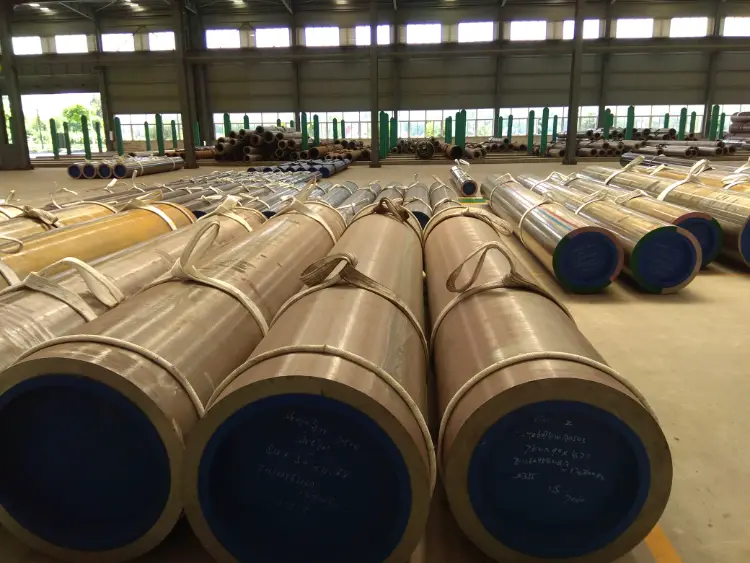
API 5L PSL2 X70 ERW Pipe
API 5L PSL2 X70 ERW Pipe: High-Strength Steel for Oil & Gas Transmission Pipelines
Comprehensive material data for API 5L PSL2 X70 ERW pipe: chemical composition, mechanical properties, thermal properties, international equivalents, and application guide for oil and gas transportation.
Electric Resistance Welding (ERW), submerged arc welding (SAW), seamless, etc.; applicable processes include cold forming, hot rolling, welding, and coating.
- Phone : +8618037372205
- Email : [email protected]
- WhatsApp: Contact via Whtsapp
- WeChat: +8618037372205
API 5L PSL2 X70 ERW Pipe Introduction
API 5L X70 PSL2 ERW pipe is a high-strength, low-alloy steel line pipe manufactured by electric resistance welding. It belongs to the API 5L specification for pipeline transportation systems in the petroleum and natural gas industries. X70 grade under PSL2 (Product Specification Level 2) offers stringent requirements for chemical composition, mechanical properties, and non-destructive testing. Key features include:
- Minimum yield strength of 485 MPa (70 ksi), providing excellent load-bearing capacity.
- Good weldability and toughness, suitable for sour service and low-temperature applications.
- Wide usage in long-distance oil and gas transmission pipelines, both onshore and offshore.
- Available in ERW form with precise dimensional control and cost-effectiveness.
API 5L PSL2 X70 ERW Pipe Chemical Composition
Chemical composition limits as per API 5L PSL2 for X70 grade. Values are maximum unless a range is given. Carbon equivalent (CE) limits apply based on carbon content and pipe thickness. Note: Microalloying elements such as Nb, V, Ti are typically added for grain refinement and strengthening.
| Element | Required Value (max, %) | Remarks |
|---|---|---|
| Carbon (C) | 0.12 | max for seamless & welded pipe; lower for improved weldability |
| Manganese (Mn) | 1.60 | max for X70 PSL2 |
| Phosphorus (P) | 0.025 | max |
| Sulfur (S) | 0.015 | max |
| Silicon (Si) | 0.45 | max |
| Vanadium (V) | 0.06 | max; often used in combination with Nb |
| Niobium (Nb) | 0.06 | max; typical 0.03-0.05 |
| Titanium (Ti) | 0.06 | max; for inclusion shape control |
| Copper (Cu) | 0.50 | max |
| Nickel (Ni) | 0.50 | max |
| Chromium (Cr) | 0.50 | max |
| Molybdenum (Mo) | 0.50 | max |
| Aluminum (Al) | 0.06 | max; total Al or acid-soluble |
| Nitrogen (N) | 0.012 | max |
| Boron (B) | 0.0005 | max, if added intentionally |
| CE(IIW) | 0.43 | max for pipe thickness ≤ 25 mm; 0.45 for thickness > 25 mm |
| CE(Pcm) | 0.25 | typically specified for weldability |
API 5L PSL2 X70 ERW Pipe Physical Properties
Physical properties are typical for X70 pipeline steel. Actual values depend on exact composition and processing. Thermal and electrical data are compiled from published experimental results for similar HSLA steels.
| Property | Typical Value | Unit | Test Condition / Remarks |
|---|---|---|---|
| Density (ρ) | 7.85 | g/cm³ | 20 °C |
| Modulus of Elasticity (E) | 205 | GPa | Tension, room temperature |
| Shear Modulus (G) | 80 | GPa | Calculated from E and Poisson ratio |
| Poisson's Ratio (ν) | 0.28 | - | Elastic range |
| Thermal Expansion Coefficient (α) | 11.7 (20-100 °C); 12.4 (20-200 °C); 13.2 (20-400 °C) | 10⁻⁶/°C | Mean coefficient |
| Thermal Conductivity (λ) | 36 - 42 | W/(m·K) | At 20 °C; decreases with increasing temperature |
| Specific Heat Capacity (cp) | 480 - 500 | J/(kg·K) | At 20 °C |
| Electrical Resistivity (ρe) | 0.20 - 0.25 | μΩ·m | At 20 °C |
API 5L PSL2 X70 ERW Pipe Mechanical Properties
Mechanical test requirements per API 5L PSL2 for X70 grade. Tensile testing transverse to weld (body of pipe) and weld seam. Impact testing (Charpy V-notch) is mandatory for PSL2. Values are minimum unless a range is given. Note: Pipe geometry and product specification level (PSL) influence test conditions.
| Property | Required Value | Unit | Test Condition |
|---|---|---|---|
| Yield Strength (Rt0.5) | 485 - 635 | MPa | Transverse, body of pipe; 0.5% total extension |
| Tensile Strength (Rm) | 570 - 760 | MPa | Transverse, body of pipe |
| Elongation (A) | min 18 | % | 50 mm gauge length, transverse; alternative min 22% for longitudinal |
| Yield to Tensile Ratio (Rt0.5/Rm) | max 0.93 | - | Customer agreement may apply |
| Charpy V-notch Impact (KV) | min 27 (average), min 20 (single) | J | At 0°C or lower as agreed; transverse specimen; full-size 10x10mm |
| Hardness | max 250 HV10 or equivalent HRC | - | For sour service requirements; supplementary |
| Bend Test | No cracks or rupture | - | 180° bend over former; diameter per standard |
API 5L PSL2 X70 ERW Pipe Full Equivalent Material Standards and Alternative Designations
| Country/Region | Standard | Designation | Remarks |
|---|---|---|---|
| International | ISO 3183 | L485 (PSL2) | Identical technical delivery conditions; L485 is the ISO equivalent of X70. |
| Europe | EN 10208-2 | L485MB | Steel pipes for pipelines for combustible fluids; M = thermomechanical rolled, B = quality class. |
| China | GB/T 9711 | L485 (PSL2) | Petroleum and natural gas industries—Steel pipe for pipeline transportation systems. |
| Russia/CIS | GOST R ISO 3183 | K60 (К60) | Grade К60 approximately corresponds to L485/X70. |
| DNV (offshore) | DNV-OS-F101 | SAWL 485 SMLS 485 | For submarine pipeline systems; 485 indicates SMYS in MPa. |
| Canada | CSA Z245.1 | Grade 483 | 483 MPa SMYS; close to X70 but not identical; often considered a substitute. |
| Australia/New Zealand | AS/NZS 2885 | Grade X70 | Pipelines—Gas and liquid petroleum; references API 5L grades. |
| Brazil | NBR 11888 | X70 | Line pipe specification; equivalent to API 5L X70. |
API 5L PSL2 X70 ERW Pipe Application Introduction
API 5L X70 ERW pipe is designed for transporting fluids and gases under high pressure in the oil and gas industry. Its combination of strength and toughness allows reduced pipe wall thickness, lowering material and installation costs. Common applications include:
- Long-distance onshore cross-country pipelines
- Offshore pipelines and risers (with appropriate coating and cathodic protection)
- Gas gathering and transmission networks
- Refinery and petrochemical plant piping
- Structural supports in energy-related facilities
Product Applications: Line pipe for natural gas transmission, Line pipe for crude oil and refined products, Sour service pipelines (with supplementary testing), Offshore platform piping, Flowlines and gathering lines
Processed into products: ERW pipe sections and spools, Field bends and induction bends, Tees, reducers, and flanges (matching X70 material), Valve bodies and fittings (forged or welded), Repair sleeves and hot-tap fittings
Application industries: Oil and Gas Exploration & Production, Pipeline Transportation (Onshore & Offshore), Petrochemical and Refining, Energy and Power Generation (gas transport), Water and Slurry Transportation (heavy-duty)
API 5L PSL2 X70 ERW Pipe Similar/Alternative Materials for Comparison
| Grade | Standard | Remarks |
|---|---|---|
| X65 (L450) | API 5L, ISO 3183 | Lower strength (450 MPa SMYS); used where reduced wall thickness and weight are beneficial. Similar toughness and weldability. |
| X80 (L555) | API 5L, ISO 3183 | Higher strength (555 MPa SMYS); used for high-pressure, large-diameter pipelines. Requires stricter welding and forming controls. |
| L485MB (EN 10208-2) | EN 10208 | European equivalent of X70 with specific Charpy and drop-weight tear test (DWTT) requirements. |
| X70M (X70 with modified chemistry) | API 5L | Variants with tailored properties for sour service (HIC/SSC resistance), using lower carbon and controlled inclusions. Designated as X70QS or X70S. |
| L485 (GB/T 9711) | GB/T 9711 | Chinese standard grade; similar to API 5L but may have slight differences in Cu or Ni tolerance. |
| Grade 483 (CSA Z245.1) | CSA Z245.1 | Canadian pipe grade with 483 MPa SMYS; equivalent in most applications but check impact test temperatures. |
Notes:
For PSL2, Charpy V-notch impact testing is mandatory, with test temperature typically 0°C or as agreed. Supplementary requirements for sour service (HIC/SSC) may apply, requiring additional chemistry restrictions (e.g., S < 0.003%, controlled Ca/S ratio). All data are based on API 5L 46th edition and typical industry practice. Actual product values may vary; always refer to material test certificates. For ERW pipe, post-weld heat treatment (normalizing or stress relieving) is often applied to improve weld zone toughness.
- Share



