
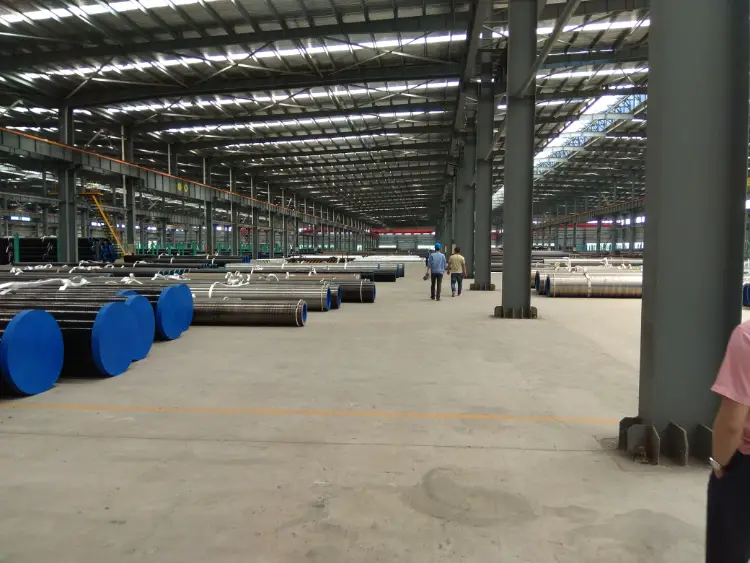
API 5L PSL2 X60 ERW Pipe
API 5L PSL2 X60 ERW Pipe: High-Strength Line Pipe for Oil & Gas Transmission
Comprehensive technical data for API 5L PSL2 X60 electric-resistance-welded pipe, including chemical composition, mechanical properties, thermal and electrical physical properties, equivalent grades, and application guide.
Rolling, forming, electric resistance welding, heat treatment (if required), cold expansion, hydrostatic testing, non-destructive examination
- Phone : +8618037372205
- Email : [email protected]
- WhatsApp: Contact via Whtsapp
- WeChat: +8618037372205
API 5L PSL2 X60 ERW Pipe Introduction
API 5L X60 PSL2 ERW pipe is a high-strength carbon-manganese steel line pipe produced by electric resistance welding, conforming to the American Petroleum Institute (API) specification 5L, Product Specification Level 2 (PSL2). This grade is designed for demanding applications in oil, gas, and water transportation pipelines. With a minimum yield strength of 415 MPa (60 ksi) and excellent toughness, it offers reliable performance in high-pressure environments. PSL2 imposes stricter requirements on chemical composition, carbon equivalent, mechanical properties, and non-destructive testing compared to PSL1. X60 ensures good weldability and formability, making it widely used in longitudinal or spiral welded pipes for onshore and offshore pipelines. Typical delivery condition is as-rolled or normalised, depending on thickness and customer specifications.
API 5L PSL2 X60 ERW Pipe Chemical Composition according to API 5L PSL2 for X60
The chemical composition limits apply to heat analysis for pipe with wall thickness ≤ 25.0 mm (0.984 in). Micro-alloying elements (V, Nb, Ti) are often added to achieve the required strength and toughness. The carbon equivalent (CEIIW) is controlled to ensure good weldability. Values are maxima unless a range is indicated.
| Element | Specified Value | Remarks |
|---|---|---|
| C | 0.26 max | If C > 0.12%, CEIIW limit applies |
| Mn | 1.35 max | Manganese content |
| P | 0.030 max | Phosphorus |
| S | 0.030 max | Sulfur |
| Si | 0.45 max | Silicon, if specified |
| V+Nb+Ti | 0.15 max | Sum of vanadium, niobium and titanium |
| V | — | Individual limit not specified, subject to sum |
| Nb | — | Individual limit not specified, subject to sum |
| Ti | — | Individual limit not specified, subject to sum |
| CEIIW | 0.43 max | Carbon equivalent (IIW) applicable when C > 0.12% |
API 5L PSL2 X60 ERW Pipe Thermal and Electrical Physical Properties
The physical properties listed below are typical for carbon-manganese structural steel grades similar to X60. They are not mandated by the API 5L standard but are commonly used for engineering calculations. Actual values may vary depending on exact chemical composition and microstructure.
| Property | Typical Value | Unit | Test Condition / Remarks |
|---|---|---|---|
| Density (ρ) | 7850 | kg/m³ | At room temperature |
| Modulus of Elasticity (E) | 205 | GPa | At 20 °C |
| Shear Modulus (G) | 80 | GPa | At 20 °C, calculated from E and Poisson's ratio |
| Poisson's Ratio (ν) | 0.30 | — | In elastic range |
| Thermal Expansion Coefficient (α) | 11.7 | 10⁻⁶/K | Between 20 °C and 100 °C |
| Thermal Conductivity (λ) | 50 | W/(m·K) | At 20 °C |
| Specific Heat Capacity (c) | 486 | J/(kg·K) | At 20 °C |
| Electrical Resistivity (ρe) | 0.18 | μΩ·m | At 20 °C |
API 5L PSL2 X60 ERW Pipe Mechanical Properties
Mechanical properties are determined on full-section, strip, or round bar specimens in accordance with API 5L. The elongation requirement depends on specimen geometry and wall thickness; a typical minimum elongation is calculated using the API 5L formula for a strip specimen with 10 mm wall thickness. The yield-to-tensile ratio (Y/T) must not exceed 0.93 for PSL2 pipe. Impact toughness tests are mandatory for PSL2 at 0 °C or lower, as agreed.
| Property | Required Value | Unit | Test Condition / Remarks |
|---|---|---|---|
| Yield Strength (ReH/Rt0.5) | 415 min | MPa | Transverse strip specimen, 0.5% total extension |
| Tensile Strength (Rm) | 520 – 760 | MPa | Transverse strip specimen |
| Elongation (A) | ≥ 19 (example) | % | Strip specimen, 2 in (50.8 mm) gauge length, wall thickness ~10 mm; calculated per API 5L Table 7. Other sizes: as per formula. |
| Yield-to-Tensile Ratio (Y/T) | 0.93 max | — | PSL2 mandatory requirement |
| Charpy Impact Energy (KV) | 27 min (average) | J | Full-size 10×10 mm specimen at 0 °C; individual min 20 J; for lower temperatures or smaller specimens, as agreed |
| Guided Bend Test | No cracks or ruptures | — | Weld and base metal, bend angle 180°, mandrel diameter per API 5L |
API 5L PSL2 X60 ERW Pipe Completely Equivalent Material Standards and Substitutable Grades
| Country/Region | Standard | Designation | Remarks |
|---|---|---|---|
| International / ISO | ISO 3183 | L415 PSL 2 | Equivalent line pipe grade, identical mechanical requirements |
| Europe | EN 10208-2 | L415MB | For onshore and offshore pipelines; equivalent to X60 PSL2 |
| Europe | EN 10208-2 | L415NB | Normalised variant; also interchangeable |
| China | GB/T 9711 | L415 | Corresponds to X60 PSL2 for petroleum and natural gas industries |
| Russia | GOST R 52079 | K60 | Approximate, similar strength and toughness level |
| Canada | CSA Z245.1 | Grade 415 | Steel pipe for pipelines, matches X60 PSL2 |
API 5L PSL2 X60 ERW Pipe Application Introduction
API 5L X60 ERW pipe is primarily used in the oil and gas industry for high-pressure transmission. Its balance of strength, toughness, and weldability makes it suitable for onshore, offshore, and sour-service applications when supplementary requirements are met. Typical industries and products include:
Product Applications: Mainline pipe for crude oil, natural gas, and refined product pipelines, Flowlines and gathering lines in upstream operations, Water injection and disposal lines, Process piping in refineries and gas plants, Tubular structural components for bridges, offshore platforms, and buildings
Processed into products: Straight pipe segments (plain ends or bevelled), Induction bends and forged elbows, Tees, reducers, and crosses (fittings produced from pipe), Flanges (welded-on, slip-on, or lap-joint), Pipeline girth welds and weld joints, Risers and pump station piping, Pile pipes for foundations
Application industries: Oil and gas transportation (pipeline systems), Petrochemical plants, Water transmission and distribution, Construction and structural engineering (piling, tubular structures), Mining and slurry pipelines, Renewable energy (geothermal wells, hydrogen transport)
API 5L PSL2 X60 ERW Pipe Similar / Neighbouring Alternative Materials
| Country/Region | Standard | Designation | Remarks |
|---|---|---|---|
| USA / Global | API 5L | X52 (L360) | Lower yield strength (360 MPa min); may be substituted in less demanding pressure conditions |
| USA / Global | API 5L | X65 (L450) | Higher yield strength (450 MPa min); can replace X60 when higher pressure capacity or reduced wall thickness is required, but may need welding parameter adjustment |
| International | ISO 3183 | L360 | Corresponds to X52, lower strength alternative |
| International | ISO 3183 | L450 | Corresponds to X65, higher strength alternative |
Notes:
- PSL2 requires stricter testing including Charpy impact tests, mandatory non-destructive inspection of the weld seam (e.g., ultrasonic for ERW), and certification with traceability.
- For sour service (H₂S-containing environments), supplementary requirements such as HIC/SSC testing per NACE MR0175 can be specified; X60 may require controlled hardness and chemistry modification.
- ERW pipe typically has a weld seam heat-affected zone; normalising or post-weld heat treatment may be applied to restore toughness.
- Dimensional tolerances (OD, wall thickness, out-of-roundness) comply with API 5L tables; common lengths: single random (approx. 6 m), double random (approx. 12 m).
- Share



