
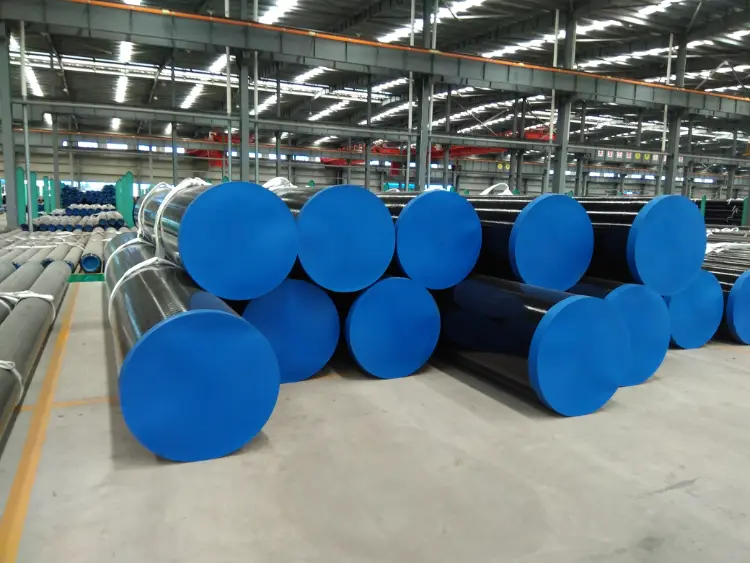
API 5L X56 PSL2 ERW Pipe
API 5L X56 PSL2 ERW Pipe: High-Strength Line Pipe for Critical Oil & Gas Applications
Comprehensive material data for API 5L X56 PSL2 ERW steel pipe, including chemical composition, mechanical and physical properties, global equivalents, and application guidance.
Electric Resistance Welded (ERW), post-weld heat treatment as required; cold expansion; hydrostatic testing; non-destructive testing (ultrasonic, eddy current, or magnetic flux leakage)
- Phone : +8618037372205
- Email : [email protected]
- WhatsApp: Contact via Whtsapp
- WeChat: +8618037372205
API 5L X56 PSL2 ERW Pipe Introduction
API 5L X56 PSL2 ERW is a high-strength low-alloy (HSLA) steel pipe designed for demanding oil and gas transmission applications. Manufactured by electric resistance welding (ERW), it conforms to the Product Specification Level 2 (PSL2) of API Specification 5L, which imposes mandatory requirements for notch toughness, chemical analysis, and non-destructive inspection. The designation 'X56' indicates a minimum yield strength of 56,000 psi (386 MPa). This material offers an excellent balance of strength, weldability, and toughness at low temperatures, making it suitable for onshore and offshore pipelines, compressor stations, and gathering systems. Its controlled chemistry and fine-grained microstructure enable good resistance to hydrogen-induced cracking (HIC) when supplementary requirements are applied. Typical wall thicknesses range from Schedule 10 to Schedule 80, with diameters up to 24 inches or larger, depending on mill capabilities.
API 5L X56 PSL2 ERW Pipe Chemical Composition
The chemical composition of API 5L X56 PSL2 ERW pipe is controlled to ensure weldability, strength, and toughness. Values below represent product analysis limits per API 5L Table 4 for PSL2 pipe. Carbon equivalent (CEIIW) is typically ≤0.43% for wall thicknesses ≤25.4 mm. For sour service applications, restricted chemistry (e.g., S ≤0.002%, Ca treatment) may be specified by supplementary requirements.
| Element | Maximum Value (wt%) | Remarks |
|---|---|---|
| Carbon (C) | 0.22 | 0.22% max; lower carbon improves weldability |
| Manganese (Mn) | 1.40 | 1.40% max; typical range 1.00–1.35% |
| Phosphorus (P) | 0.025 | Max for PSL2; lower for sour service |
| Sulfur (S) | 0.015 | Max for PSL2; ≤0.002% optional for HIC resistance |
| Silicon (Si) | 0.45 | Typical residual; not mandated by standard |
| Columbium (Nb) | 0.05 | Usually combined microalloying: Nb+V+Ti ≤0.15% |
| Vanadium (V) | 0.05 | Combined microalloying limit applies |
| Titanium (Ti) | 0.04 | Combined microalloying limit applies |
API 5L X56 PSL2 ERW Pipe Thermal and Electrical Physical Properties
Physical properties are not specified by API 5L but are derived from published data for similar C-Mn microalloyed steels. Values are valid from ambient temperature (20–25°C) unless noted. These properties are affected by microstructure and processing, so precise values should be confirmed by testing for critical designs.
| Property | Standard Required Value | Unit | Test Condition |
|---|---|---|---|
| Density (ρ) | 7.85 | g/cm³ | At 20°C |
| Modulus of Elasticity (E) | 205 | GPa | At 20°C, tension |
| Shear Modulus (G) | 80 | GPa | At 20°C, calculated |
| Poisson's Ratio (ν) | 0.29 | - | At 20°C, elastic range |
| Thermal Expansion Coefficient (α) | 11.7 | 10⁻⁶/°C | 20–100°C |
| Thermal Expansion Coefficient (α) | 12.2 | 10⁻⁶/°C | 20–200°C |
| Thermal Expansion Coefficient (α) | 12.9 | 10⁻⁶/°C | 20–300°C |
| Thermal Conductivity (λ) | 51 | W/(m·K) | At 20°C |
| Specific Heat Capacity (cp) | 460 | J/(kg·K) | At 20°C |
| Electrical Resistivity (ρe) | 0.20 | μΩ·m | At 20°C |
API 5L X56 PSL2 ERW Pipe Mechanical Properties
Mechanical properties are verified by tests on pipe body using longitudinal or transverse strip specimens, depending on size. Values meet API 5L PSL2 requirements. Yield and tensile limits apply to room temperature (unless otherwise specified). Charpy V-notch impact tests are mandatory for PSL2; the table shows typical acceptance criteria for full-size (10×10 mm) transverse specimens at 0°C. Actual test temperatures and absorbed energy may be adjusted by client specifications.
| Property | Standard Required Value | Unit | Test Condition |
|---|---|---|---|
| Yield Strength (ReH) | 386 – 544 | MPa | Transverse 0.5% total extension, room temperature |
| Tensile Strength (Rm) | 490 – 760 | MPa | Transverse, room temperature |
| Elongation (A) | Min. 22 (for walls ≤ 19.1 mm) | % | Gauge length 50 mm (2 in), transverse specimen |
| Elongation (A) | Min. 20 (for walls > 19.1 mm) | % | Gauge length 50 mm (2 in), transverse specimen |
| Yield to Tensile Ratio (ReH/Rm) | ≤0.93 | - | Maximum allowed for PSL2 |
| Charpy V-notch Impact (KV2) | Min. 27 (average) / Min. 20 (single) | J | Full-size transverse specimen, 0°C (PSL2 typical) |
| Guided Bend Test | No cracks > 3 mm | - | 180° bend, mandrel diameter = 90 mm (for wall ≤ 12.7 mm); or per API 5L |
API 5L X56 PSL2 ERW Pipe Exact Equivalent Material Standards & Replaceable Grades
| Country/Region | Standard | Grade | Remarks |
|---|---|---|---|
| International | ISO 3183 | L390 | PSL2 pipe in gas and liquid transmission |
| Europe | EN 10208-2 | L390GA | Petroleum and natural gas industries – Steel pipe for pipelines |
| China | GB/T 9711 | L390 | PSL2 petroleum and natural gas industry steel pipe |
| Canada | CSA Z245.1 | 386 (Category II) | Yields 386 MPa minimum, similar PSL2 requirements |
| Norway (DNV) | DNV-ST-F101 | SAWL 390 | With supplementary PSL2-type testing |
API 5L X56 PSL2 ERW Pipe Application Introduction
API 5L X56 PSL2 ERW pipe is a workhorse material for modern pipeline infrastructure. Its controlled strength and toughness allow safe operation under high pressure and in a wide temperature range. When combined with appropriate coatings, it can be buried, submerged, or used above ground. Typical product forms include plain-end line pipe, beveled pipe for field welding, and pre-fabricated spools. It is also suitable for structural applications such as pipe piles and casing.
Product Applications: Transmission Pipelines (Oil, Gas, Water), Flowlines and Gathering Lines, Compressor Station Piping, Pig Launchers and Receivers, Pipe-in-Pipe Systems, Casing and Tubing for Wells, Pipe Piles and Support Columns
Processed into products: Pipe segments (straight lengths and bends), Tees, Reducers, and Caps (matching fittings per ASTM A860), Flanges (weld-neck, slip-on), Valve bodies and trim (forges to similar chemistry), Repair sleeves and hot-tap fittings, Anchors and supports, Instrumentation mounts like thermometer wells and pitot tubes (manufactured from pipe stock)
Application industries: Oil & Gas Exploration and Production, Pipeline Transportation (Onshore & Offshore), Petrochemical and Refining Plants, Water and Wastewater Utilities, Power Generation (Cooling Water Lines), Construction and Structural Engineering
API 5L X56 PSL2 ERW Pipe Similar / Alternative Material Recommendations
| Country/Region | Standard | Grade | Remarks |
|---|---|---|---|
| USA | API 5L PSL2 | X52 | Lower strength (yield 52 ksi), otherwise similar chemistry and toughness requirements |
| USA | API 5L PSL2 | X60 | Higher strength (yield 60 ksi), may be considered for upgraded design pressure |
| USA | ASTM A860 | WPHY 56 | Wrought steel butt-welding fittings; counterpart to X56 pipe |
| International | ISO 3183 | L360 | Slightly lower yield (360 MPa) than X56, but widely interchangeable in some pipe systems |
| International | ISO 3183 | L415 | Higher strength (415 MPa); can replace X56 with design adjustment |
Notes:
Additional Considerations:
- For sour service (H2S-containing environment), specify supplementary HIC and SSC testing per NACE MR0175/ISO 15156 and API 5L Annex H.
- ERW weld seam should undergo 100% ultrasonic or electromagnetic inspection per PSL2 requirements.
- The material can be normalized or stress relieved upon request, which may change mechanical properties slightly—confirm with the manufacturer.
- When ordering, state whether CEV limits (typically ≤0.43%) are required, and whether through-wall hardness testing after welding simulation is needed.
- All data presented are based on the API 5L 46th edition; for older editions, verify specific grade requirements.
- Share



